

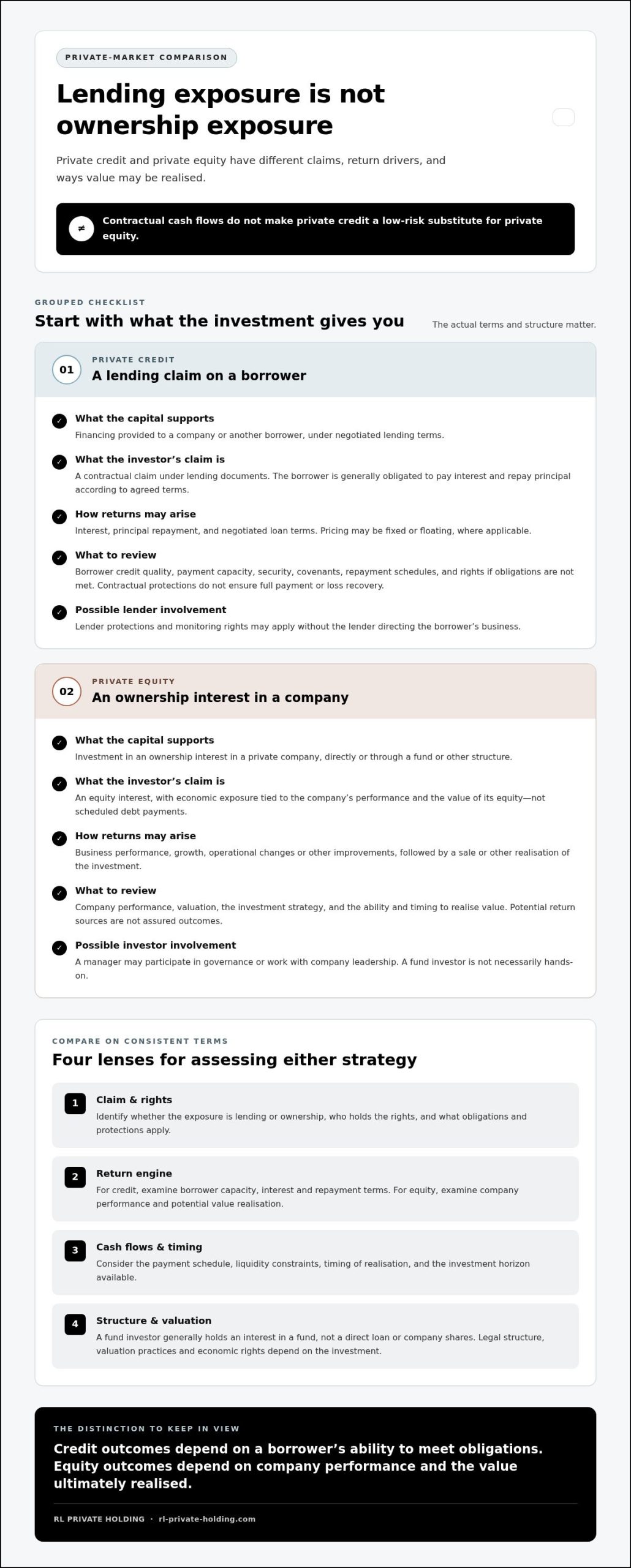
Contractual cash flows don’t make private credit a low-risk substitute for private equity. The distinction matters when assessing investing in private credit vs private equity: one strategy centres on lending and repayment, while the other seeks returns through ownership and business growth. Compare their potential returns, risks, liquidity and investment horizons on consistent terms.
Private credit investors are exposed to borrowers’ ability to meet interest and repayment obligations, as well as the terms and liquidity of the investment. Private equity returns depend on portfolio company performance and valuation, and on the ability to realise value, often over a longer holding period. Neither strategy is automatically suited to every portfolio objective.
This guide compares how each strategy may generate returns, where its principal risks lie, and what to consider about liquidity and investor involvement. It also sets out portfolio questions to resolve before assessing an allocation, including the investment’s intended role and the time horizon available. RL Private Holding’s activities include private equity, venture capital and wealth management, providing context for a disciplined assessment of private-market strategies.
Key Takeaways
- Distinguish lending exposure from ownership exposure before comparing the potential role of either strategy in a portfolio.
- Assess how interest, borrower credit quality and loan terms shape private credit outcomes, compared with business growth and investment realization in private equity.
- When investing in private credit vs private equity, compare risks, valuation practices and liquidity constraints without assuming one strategy is universally safer or more suitable.
- Set your investment objectives, time horizon, liquidity needs and risk tolerance before considering an allocation.
- Review how an allocation would interact with existing exposures and portfolio concentration, and define the role it is intended to serve.
Private Credit vs. Private Equity: What Does an Investor Own?
Private credit gives investors exposure to lending, while private equity gives them exposure to company ownership. That distinction shapes the investor’s claim on a business and the way potential returns may arise. Investors don’t always hold a loan or company shares directly. A fund investor, for example, generally holds an interest in a fund whose assets are invested according to its mandate. The legal structure and economic rights depend on the investment.
| Comparison | Private credit | Private equity |
|---|---|---|
| Capital supplied | Financing provided to a borrower | Capital invested for an ownership interest |
| Investor claim | Contractual claim under the lending documents | Equity interest, directly or through an investment structure |
| Potential return drivers | Interest, repayment and negotiated loan terms | Business performance, value creation and eventual realization |
| Typical involvement | Lender protections and monitoring rights may apply | Investment managers may engage with company strategy and operations |
What does an investor own in private credit?
Private credit is privately negotiated lending to companies or other borrowers. The borrower is generally obligated to pay interest and repay principal according to agreed terms. Loan documents may also set out security, covenants, repayment schedules and the lender’s rights if the borrower fails to meet its obligations. Terms differ, and a contractual repayment obligation doesn’t ensure the borrower will pay in full or that losses can be recovered.
Direct lending is one strategy within private credit, not another name for the entire asset class. Depending on the structure, an investor may hold an interest in a fund rather than a direct claim against an individual borrower. When reviewing an opportunity, identify who holds the lending rights, what protections apply and how the investment’s terms operate.
What does an investor own in private equity?
Private equity involves investing in an ownership interest in a private company, either directly or through a fund or other structure. The investor’s economic exposure is tied to the company’s performance and the value of its equity, rather than a borrower’s scheduled debt payments. As an overview of the category, Private Equity includes approaches such as buyouts and growth capital.
Ownership-driven value creation may involve business growth, operational changes or other improvements, followed by an eventual sale or other realization of the investment. These are potential return sources, not assured outcomes. The specific strategy matters: a buyout and a growth investment can involve different ownership positions, financing arrangements and degrees of influence.
Investor involvement also depends on the structure. A private equity manager may participate in governance or work with a company’s leadership, but a fund investor’s role is not necessarily hands-on. In private credit, a lender may have monitoring or protective rights without directing the borrower’s business. For anyone assessing investing in private credit vs private equity, start by identifying the actual claim, decision rights and obligations attached to the investment. Mandates, funds, borrowers and negotiated terms can all change the comparison.
How Private Credit and Private Equity Generate Potential Returns
The two strategies have different economic engines. Private credit is structured around contractual interest and principal repayment, while private equity depends on the value of an ownership interest increasing and being realised. Neither structure guarantees a return. The investment terms, performance of the underlying borrower or company, and timing of cash flows all affect the outcome.
Contractual yield is tied to a borrower’s obligations and ability to pay; ownership-linked returns depend on a company’s performance and the value realised when an investment is sold or otherwise monetised. This distinction is central to investing in private credit vs private equity, but a headline return objective alone doesn’t show how an investment may perform in different circumstances.
Private credit return drivers and cash-flow considerations
Private credit may generate income through interest payments, with principal repayment due under the loan agreement. Pricing can be fixed or floating, where applicable. A floating rate may change as its reference rate changes, while a fixed rate is set according to the agreement. Neither feature, on its own, determines the investor’s realised return.
Borrower credit quality and negotiated terms also matter. A borrower that struggles to meet its obligations may delay payments, default or seek to restructure its debt. Recoveries depend on the circumstances and applicable claims. These events can reduce income, defer cash flows or result in losses, even where a loan has contractual protections. Compare the payment schedule with the borrower’s capacity to pay, and review how the documents address missed payments and default.
Private equity return drivers and value realization
Private equity returns may reflect company earnings, growth, operational changes and the valuation assigned to the business when an investment is realised. Ownership decisions can influence the company’s direction, but improvements are not assured. Changes in the company’s prospects or market conditions can affect its value.
Value may be realised through a sale, refinancing or another transaction. The timing and terms depend on the company’s position and available opportunities, so investors can’t assume a predictable exit date or gain. A business may perform well yet take longer to sell than anticipated, or a transaction may value it differently from earlier expectations.
For a practical comparison, consider two hypothetical investments. For a loan, assess the interest terms, repayment schedule and borrower’s capacity to pay. For an equity investment, consider the company’s prospects, ownership plan and possible routes to realisation. The questions differ, as do the risks that could interrupt the expected return path.
Investment structures can also affect when proceeds reach investors and how returns are reported. Fund-level expenses, leverage and distribution policies may influence the result received by an investor, even where the underlying assets generate income or increase in value. Read return expectations alongside the mandate and terms, rather than treating a projected yield or valuation as guaranteed.
RL Private Holding’s private equity investment management activities provide context for considering ownership-led strategies and their intended portfolio role. A disciplined review of objectives, investment horizon and underlying value drivers can help frame that assessment.
Risk, Liquidity, and Valuation: Comparing the Trade-Offs
Private credit and private equity carry different risks, but neither is inherently safer across all investments. Credit investors are exposed to borrower default and the terms of debt claims. Equity investors bear company-level and execution risk, with outcomes also affected by the ability to realise value. Concentration and leverage can increase exposure in either strategy. The relevant comparison depends on the investment structure, underlying assets and portfolio context.
| Dimension | Private credit | Private equity |
|---|---|---|
| Risk source | Borrower default, weaker credit conditions, limited covenant protection and concentration among borrowers or sectors. | Company performance, ownership decisions, capital structure, execution and concentration in businesses or sectors. |
| Liquidity | Transfers or redemptions may be restricted; repayment depends on loan terms and borrower capacity. | Investors may need to wait for a sale, refinancing or another realisation event; fund terms can also constrain access. |
| Valuation | Estimates may rely on credit assessments and periodic valuation processes rather than frequent market trades. | Estimates may reflect company performance and valuation methods, not a current executable sale price. |
| Potential loss | Missed payments, default or restructuring can reduce income or principal recovery. | Weak performance, adverse financing or exit conditions can lower realised proceeds, potentially including loss of invested capital. |
What risks matter in private credit?
A borrower’s capacity to service debt can deteriorate as its business or credit conditions change. Covenants may provide protections, but their scope and enforceability depend on the loan documents; they don’t remove default risk. Exposure concentrated in a small number of borrowers or one sector can make a portfolio more sensitive to a particular shock. Interest-rate terms matter too: changing rates may affect floating-rate loan payments and borrower affordability, while fixed-rate loans carry different sensitivities.
Private credit valuations may appear less volatile than prices observed in public markets, but the comparison depends on valuation frequency and methodology. Less frequent repricing can make reported values adjust differently or later. It doesn’t establish that underlying risk or potential loss is lower. When comparing valuations, consider when they were assessed and which information and methods informed them.
What risks matter in private equity?
Equity value can be affected by operating results, competitive conditions, management decisions and the company’s capital structure. Leverage can amplify the effect of weaker performance, while an improvement plan may not deliver its intended results. Concentrated exposure to a company or sector can magnify the impact of those developments.
Exit conditions add another uncertainty. A company’s estimated valuation is not a guaranteed sale price, and transaction markets may change before an investment can be realised. A sale, refinancing or other route may be delayed, unavailable or produce proceeds below expectations.
Liquidity is limited in both private markets, but the source of that constraint differs. A loan may have a defined maturity without assuring timely repayment; an equity investment generally depends on a realisation event. In either case, fund terms and the availability of buyers or transactions can affect when capital is returned. Investors assessing investing in private credit vs private equity should distinguish reported value from accessible cash and consider how a delayed exit or loss would affect the wider portfolio.
Which Strategy Fits an Investor’s Objectives and Constraints?
There is no universal allocation that suits every investor. Start by defining the role an investment is meant to play, then test whether its time horizon, liquidity profile and risk exposures fit the wider portfolio. The process below can help structure an assessment of investing in private credit vs private equity without treating either strategy as a default choice.
A practical framework for comparing portfolio fit
- Define the objective. Identify whether the priority is income orientation, ownership exposure, diversification or another specific portfolio goal. Then assess whether the strategy’s underlying return drivers correspond to that objective.
- Set the time horizon. Consider how long capital may remain invested and whether you can hold through changing business and market conditions. A planned use for capital may affect which investment horizon is workable.
- Map liquidity needs. Compare expected distributions, repayments or realisation proceeds with foreseeable cash requirements. Don’t treat a scheduled payment or estimated exit as guaranteed liquidity.
- Assess risk tolerance and capacity. Consider whether the portfolio can absorb delayed cash flows or a loss, and distinguish willingness to accept risk from the financial ability to do so.
- Review existing exposures. Look for concentration by borrower, company, sector, geography or strategy. Assess the proposed allocation’s intended portfolio role alongside existing private-market and other investments.
This sequence helps reveal mismatches early. For example, a strategy with uncertain access to capital may conflict with near-term spending needs, even if its potential return drivers appear aligned with the investor’s objectives. A useful test is to compare the investment’s possible cash-flow timing with the dates when the portfolio may need funds.
Questions to resolve during investment due diligence
Portfolio fit depends not only on asset class, but also on the mandate and governance of the specific investment. Review the documentation and reporting arrangements, focusing on how decisions are made, values are assessed and investor interests are represented.
- Strategy and underwriting: What investments fall within the mandate, and how are credit risks or company prospects assessed?
- Governance and responsibilities: Who makes investment, monitoring and exit decisions, and what oversight applies?
- Valuation and reporting: How frequently are values assessed, what methods are used, and what information do investors receive?
- Fees and incentives: What charges and performance-incentive arrangements apply, and how might they affect net outcomes?
For investors considering ownership strategies, RL Private Holding’s private equity investment management framework offers related context on portfolio-level considerations. Reviewing it alongside your objectives can help clarify the questions that matter before an allocation is assessed.
RL Private Holding provides private equity and wealth management services to institutional and private investors. Explore RL Private Holding’s investment approach for more information about its portfolio activities.
How RL Private Holding Approaches Private-Market Investment Decisions
Comparing private credit and private equity is an educational starting point, not a recommendation to choose one strategy or allocate a particular share of a portfolio. An investment decision depends on its objectives, constraints, existing exposures and the terms of the specific opportunity. A disciplined assessment considers how a strategy may contribute to the portfolio and whether its risks and time horizon align with the investor’s broader plan.
Private equity and venture capital within a broader portfolio
RL Private Holding’s investment activities include private equity and venture capital, alongside real estate asset management and wealth management. These activities form part of a global portfolio of businesses managed for institutional and private investors. Its range of investment areas provides context for considering how different strategies may serve distinct objectives, without implying that they are interchangeable or appropriate for every investor.
Venture capital merits separate consideration within a broader discussion of private-market investing. It has its own strategy scope and investment considerations, so assess it according to its specific mandate rather than assuming it has the same risk profile or portfolio role as every other private equity strategy. Where growth-stage investing is relevant to the analysis, RL Private Holding’s venture capital investment frameworks provide related context.
The same disciplined questions apply across strategies: What is the intended portfolio role? How long may the capital be committed? What level of liquidity is required? How could the investment interact with existing exposures? In investing in private credit vs private equity, these questions keep the assessment anchored in the investor’s objectives rather than a broad label or a single return expectation.
Explore RL Private Holding’s investment perspective
RL Private Holding is headquartered in Luxembourg and operates globally, with activities spanning private equity, venture capital, real estate, asset management and wealth management. The firm provides private equity and wealth management services to institutional and private investors. The comparison in this guide can help readers identify factors to examine, but it does not substitute for an assessment of an individual investor’s circumstances, objectives or investment terms.
A considered review should distinguish the characteristics of an asset class from the details of a particular investment. Mandate, governance, valuation, liquidity and reporting arrangements can vary, and those differences matter when assessing portfolio fit. No allocation follows automatically from the comparison; the relevant decision is whether an investment’s characteristics correspond to the portfolio’s defined purpose and constraints.
To explore RL Private Holding’s portfolio activities and investment-management perspective, visit RL Private Holding’s website.
Turn Your Investment Criteria Into a Clear Next Step
Before moving from comparison to consideration, write down the conditions an investment would need to meet. Define its intended portfolio role, the period for which capital can remain committed, the liquidity you may need, and the risks you are prepared to bear. This creates a consistent basis for evaluating individual opportunities rather than relying on broad assumptions about an asset class.
For investing in private credit vs private equity, test those criteria against the specific mandate, structure and terms under review. Consider how a delayed cash flow, a weaker-than-expected outcome or a longer investment period could affect your wider financial plans. This can clarify which questions require further analysis before an allocation is considered.
RL Private Holding’s portfolio includes private equity, venture capital, real estate asset management and wealth management. Explore RL Private Holding’s investment activities to learn more about its investment-management perspective.
Frequently Asked Questions
Is private credit less risky than private equity?
Not necessarily. Relative risk depends on the investment and how it is structured. A loan may have contractual protections, but a borrower’s financial position can weaken. An equity investment can be affected by company performance and exit conditions. To compare a specific opportunity, examine how it might fare under adverse scenarios, including delayed cash flows, lower valuations or increased leverage, rather than relying on the asset-class label.
Can private credit lose money?
Yes. If a borrower defaults or restructures its debt, payments may be delayed and the amount recovered may be less than expected. Recovery depends on the borrower’s circumstances, the lender’s position and the relevant terms. Proceeds from a restructuring or recovery process, for example, may not cover all outstanding principal. Consider possible loss of capital as well as expected income from a loan.
How do private credit and private equity generate returns?
Private credit may produce returns through interest payments and repayment of principal, subject to the borrower meeting its obligations. Private equity may generate value through company growth or other ownership-related changes, with proceeds depending on how and when the investment is realised. For portfolio planning, compare the expected timing of credit cash flows with the less predictable timing of equity proceeds. Neither anticipated income nor projected value growth is assured.
What is the main difference between private credit and private equity?
The main distinction is the investor’s economic position: private credit generally provides lending exposure, while private equity generally provides ownership exposure. That difference affects the rights and potential cash flows attached to an investment. However, investors may hold an interest through a fund or another structure rather than directly owning a loan or company shares. Review the governing documents to understand the actual claim, decision rights and obligations.
Is private credit more liquid than private equity?
Not automatically. Liquidity depends on the investment vehicle, transfer restrictions, redemption terms where applicable, repayment schedule and the availability of buyers or other exit routes. A loan’s stated maturity does not by itself ensure that an investor can access cash on a chosen date. Compare the structure’s provisions with your cash needs, including whether a transfer or early exit is permitted and under what conditions.
Can private credit and private equity be held in the same portfolio?
They can be considered together, but whether both fit depends on the portfolio’s objectives, liquidity needs, risk limits and existing exposures. For example, an investor already concentrated in private-company ownership may assess whether additional equity exposure increases that concentration, while also considering how credit risk would interact with other holdings. Assess each strategy’s role and the portfolio’s ability to absorb delayed proceeds or losses before deciding on an allocation.
Which is better for long-term investors, private credit or private equity?
There is no universal winner for long-term investors. A long horizon may allow an investor to consider strategies with extended holding periods, but it doesn’t remove the need to assess liquidity, potential losses and the investment mandate. Compare the strategy’s return drivers, cash-flow profile and risks with your objectives and existing portfolio. The more relevant question is whether the specific investment fits your constraints, not simply how long you plan to invest.