

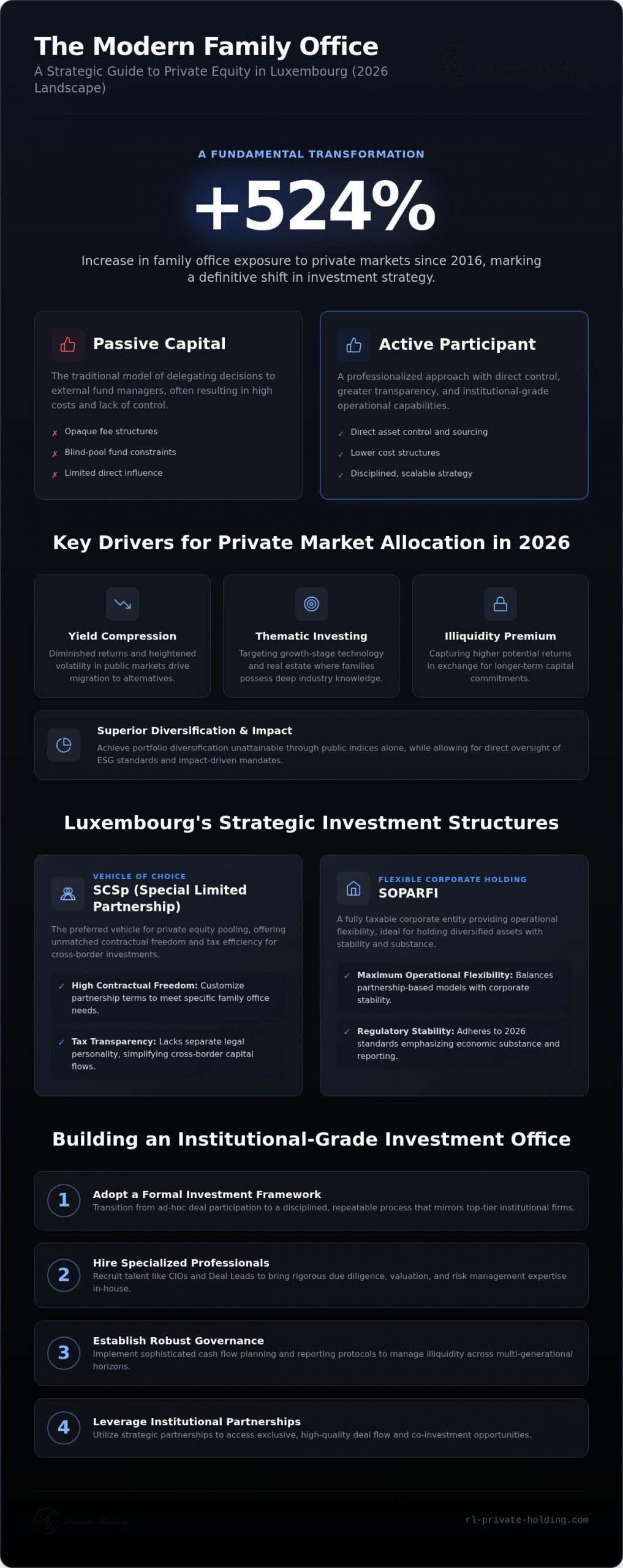
Since 2016, family office exposure to private markets has expanded by 524 percent, signaling a definitive transition from passive capital allocation toward active, professionalized investment management. Sophisticated investors frequently encounter systemic obstacles in traditional fund environments, such as opaque fee structures and the persistent difficulty of sourcing high-quality direct deal flow. This environment requires a disciplined approach to private equity for family offices Luxembourg to maintain a competitive advantage in an increasingly complex global market.
This strategic framework serves as a comprehensive guide to institutionalizing your private equity operations and optimizing your presence within the Grand Duchy. You will gain clarity on the 2026 regulatory landscape, including the modernized carried interest regime and the expanded eligibility of Reserved Alternative Investment Funds. We provide the technical insights necessary to refine your tax and legal structures, facilitating diversified exposure to growth-stage technology and real estate assets through a methodical and transparent investment process. The following analysis details how to transition from a traditional wealth preservation model to a sophisticated private market participant.
Key Takeaways
- Understand the transition from passive capital allocation to active participation through institutional-grade private market strategies.
- Identify the technical advantages of the SCSp and SOPARFI vehicles when structuring private equity for family offices Luxembourg for maximum operational flexibility.
- Develop a strategic framework for balancing direct deal participation with indirect fund interests to optimize diversification and risk-adjusted returns.
- Establish robust governance and cash flow planning protocols to manage the illiquidity premium across multi-generational investment horizons.
- Learn how to leverage institutional partnerships to access exclusive deal flow within growth-stage technology and real estate sectors.
The Evolution of Family Offices into Private Equity Participants
The landscape for private capital has undergone a fundamental transformation. Historically, family offices operated as passive limited partners, delegating decision-making and asset selection to external fund managers. By 2026, this model has largely been superseded. Sophisticated principals now demand greater transparency, lower cost structures, and direct influence over their capital allocations. The adoption of private equity for family offices Luxembourg reflects a broader global shift toward direct asset control, allowing families to move beyond the constraints of traditional blind-pool fund structures. When considering What is a Family Office? in the modern context, it’s clear the entity has moved beyond simple fiduciary oversight.
Luxembourg provides the structural stability and regulatory clarity required for this transition. Its ecosystem allows for the seamless integration of global assets into a single, institutional-grade framework that supports both local and cross-border transactions. The professionalised family office functions as a strategic hybrid, merging the long-term capital preservation goals of traditional wealth management with the rigorous operational and transactional capabilities of private equity firms.
Drivers of Private Market Allocation in 2026
Yield compression in traditional public equities and fixed-income markets has forced a strategic migration toward alternative assets. In 2026, public markets are often characterized by heightened volatility and diminished returns, making them insufficient for multi-generational wealth preservation. Family offices are increasingly prioritizing thematic investing, specifically targeting sectors where they possess deep industry knowledge or proprietary networks. This often manifests as a focus on growth-stage technology and real estate. By accessing these assets through private channels, families capture the illiquidity premium and secure a level of portfolio diversification that is unattainable through public indices alone. The rise of impact-driven mandates also favors private equity, as it allows for more direct oversight of environmental and social governance standards within portfolio companies.
Institutional Gravity: Professionalising the Investment Office
Transitioning from ad-hoc deal participation to a consistent, high-performing investment program requires a fundamental shift in internal capabilities. Families are no longer relying on informal networks for deal flow. Instead, they are adopting a formal private equity investment management framework that mirrors the operations of top-tier institutional firms. This professionalization involves hiring specialized investment professionals, such as Chief Investment Officers (CIOs) and dedicated Deal Leads, who bring rigorous due diligence and valuation expertise. By integrating institutional reporting standards and sophisticated risk management protocols, the modern family office ensures that its private equity for family offices Luxembourg strategy is both disciplined and scalable, providing a steady hand in the management of complex, high-stakes portfolios.
Strategic Investment Structures for PE in Luxembourg
The selection of an appropriate legal vehicle is the cornerstone of any institutional-grade private market program. Luxembourg’s enduring appeal lies in its diverse array of structures, each designed to address specific requirements for transparency, tax efficiency, and operational control. For those developing a framework for private equity for family offices Luxembourg, the choice often centers on balancing the flexibility of partnership-based models with the stability of traditional corporate holdings. These structures must now account for the 2026 regulatory environment, which emphasizes economic substance and sophisticated reporting standards.
The Luxembourg Special Limited Partnership (SCSp)
The Luxembourg special limited partnership has emerged as the preferred vehicle for private equity pooling due to its high degree of contractual freedom. Because the SCSp lacks a separate legal personality from its partners, it offers a level of tax transparency that is highly valued for cross-border capital flows. This vehicle allows family offices to tailor governance rights and distribution waterfalls within the partnership agreement, providing a bespoke investment environment. It remains particularly attractive for single family offices that prioritize confidentiality and require a structure that can be established rapidly without extensive regulatory approvals.
SOPARFI: The Classic Holding Structure
The Société de Participations Financières, or SOPARFI, remains a fundamental tool for managing direct equity participations. As a fully taxable commercial company, it benefits from Luxembourg’s extensive network of double tax treaties and the participation exemption regime. This regime can provide full exemptions on dividends and capital gains, provided specific holding periods and ownership thresholds are met. The SOPARFI is ideally suited for consolidating diverse assets, such as growth-stage technology firms and real estate holdings, under a single corporate umbrella. It provides a stable platform for long-term wealth preservation while maintaining the professional image required for institutional deal-making.
Operating these structures in 2026 requires strict adherence to substance requirements. Entities must demonstrate a physical presence and local decision-making capabilities to maintain their tax status. Larger family offices must also consider the implications of the Alternative Investment Fund Managers Directive (AIFMD) if their assets under management exceed specific thresholds. Understanding the evolving role of family offices in private equity is essential for navigating these complexities effectively. Those seeking to optimize their Luxembourgish operations can find significant value in partnering with an established private equity investment management partner to ensure all structural and regulatory components are aligned with institutional standards.
Direct vs. Indirect Allocation: A Strategic Framework
The allocation of capital within private markets requires a deliberate choice between direct participation and indirect fund commitments. This decision is not merely a matter of preference; it’s a strategic calculation based on the family office’s risk tolerance, internal capabilities, and desired level of operational involvement. For those implementing private equity for family offices Luxembourg, the objective is to construct a portfolio that balances the high-conviction returns of direct deals with the stability of diversified fund interests. Each path presents distinct advantages and operational requirements that must be weighed against the family’s overarching objectives.
The Direct Investment Path
Direct investment allows family offices to bypass the traditional fee structures of private equity funds, including management fees and carried interest. This path offers greater control over investment timing and a closer alignment with the family’s long-term values. Success in direct deals requires a sophisticated internal deal team capable of sourcing, vetting, and executing opportunities with institutional precision. Many families focus their direct efforts on venture capital Luxembourg to capture high-growth tech exposure. Utilizing Luxembourg’s private equity legal framework ensures these direct participations are structured with the necessary governance rights and protection mechanisms.
The Indirect (Fund) Path
Indirect allocation remains a vital component for achieving broad market exposure. By committing capital as a limited partner to established private equity firms, family offices leverage the expertise and networks of top-tier General Partners (GPs). This approach provides diversification across different industries, geographies, and vintage years, reducing the impact of any single asset’s underperformance. It’s particularly effective for families who prefer a more passive role while still benefiting from the illiquidity premium of private markets. Selecting the right private equity firm involves a rigorous assessment of the GP’s track record, investment thesis, and structural alignment.
Co-investment opportunities represent a growing middle ground for evolving family offices. These allow families to invest alongside a GP in a specific transaction, often with reduced fees and greater transparency. This model provides a practical way to build direct investment experience without the immediate need for a full-scale internal team. Building a deal flow engine is the final requirement for a professionalized framework. This involves establishing a network of institutional partners to ensure a steady stream of vetted opportunities. A disciplined approach to sourcing and execution is what differentiates professionalized investors from ad-hoc participants in the private equity space.
Risk Mitigation and Governance in Private Markets
Managing risk in private markets requires a departure from the high-frequency monitoring typical of public equities. The illiquidity premium is a fundamental component of private equity for family offices Luxembourg, yet it demands a sophisticated cash flow planning model to manage the timing of capital calls and distributions. A robust framework ensures that the family’s lifestyle and operational requirements aren’t compromised by the multi-year lock-up periods inherent in these assets. A family office investment strategies Luxembourg framework incorporates risk limits by defining concentration thresholds and liquidity buffers across the private market portfolio.
Succession and Long-Term Value Creation
Multi-generational wealth preservation is often the primary objective for family offices. Aligning private equity horizons with these long-term goals requires a governance structure that survives the original principal. Direct board participation serves as an effective educational platform for the next generation, offering them exposure to operational decision-making and fiduciary responsibility. It’s essential that portfolios reflect enduring family values, often through the integration of specific environmental, social, and governance (ESG) criteria that define the family’s legacy. This alignment ensures that the investment office doesn’t just generate returns but also maintains the family’s reputation and strategic intent across decades.
Exit Strategy Frameworks
Planning for liquidity must begin at the point of entry rather than being treated as an afterthought. While public markets offer daily liquidity, private holdings require a structured exit framework to realize value. Secondary markets have become a vital tool in 2026, allowing family offices to manage liquidity by selling limited partner interests or direct stakes to other institutional investors. When a portfolio company matures, the choice between an initial public offering (IPO) and a strategic sale depends on prevailing market conditions and the family’s desire for continued involvement. Recapitalization provides a strategic alternative, allowing for a partial exit while maintaining a long-term equity position in high-performing assets.
Establishing these protocols requires a disciplined approach to asset management that balances institutional rigor with the unique needs of a private family. Families seeking to professionalize their risk management and governance protocols can benefit from private equity investment management expertise to ensure their portfolio remains resilient across various market cycles.
RL Private Holding: Institutional Expertise for Family Office Portfolios
RL Private Holding operates at the intersection of institutional discipline and bespoke private market access. For family offices seeking to professionalise their approach to private equity for family offices Luxembourg, the firm provides a structured gateway to high-conviction opportunities. we manage a global portfolio from our Luxembourg headquarters, ensuring that every allocation is underpinned by the Grand Duchy’s robust legal and regulatory standards. This institutional foundation allows us to act as a steady hand for families navigating the transition from passive capital allocation to active, direct investment participation.
A Strategic Partner in Luxembourg
The firm specialises in the management of complex global portfolios across diverse sectors, with a particular emphasis on growth-stage European technology. we understand that transparency and long-term value alignment are non-negotiable for sophisticated family offices. Our collaborative co-investment models allow partners to participate directly in vetted transactions, providing a level of transparency that traditional blind-pool funds often lack. By leveraging our institutional-grade deal flow, families can access exclusive opportunities that are typically reserved for larger sovereign wealth funds or global private equity firms. we maintain a discreet presence in the market, focusing on the structural integrity of every deal and the long-term viability of our portfolio companies.
Building Future-Proof Portfolios
A resilient portfolio requires more than just high-growth equity; it demands a balanced allocation to tangible assets. Integrating real estate asset management Luxembourg with private equity strategies provides a hedge against market volatility while securing steady cash flows. This dual-focus approach ensures that wealth preservation remains central to the investment mandate. Our team applies a disciplined asset allocation framework to every engagement, ensuring that risk limits are maintained and multi-generational goals are protected. we prioritise the structural components of the business, such as sectors of interest and organisational hierarchy, to provide a clear overview of the scope and potential of every investment.
The transition toward a professionalised investment office is a significant undertaking that requires a steady, experienced partner. RL Private Holding offers the technical expertise and global reach necessary to navigate the complexities of private equity for family offices Luxembourg in 2026. Our approach is methodical and deliberate, reflecting the serious nature of the assets we manage. we invite you to contact us to discuss how our institutional-grade private market strategies can be tailored to meet your specific objectives and long-term vision.
Advancing Toward Institutional Private Market Excellence
The transition toward a professionalised investment office represents a fundamental shift in the strategic management of family wealth. By adopting institutional-grade structures and rigorous governance protocols, family offices move beyond traditional capital preservation toward active value creation. The 2026 framework for private equity for family offices Luxembourg emphasizes the necessity of structural flexibility and technical expertise to navigate a complex global environment. It’s clear that professionalisation is now an essential requirement for long-term success.
RL Private Holding provides the global investment management expertise and institutional governance required to build resilient, high-performing portfolios. Our specialized focus on growth-stage technology and real estate allows partners to secure diversified exposure while maintaining the highest standards of transparency. We maintain a steady presence in the market. This disciplined approach ensures that multi-generational wealth is not only preserved but actively grows through high-conviction opportunities.
Explore Strategic Private Equity Management with RL Private Holding to professionalise your allocation strategy and secure long-term capital growth. We look forward to supporting your transition toward a more sophisticated and effective private market presence within the Grand Duchy.
Frequently Asked Questions
How do Luxembourg family offices typically structure their private equity investments?
Luxembourg family offices typically utilize a tiered approach that combines the Société de Participations Financières (SOPARFI) for holding direct equity with the Special Limited Partnership (SCSp) for pooling capital. This configuration allows for the efficient segregation of assets while maintaining a high degree of operational control. By layering these vehicles, offices can manage complex global portfolios within the Grand Duchy’s robust legal and regulatory framework.
What are the benefits of using an SCSp for a family office in Luxembourg?
The Special Limited Partnership (SCSp) offers unparalleled contractual flexibility, allowing partners to tailor governance rights and distribution waterfalls to their specific requirements. Because the SCSp lacks a separate legal personality, it’s often treated as tax-transparent, which simplifies the management of cross-border investment flows. It’s particularly effective for single-family offices that prioritize confidentiality and require a vehicle that can be established rapidly without prior regulatory approval.
Is private equity suitable for all family office portfolios?
Private equity isn’t universally appropriate for every portfolio, as it requires a multi-year commitment and a high tolerance for illiquidity. Families with immediate capital requirements or shorter investment horizons may find the lock-up periods, which often exceed seven years, too restrictive. However, for those focused on multi-generational wealth preservation, the asset class provides a necessary hedge against public market volatility and inflation.
What is the difference between direct and indirect private equity investment for a family office?
Direct investment involves the acquisition of specific company stakes, while indirect investment refers to committing capital as a limited partner in an external fund. Direct participation grants the family office full control over asset selection and timing but necessitates a sophisticated internal deal team. Indirect paths provide immediate diversification across sectors and vintages by leveraging the expertise and networks of established general partners.
How does the Luxembourg SOPARFI compare to other investment vehicles for PE?
The SOPARFI is a fully taxable corporate entity, distinguishing it from tax-transparent partnership vehicles like the SCSp. It’s the standard choice for holding companies due to its access to Luxembourg’s extensive network of double tax treaties and the participation exemption regime. This structure provides a stable and recognized platform for managing global equity participations and real estate assets under a single corporate umbrella.
What are the key risks associated with family office private equity allocations?
The most significant risks involve asset illiquidity and the technical complexity of sourcing institutional-grade private equity for family offices Luxembourg. Without a public exchange to facilitate exits, capital remains committed for extended durations, making accurate cash flow forecasting essential. Additionally, direct investments carry operational risks that require rigorous due diligence and ongoing monitoring by specialized investment professionals to mitigate potential losses.
How much of a family office portfolio should be allocated to private equity in 2026?
In the current 2026 market environment, sophisticated family offices often allocate between 15 percent and 25 percent of their total portfolio to private markets. This allocation reflects a strategic shift away from traditional fixed income toward assets that offer higher growth potential and long-term value. The specific percentage depends on the family’s liquidity needs and their capacity to manage the administrative requirements of private equity for family offices Luxembourg.
Can a family office co-invest alongside institutional private equity firms?
Co-investment is a common and effective model that allows family offices to invest directly in specific deals alongside institutional private equity firms. This arrangement enables the family to benefit from the GP’s professional due diligence and sector expertise while often paying lower fees than those associated with a standard fund commitment. It serves as a practical middle ground for offices seeking to build direct investment experience without a full internal deal team.