

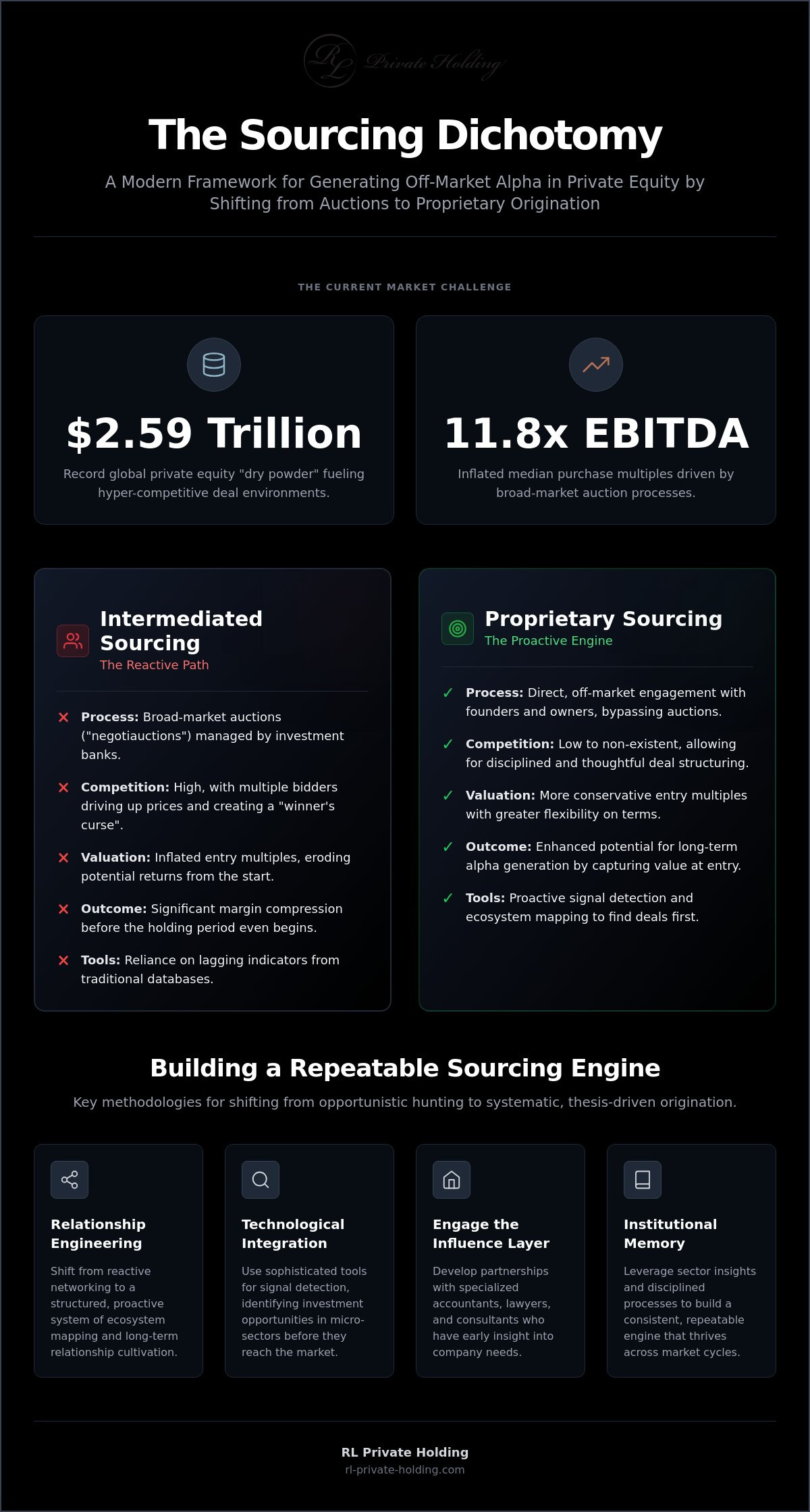
With global private equity dry powder reaching a record $2.59 trillion in early 2026, the traditional auction process has increasingly become a mechanism for margin compression rather than value creation. Many institutional investors recognize that relying on broad-market “negotiauctions” often leads to inflated median purchase multiples, which have recently climbed to 11.8x EBITDA. This environment makes proprietary deal sourcing in private equity not just a competitive advantage, but a structural necessity for firms seeking to deliver superior risk-adjusted returns. It’s clear that the high cost of maintaining internal origination teams, coupled with the prevalence of inaccurate data in legacy databases, has made consistent off-market discovery difficult to sustain.
This exploration provides a sophisticated framework for establishing a repeatable, data-driven origination engine that functions independently of competitive bidding cycles. You’ll gain insights into how top-quartile firms bypass intermediated processes to secure off-market alpha through disciplined outreach and institutional memory. We will examine the specific methodologies required to reduce entry multiples and increase control over deal structuring in an increasingly crowded global landscape. The following analysis moves beyond networking as an art form, presenting sourcing as a rigorous engineering discipline for the modern era.
Key Takeaways
- Establish the technical distinctions between off-market and intermediated transactions to mitigate the risks associated with competitive auction environments.
- Develop a structured framework for proprietary deal sourcing in private equity by shifting from reactive networking to proactive relationship engineering and ecosystem mapping.
- Evaluate the comparative advantages of off-market origination, specifically focusing on the correlation between reduced entry multiples and enhanced long-term alpha generation.
- Integrate sophisticated technological tools for signal detection to identify investment opportunities within micro-sectors before they are recognized by traditional market participants.
- Leverage institutional memory and global sector insights to build a repeatable sourcing engine that maintains discipline across various private market cycles.
Defining Proprietary Deal Sourcing and Its Role in Alpha Generation
In the institutional landscape of private equity, the definition of a proprietary deal has matured beyond simple bilateral discussions. True proprietary deal sourcing in private equity requires a firm to differentiate between intermediated auctions, pre-market opportunities, and genuine off-market transactions. Intermediated deals involve broad mandates managed by investment banks, while pre-market deals exist in a state of limited competition before a formal process begins. Off-market transactions remain the most coveted, as they occur through direct engagement between the GP and the founder, often bypassing the competitive friction that drives up valuations.
Alpha generation begins at the point of entry. When firms rely on broad auctions, they often encounter the “winner’s curse,” where the successful bidder overpays to secure the asset. In 2026, with median purchase multiples reaching 11.8x EBITDA, the correlation between deal origin and internal rate of return (IRR) has never been more pronounced. Securing a transaction outside of a multi-round auction typically allows for more conservative entry multiples and greater flexibility in deal structuring. It’s a fundamental shift in how value is captured at the start of the investment lifecycle.
Modern origination has shifted from opportunistic hunting to systematic farming. This transition involves moving away from sporadic, high-effort strikes toward a disciplined, long-term cultivation of specific sectors. It isn’t about finding a deal today; it’s about building the infrastructure to ensure the deal finds the firm when the timing is optimal for the seller. This requires a synthesis of institutional memory and data-driven outreach that most traditional models lack.
The Economics of the ‘Negotiauction’
The negotiauction is defined as a process where sellers combine auction speed with bilateral negotiation. This hybrid model leverages the $2.59 trillion in global dry powder to create artificial urgency, often forcing GPs into aggressive terms. As more capital chases fewer high-quality assets, these processes erode the traditional advantages of private ownership by compressing margins before the holding period even begins. Avoiding these crowded rooms is essential for maintaining pricing discipline.
Why Traditional Databases Fall Short for Alpha Generation
Standard platforms like PitchBook or Capital IQ provide essential market data, but they often function as lagging indicators. The data decay problem is significant because accurately indexing the 200 million private companies globally is a monumental task that most databases fail to achieve in real time. Relying on these tools often leads to reactive screening rather than proactive, thesis-driven origination. Firms must look beyond public signals to identify proprietary deal sourcing in private equity opportunities before they appear on a competitor’s screen.
The Institutional Mechanics of Off-Market Deal Origination
Developing a repeatable engine for proprietary deal sourcing in private equity requires a shift from sporadic networking to structured relationship engineering. Successful firms treat the market as a mapped ecosystem rather than a series of disconnected opportunities. This process involves identifying the “influence layer” surrounding target companies, which includes specialized accountants, legal advisors, and sector consultants who often hold early insights into succession planning or capital requirements. By the time a business appears in a traditional database, the opportunity for a truly proprietary entry has often passed.
Direct-to-founder outreach remains a cornerstone of this discipline. Engaging with entrepreneurs and family-owned businesses requires a nuanced understanding of legacy and transition, making “street smarts” and hands-on involvement critical components of proprietary sourcing and operations. This long-term alignment often positions the GP as the partner of choice, effectively bypassing the competitive friction of an auction. Firms that synthesize proprietary data sets are better positioned to act with conviction when hidden triggers for liquidity, such as leadership transitions or internal restructuring, finally surface.
Relationship Engineering vs. Traditional Networking
Traditional networking often relies on serendipity, whereas relationship engineering utilizes a methodical cadence of engagement. This disciplined approach ensures that trust is established well before a liquidity event is on the horizon. By applying established private equity investment management frameworks, firms can align their sourcing efforts with deep sector expertise, providing value to founders through industry insights long before a transaction occurs. It’s about becoming a known quantity in the specific micro-sectors where the firm intends to deploy capital.
Institutional Memory as a Sourcing Asset
One of the most underutilized assets in origination is the data legacy of previously declined opportunities. Sophisticated firms maintain a longitudinal database that tracks companies they’ve interacted with but didn’t eventually back. This institutional memory captures why a deal was passed over and monitors the company’s subsequent performance against those initial findings. A robust re-engagement strategy often yields proprietary outcomes because the firm has already performed significant due diligence and built a rapport with the management team. It’s common for a “no” in 2023 to become a highly successful proprietary acquisition in 2026 once the specific triggers for a liquidity event align with the firm’s thesis. Capturing these off-radar market insights requires internal protocols that categorize intelligence beyond simple financial metrics. For those seeking a partner with a disciplined global approach, exploring the capabilities of RL Private Holding provides a clear view of how institutional gravity translates into market access.
Proprietary vs. Intermediated Sourcing: A Comparative Analysis
The structural divergence between proprietary and intermediated sourcing models is most evident in the resulting internal rate of return (IRR). While intermediated auctions provide immediate access to vetted assets, they often force GPs into a price-taking position. In contrast, proprietary deal sourcing in private equity allows for a price-making environment where valuations are determined by bilateral negotiation rather than competitive tension. This distinction is critical in 2026, as median purchase multiples have climbed to 11.8x EBITDA, leaving little room for error in financial engineering. Firms that bypass these crowded processes often secure a significant spread in entry multiples, providing a foundational advantage before operational value creation begins.
Beyond the entry price, the luxury of time in off-market investigations provides a distinct due diligence advantage. In a formal auction, the data room access is often restricted to a few weeks, forcing teams to make high-stakes decisions under artificial pressure. Proprietary engagements allow for a deeper, longitudinal analysis of the target’s operational health and cultural alignment. This extended period enables the GP to identify risks that might remain obscured in a high-velocity sale process. It also facilitates the creation of bespoke deal structures, such as earn-outs or phased equity rollovers, that wouldn’t be feasible in a standardized bidding environment.
However, the institutional cost of maintaining a proprietary engine is significant. It requires a heavy investment in human capital and specialized technology that traditional models don’t necessitate. Firms must account for the “cost-to-source,” which includes the salaries of dedicated origination teams and the opportunity cost of long-term relationship cultivation. It’s a trade-off between the high upfront costs of a sourcing engine and the high transaction costs of an intermediated auction. For many, the choice depends on whether they prioritize volume or the structural alpha found in off-market discovery.
Multiple Arbitrage and Entry Discipline
Entry multiples in proprietary environments typically sit several turns below their auction counterparts. This gap provides a vital margin of safety against market volatility and shifting interest rates, which currently sit at 3.50% to 3.75%. Proprietary sourcing mitigates the risk of overpayment by insulating the transaction from the price-inflating pressures of competitive bidding. This discipline is essential for protecting downside risk in a landscape where global dry powder remains at a record $2.59 trillion.
The Velocity Trade-off
Off-market deals often require a longer gestation period, sometimes spanning several years from the initial contact to the final close. This slower velocity can challenge deployment targets, especially for funds with strict investment horizons. Balancing this need for capital deployment with the discipline of proprietary selection requires robust risk management protocols. With the average holding period for portfolio companies now reaching seven years, the initial patience required for a proprietary entry is often rewarded through a more stable and controlled investment lifecycle. Firms must maintain a diversified pipeline to ensure that the slower pace of individual proprietary deals doesn’t stall overall portfolio construction.
Strategic Frameworks for Building a Sourcing Engine in 2026
Establishing a repeatable engine for proprietary deal sourcing in private equity requires a transition from individual-led efforts to institutionalized processes. The first phase of this framework involves rigorous thesis development. Firms must identify micro-sectors characterized by fragmented ownership and historically low levels of intermediation. By focusing on these specific niches, an investment team can establish itself as a specialized partner rather than a generic financial buyer. This focused approach allows for a deeper understanding of sector-specific triggers that precede a formal sale process.
The second phase focuses on process institutionalization. It’s vital that sourcing flow becomes a permanent firm asset rather than a byproduct of a specific partner’s personal network. This involves creating internal protocols for data capture and relationship management that survive personnel transitions. When origination is treated as a core operational function, the firm can maintain a consistent presence in its chosen markets regardless of individual partner availability. This disciplined structure ensures that long-term deal cultivation remains a priority through various market cycles.
Leveraging Luxembourg as a Global Origination Hub
The choice of investment vehicle significantly impacts origination efficiency and institutional credibility. Utilizing Luxembourg investment structures, such as the Special Limited Partnership (SCSp), facilitates cross-border sourcing by providing a globally recognized framework for capital deployment. A centralized holding structure in Luxembourg improves capital allocation speed, which is a critical factor when negotiating off-market deals with time-sensitive sellers. This institutional setup also enhances standing with international founders who value the stability and transparency of established European financial hubs. For those seeking to optimize their deployment strategy, a partner with expertise in private equity investment management can provide the necessary structural support.
AI and Machine Learning in Signal Detection
Technological integration has evolved from basic web scraping to sophisticated predictive models. Modern sourcing engines leverage machine learning to detect signals that indicate a potential liquidity event before it becomes public knowledge. These triggers include sudden changes in senior management, a surge in patent filings, or aggressive geographic expansion. While these tools provide a significant advantage in signal detection, the most successful firms integrate this data without losing the human element. The final decision to engage still relies on the trust built through primary research and direct interaction. It’s the synthesis of high-tech signal detection and high-touch relationship management that defines the modern sourcing engine.
The final stage of the framework is ecosystem cultivation. This involves building a national network of strategic partners, including industry veterans and regional advisors, who provide localized intelligence. This collaborative approach ensures a steady flow of high-conviction opportunities that have been pre-vetted by trusted sources. By combining these four steps, firms can build a robust defense against the margin compression found in the broader auction market.
The RL Private Holding Approach to Private Market Origination
RL Private Holding maintains an unwavering commitment to disciplined, thesis-driven investment management. Our approach to proprietary deal sourcing in private equity is built upon the synthesis of global market intelligence and localized sector expertise. By leveraging a diversified portfolio that spans multiple geographies, we identify emerging trends before they reach broader market saturation. This cross-pollination of data allows us to act with conviction in sectors where others may only see noise. It’s a methodical process that prioritizes structural integrity over short-term market momentum.
Our methodology integrates insights from venture capital and private equity to detect early-stage signals in the technology and asset management sectors. This dual perspective provides a longitudinal view of a company’s trajectory, from initial growth to institutional maturity. We collaborate closely with institutional partners to execute complex, off-market transactions that require both capital depth and structural sophistication. This collaborative model ensures that every transaction is supported by a robust framework of due diligence and strategic alignment.
A Disciplined Global Partner
Our sourcing pillars are firmly rooted in technology, real estate, and asset management. We prioritize these sectors because they offer the greatest potential for structural alpha through operational improvement. The “silent giant” persona of RL Private Holding serves as a distinct advantage when building trust with private sellers who value discretion over public exposure. This professional distance ensures that negotiations remain focused on long-term value rather than the artificial urgency of a crowded auction room. Trust is the primary currency in off-market origination, and it’s earned through a history of stability and professional conduct.
We also ensure that our activities align with sophisticated family office investment strategies. This alignment focuses on wealth preservation and the steady cultivation of assets through disciplined cycles. By maintaining this institutional gravity, we position ourselves as a steady hand in the global financial landscape. Our partners value this long-term thinking, which stands in contrast to the high-velocity, high-friction models common in the broader market.
Conclusion: The Future of Alpha
The enduring value of proprietary deal sourcing in private equity lies in its ability to bypass the inefficiencies of the auction market. As we move through 2026, the institutional framework presented here remains the most reliable path to securing off-market alpha. Success in this environment requires more than just capital. It demands a rigorous, repeatable engine that prioritizes discipline over opportunistic hunting. The shift from reactive screening to proactive, thesis-driven origination is now a requirement for firms seeking to deliver superior risk-adjusted returns.
Sophisticated investors and institutional partners are invited to explore our strategic approach to private market origination. By focusing on the structural components of the business and maintaining a clear plan, we continue to identify and secure the most compelling off-market opportunities globally. The landscape of private equity will continue to evolve, but the principles of disciplined sourcing and relationship engineering will remain the foundation of institutional success.
Securing Structural Alpha in a Competitive Global Landscape
The institutionalization of proprietary deal sourcing in private equity represents a fundamental shift from opportunistic discovery to disciplined ecosystem mapping. By prioritizing relationship engineering over the volatility of intermediated auctions, firms can secure assets at entry multiples that preserve long-term margins. This framework emphasizes that success in 2026 depends on the synthesis of institutional memory and predictive signal detection. It’s a methodical approach that ensures capital is deployed with precision rather than under the artificial pressure of a bidding room.
RL Private Holding remains committed to this rigorous standard of origination. Headquartered in the Luxembourg financial centre, we manage a diversified global portfolio with deep expertise across the technology and real estate sectors. Our focus on structural integrity and professional distance allows us to build the trust necessary for off-market success. We invite sophisticated partners to explore our Private Equity Investment Management frameworks to understand how we maintain discipline in an evolving market. Establishing a steady hand in private market discovery is the most reliable path toward enduring value.
Frequently Asked Questions
What is proprietary deal sourcing in private equity?
It is the practice of identifying and securing investment opportunities outside of competitive auction processes managed by intermediaries. This method focuses on direct engagement with business owners to establish bilateral negotiations. It allows firms to bypass the price-inflating tension of broad-market bidding cycles. Successful origination requires a disciplined, thesis-driven approach to identify assets before they reach the public market and become subject to standardized auction rules.
How does proprietary deal flow differ from intermediated deals?
Intermediated deals are managed by investment banks or brokers who invite multiple bidders to participate in a structured auction. Proprietary deal flow occurs when a firm initiates a direct relationship with a seller before a formal process begins. This distinction is critical because proprietary deals often lead to more favorable entry multiples and greater flexibility in structuring. It’s a method that prioritizes relationship engineering over the speed of a high-velocity bidding environment.
Why is proprietary deal sourcing important for alpha generation?
Proprietary deal sourcing in private equity is essential for alpha generation because it mitigates the winner’s curse associated with high-multiple auctions. By avoiding competitive bidding, firms can enter investments at valuations that aren’t artificially inflated by market hype. This lower entry point provides a significant margin of safety and a clearer path toward superior risk-adjusted returns throughout the investment lifecycle. It ensures that value capture begins at the point of entry.
What are the biggest challenges in building a proprietary deal engine?
The primary challenges include the high cost of human capital and the extended gestation period required for off-market transactions. Building a repeatable engine requires a dedicated origination team and sophisticated technology for signal detection. Additionally, maintaining pricing discipline over several years of relationship cultivation demands a high degree of institutional patience that many smaller funds struggle to sustain. It’s an engineering discipline that requires long-term commitment and significant internal resources.
Does proprietary sourcing actually lead to better investment returns?
Research generally indicates a correlation between off-market origin and higher internal rates of return due to lower entry multiples. While the cost-to-source is higher, the avoidance of the 11.8x EBITDA median multiples seen in broad auctions in 2026 provides a structural advantage. These deals also allow for more thorough due diligence, reducing the risk of unforeseen operational issues post-acquisition. The ability to structure bespoke terms further enhances the overall return profile.
How can technology improve private equity deal sourcing in 2026?
Technology facilitates the shift from manual scraping to predictive signal detection through machine learning. Advanced platforms can identify liquidity triggers, such as leadership changes or patent filings, before they become public knowledge. Integrating these tools allows firms to prioritize their outreach efforts, ensuring that their origination teams focus on the highest-conviction opportunities within their chosen micro-sectors. It’s about leveraging data to identify the right moment for direct engagement with a founder.
Can proprietary deal sourcing be scaled across a large fund?
Scaling proprietary deal sourcing in private equity requires the institutionalization of processes so they don’t depend solely on individual partner networks. Large funds achieve this by building centralized databases of historical deal data and mapping entire industry ecosystems. This systematic approach ensures a consistent flow of opportunities across various geography-specific and sector-specific teams, maintaining a unified global investment strategy while preserving localized market intelligence. It transforms networking into an institutional asset.
What role does a Luxembourg structure play in deal origination?
A Luxembourg investment structure, such as the SCSp, provides a globally recognized framework that enhances institutional credibility with international sellers. It facilitates faster capital allocation, which is vital when a proprietary opportunity requires a swift and certain close. The transparency and stability of the Luxembourg financial centre offer a secure environment for managing complex cross-border transactions and aligning with sophisticated institutional partners. This structural stability is a key component of a professional origination framework.