

The pursuit of institutional funding often focuses on the immediate injection of liquidity, yet the true determinant of success is the underlying architecture of the deal. Many founders rightly fear that scaling a business with venture capital inevitably leads to excessive dilution and a loss of strategic autonomy. These concerns are valid in an environment where short-term exit pressures often overshadow the necessity of building long-term enterprise value. It’s common for leadership teams to feel misaligned with capital partners who prioritize rapid liquidation over structural stability.
This guide provides a sophisticated framework for navigating the 2026 investment landscape, ensuring that capital serves as a catalyst for sustainable expansion rather than a source of operational friction. You’ll gain an institutional perspective on architecting growth that preserves founder equity while leveraging the robust regulatory advantages of the Luxembourg financial hub. We’ll examine the integration of hybrid capital structures, the nuances of institutional governance, and the methodology for selecting partners aligned with permanent value creation. By the end of this analysis, you’ll possess a clear roadmap for global expansion that balances aggressive scaling with disciplined capital management.
Key Takeaways
- Identify the precise unit economics and operational milestones that signal readiness for high-stakes institutional expansion.
- Develop a sophisticated capital architecture for scaling a business with venture capital that balances immediate liquidity needs with long-term equity preservation.
- Distinguish between traditional fund lifecycles and permanent capital structures to secure a partner capable of supporting extended growth horizons.
- Establish the necessary organizational infrastructure and executive professionalization required to operate within a global institutional framework.
- Leverage the strategic advantages of the Luxembourg investment landscape to facilitate disciplined cross-border scaling and asset management.
The Strategic Transition: When Scaling a Business with Venture Capital Becomes Essential
The transition from organic growth to venture-scale expansion represents a fundamental shift in a company’s financial and operational lifecycle. For many firms, organic growth provides a stable foundation, yet it often lacks the velocity required to capture emerging market opportunities before competitors intervene. Venture-scale scaling is the application of institutional capital to proven business models. This pivot occurs when the primary constraint on growth is no longer the validity of the product, but the availability of liquidity to saturate the market and establish a dominant position.
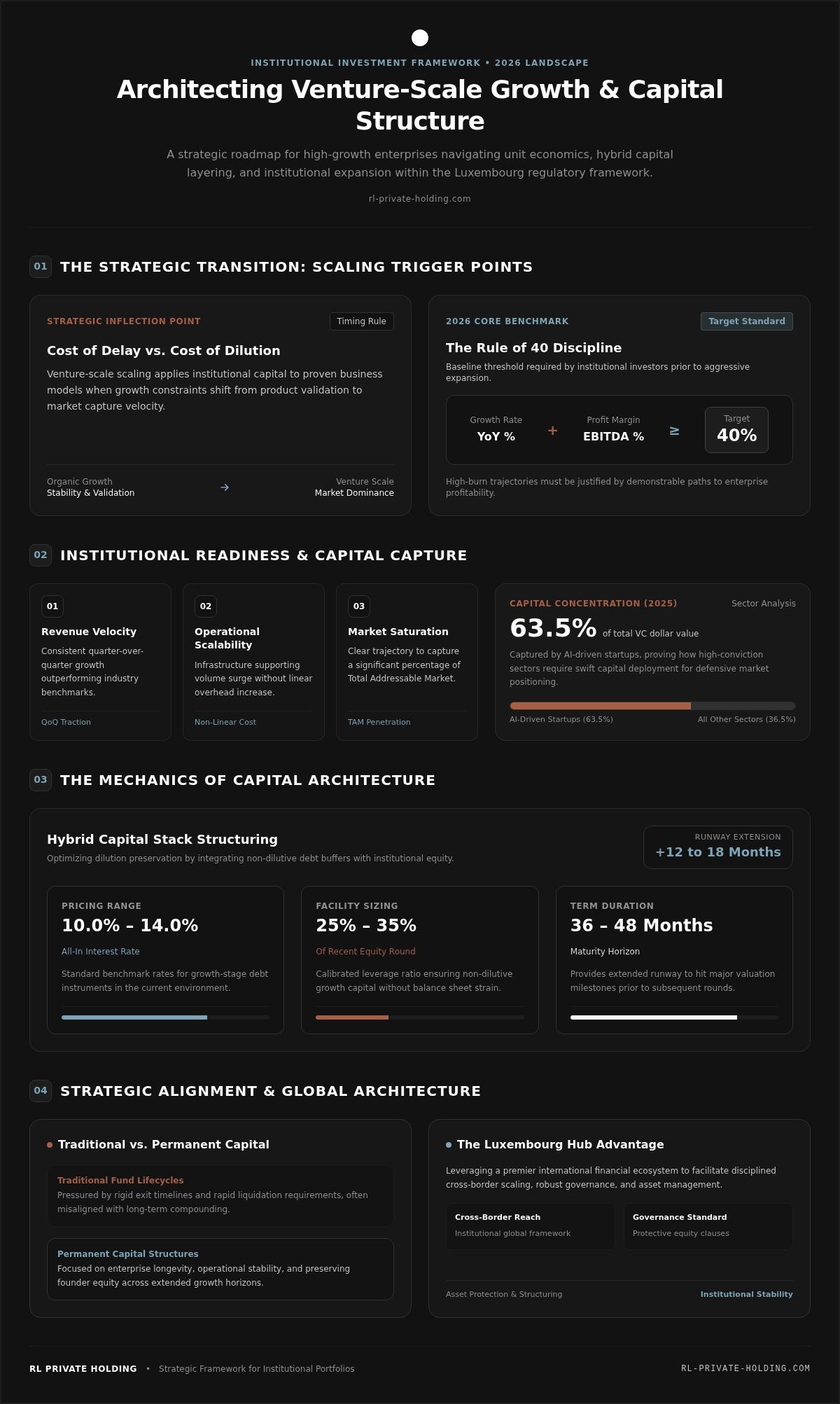
Strategic readiness for venture capital financing requires a rigorous assessment of unit economics and product-market fit. Institutional investors in 2026 prioritize companies that demonstrate a clear path to profitability, often adhering to the Rule of 40 discipline where the combined growth rate and profit margin exceed 40%. While high-burn trajectories are common in technology-driven sectors, they must be supported by high-growth outcomes that justify the capital intensity. Scaling a business with venture capital becomes essential when the cost of delay exceeds the cost of dilution, particularly in markets where first-mover advantages are decisive.
Identifying the Indicators for Institutional Funding
Determining the optimal moment for institutional entry involves analyzing revenue velocity and market capture potential. In 2025, AI-driven startups captured 63.5% of venture dollar value, illustrating how specific sectors demand rapid capital deployment to maintain a competitive edge. Leaders must evaluate whether their existing operational framework can handle a significant increase in volume without systemic failure. Defensive capital also plays a role; securing a substantial balance sheet prevents competitors from eroding market share through aggressive pricing or talent acquisition. Key indicators include:
- Revenue Velocity: Consistent quarter-over-quarter growth that outpaces industry benchmarks.
- Operational Scalability: Infrastructure that supports expansion without a linear increase in overhead.
- Market Saturation Potential: A clear opportunity to capture a significant percentage of the Total Addressable Market (TAM).
The Shift from Resource Scarcity to Strategic Capital
Transitioning to institutional funding marks the end of the survival mindset typical of early-stage operations. Capital is no longer a means of extending runway; it’s a tool for achieving market dominance. This shift requires founders to seek strategic alignment with partners who understand the nuances of global expansion. In the Luxembourg investment landscape, this alignment often focuses on long-term value rather than immediate liquidity events. Choosing a partner ensures that the capital mandate supports the founder’s vision for institutional permanence. It’s a move from tactical execution to strategic architecture, where every Euro deployed is focused on building a sustainable and defensible enterprise.
The Mechanics of Capital Architecture in Growth-Stage Scaling
The architecture of a company’s capital stack is a strategic lever that determines its ability to withstand market volatility while maintaining aggressive expansion. Scaling a business with venture capital requires a shift from simple fundraising to complex financial engineering. It’s no longer sufficient to secure a single large equity check. Instead, sophisticated firms in 2026 layer their capital, utilizing primary equity alongside venture debt to extend runways by 12 to 18 months. Current venture debt benchmarks show all-in interest rates between 10.0% and 14.0%, typically sized at 25% to 35% of the most recent equity round. These facilities often carry 36 to 48 month terms, providing a non-dilutive buffer that preserves founder equity during critical growth phases.
Founders must integrate private equity investment management principles to ensure long-term value. This includes a disciplined approach to liquidation preferences and anti-dilution clauses. While these terms protect institutional investors, they can significantly impact founder proceeds during an exit. Understanding the mechanics of venture capital is essential to negotiating structures that balance immediate liquidity with the preservation of equity value. Strategic scaling isn’t merely about the volume of capital, but the precision with which that capital is deployed across the corporate lifecycle.
Optimizing the Capital Stack for Long-Term Value
A clean capitalization table is a prerequisite for subsequent funding rounds. Management teams should use tranches to align capital injections with specific performance milestones, such as reaching a designated Annual Recurring Revenue (ARR) or achieving profitability targets. This phased approach reduces immediate dilution and ensures that the cost of capital remains aligned with the company’s risk profile. Firms interested in architecting these complex structures often benefit from sophisticated investment management services that prioritize structural integrity over short-term gains.
Institutional Governance and Board Composition
Institutional scale necessitates a transition from founder-controlled boards to a balanced governance model. This shift introduces rigorous reporting standards and operational oversight. A lead investor provides more than just capital; they offer a global network and sector expertise that can accelerate expansion. Establishing these standards early prepares the organization for the scrutiny of late-stage growth rounds, where median valuations in 2026 now exceed €103.3 million. Effective governance ensures that strategic decisions are based on data-driven insights, which is vital for maintaining stability in the Luxembourg investment landscape.
Strategic Alignment: Selecting the Right Venture Capital Partner
Selecting a capital partner is a decision that extends far beyond the immediate balance sheet impact. While liquidity is the primary driver for institutional engagement, the qualitative attributes of an investor often dictate the long-term success of the partnership. Strategic capital is defined as funding that brings industry-specific leverage and governance to the enterprise. When scaling a business with venture capital, the distinction between traditional closed-end funds and permanent capital vehicles becomes a critical consideration for the executive team. Traditional funds often operate within a strict ten-year lifecycle, which can create structural pressure for premature exits to satisfy limited partner liquidity requirements. In contrast, investment holding companies offer a stable, permanent capital base that allows for the architecting of sustainable value without the arbitrary constraints of fund expiration dates.
Founders should seek institutional investment capital that aligns with their specific operational trajectory and geographic focus. A partner who understands the nuances of global financial hubs can provide the necessary oversight to manage complex regulatory environments. This alignment ensures that the capital provided is not merely a commodity, but a strategic tool used to secure market dominance. It’s essential to evaluate an investor’s previous track record in navigating similar growth phases, as this experience often translates into more effective board-level guidance during periods of rapid expansion.
Sector Expertise and Market Access
A partner’s value is frequently measured by their ability to facilitate market entry and provide high-level strategic introductions. For firms aiming to establish a presence within the European Union, a partner with deep knowledge of venture capital Luxembourg provides a distinct competitive advantage. The Luxembourg financial ecosystem offers a sophisticated regulatory framework that is ideal for cross-border expansion and institutional-grade asset management. Utilizing an investor’s existing portfolio can create synergies that accelerate business development and optimize the supply chain. This network effect is a primary benefit of partnering with a well-integrated holding company that maintains a diverse array of technology and real estate holdings.
Cultural and Strategic Fit
Alignment on the exit philosophy is a fundamental requirement for a successful partnership. Whether the long-term goal is an initial public offering or a strategic acquisition, the investor’s mandate must mirror the founder’s vision for the company. Transparency regarding the level of operational involvement is also necessary to prevent friction. Some partners provide intensive, hands-on guidance, while others maintain a more discreet, advisory-focused presence. Scaling a business with venture capital requires a relationship built on shared values and a mutual commitment to disciplined growth. This cultural compatibility ensures that the organization remains focused on its core mission while navigating the complexities of institutional-scale operations.
The Roadmap to Execution: Preparing the Organization for Scale
Execution is the bridge between capital injection and market dominance. Without a robust operational framework, the influx of liquidity from scaling a business with venture capital can lead to organizational fragmentation. Professionalization is not merely an administrative upgrade; it’s a strategic necessity to manage the complexity of institutional-scale operations. As firms move beyond the initial growth phase, the focus must shift from tactical survival to the implementation of systems that support long-term enterprise value.
Building the Scale-Up Leadership Team
The founding team often possesses the vision required for early-stage survival, but the transition to a growth-stage entity requires a different skill set. Identifying the gap between founding talent and scaling talent is crucial. High-growth firms must prioritize hiring experienced Chief Financial Officers (CFOs) and Chief Operating Officers (COOs) who have previously managed international expansion. These leaders bring the discipline required to maintain organizational culture while headcount increases rapidly. It’s the responsibility of the new executive layer to translate board-level strategy into daily operational excellence, ensuring the company meets the rigorous performance benchmarks expected by institutional partners.
Operational Scalability and Infrastructure
Operational scalability relies on systems capable of handling a tenfold increase in transaction volume without a proportional increase in overhead. Automation plays a central role in maintaining margins as the business expands across new jurisdictions. For companies based in Luxembourg, preparing for global market entry involves navigating diverse regulatory standards and ensuring compliance with local financial laws. Investing in institutional-grade technology ensures that data remains transparent and accessible, which is vital for real-time decision-making. This infrastructure allows the company to absorb the 25% to 35% increase in capital typically provided by venture debt facilities without losing focus on core profitability.
Financial controls are the final pillar of institutional execution. With the deployment of substantial capital, the risk of mismanagement or inefficient burn increases. Establishing a culture of data-driven decision-making ensures that every Euro is allocated toward high-impact initiatives. This accountability is vital for maintaining the trust of institutional partners and securing future funding rounds. To ensure your organization is prepared for this transition, consult with our experts on institutional growth strategies. By professionalizing the internal environment, leadership can focus on the strategic objectives that drive global expansion and sustainable value creation.
Institutional Partnership with RL Private Holding
RL Private Holding operates as a permanent capital vehicle, offering a structural advantage over traditional venture capital funds. By functioning as an investment holding company, the firm provides growth-stage companies with a stable balance sheet that isn’t subject to the typical 10-year liquidation pressure of closed-end funds. Scaling a business with venture capital in this context means aligning with a partner whose time horizons are measured in decades rather than years. This model allows for the patient execution of global strategies, ensuring that enterprise value is maximized through disciplined growth and institutional-grade oversight.
The firm’s presence in Luxembourg, a premier global financial center, provides portfolio companies with access to a sophisticated regulatory environment and a vast network of international institutional investors. This geographic advantage is essential for firms navigating the complexities of European and global market entry in 2026. RL Private Holding maintains a discreet but authoritative presence, acting as a steady hand in the background of major investments. This approach appeals to founders who value professional distance and a partner who prioritizes structural integrity over disruptive innovation.
A Global Perspective on Venture Capital
Accessing global markets through a Luxembourg-based institutional partner provides a strategic gateway to the broader European landscape. RL Private Holding manages a diversified portfolio that spans technology and real estate, creating a stable ecosystem for growth-stage firms. This multi-sector diversification mitigates the volatility often associated with pure-play technology investments. By integrating into this diversified framework, firms benefit from sophisticated asset management expertise that’s tailored to the unique requirements of high-stakes scaling. It’s a methodology that prioritizes long-term stability and the preservation of capital across various market cycles.
Next Steps for Strategic Engagement
Evaluating a firm’s readiness for institutional engagement requires a rigorous analysis of unit economics and governance structures. It’s a methodical alignment process where strategic objectives are stress-tested against the firm’s investment mandate. Due diligence is conducted with institutional precision, focusing on the sustainability of the business model and the professionalization of the leadership team. For organizations prepared to architect a future of permanent value, the next step is a formal consultation. Inquire about our strategic venture capital funding frameworks to determine how our permanent capital model can support your global scaling objectives.
Architecting Permanent Value in the Global Market
The transition from a growth-stage firm to an institutional leader requires more than just capital; it demands a fundamental realignment of corporate architecture. Success in scaling a business with venture capital in 2026 depends on the precision of your capital stack and the professionalization of your executive team. By prioritizing strategic alignment over immediate liquidity, founders can preserve equity while securing the resources necessary for global dominance. This disciplined approach ensures that expansion remains sustainable and that the organization stays resilient against market volatility.
RL Private Holding provides the institutional-grade asset management and Luxembourg-based strategic expertise required to navigate this complex transition. Our diversified global portfolio and permanent capital model offer a stable foundation for firms that value long-term enterprise value over short-term exit pressure. It’s a commitment to building a legacy of institutional permanence through a disciplined approach to capital and operational excellence. We invite you to Contact RL Private Holding for Strategic Investment Inquiries to discuss how our framework can support your specific organizational objectives. We look forward to supporting your path toward disciplined global expansion.
Frequently Asked Questions
What is the primary difference between scaling with venture capital and private equity?
Venture capital scaling primarily addresses early-stage firms with high-growth potential and unproven profitability. It’s focused on market capture and rapid expansion. Private equity investment management typically involves more mature entities, focusing on operational efficiency and structural optimization. While venture capital involves minority stakes to fuel growth, private equity often seeks controlling interests to implement institutional-grade governance and long-term value creation.
How does a Luxembourg-based holding company structure benefit global scaling?
A Luxembourg-based holding company provides a sophisticated regulatory framework and access to a global financial hub. This structure allows for a permanent capital approach, which bypasses the liquidation pressures of traditional ten-year fund cycles. It offers stability for scaling a business with venture capital by providing a consistent balance sheet. This environment is ideal for managing cross-border expansion and maintaining institutional-grade asset management across diverse jurisdictions.
What are the most critical financial metrics investors look for in growth-stage firms?
Institutional investors prioritize the Rule of 40, where the combined revenue growth rate and profit margin exceed 40%. Other essential metrics include the ratio of Customer Lifetime Value (LTV) to Customer Acquisition Cost (CAC) and net revenue retention. These indicators demonstrate unit economic health and the sustainability of the business model. Accurate tracking of these figures is vital for securing institutional-grade funding and establishing trust with global partners.
How can founders minimize equity dilution during multiple funding rounds?
Founders can minimize dilution by integrating venture debt into their capital stack, typically sized at 25% to 35% of an equity round. Utilizing performance-based tranches ensures that capital is only deployed as the company meets specific valuation milestones. Maintaining a clean capitalization table and seeking higher valuations through proven unit economics also reduces the percentage of equity surrendered when scaling a business with venture capital. This balanced approach preserves founder control.
What role does governance play in the success of a venture-backed scale-up?
Governance provides the structural discipline required to manage rapid organizational growth. It transitions a firm from founder-led tactical execution to institutional-scale operations through balanced board oversight. Effective governance ensures rigorous financial reporting and data-driven decision-making, which are essential for maintaining investor confidence. By establishing professional standards early, a scale-up can navigate the complexities of global markets and regulatory compliance with greater precision and stability.
Is venture capital suitable for businesses focused on long-term dividends rather than a quick exit?
Traditional venture capital funds are structured for liquidation within a specific timeframe, making them less suitable for dividend-focused models. However, an investment holding company model allows for a more patient approach to value creation. This permanent capital structure supports businesses that prioritize long-term stability and sustainable yields. It offers an alternative for leadership teams who seek institutional partnership without the immediate pressure of a short-term exit mandate.
How should a business prepare its financial reporting for institutional-grade due diligence?
Preparing for institutional-grade due diligence requires the professionalization of all financial systems and the implementation of robust internal controls. Financial statements should be audit-ready and reflect a clear understanding of GAAP or IFRS standards. Utilizing automated reporting tools ensures data transparency and allows for real-time analysis of key performance indicators. This level of preparation demonstrates operational maturity and readiness for the scrutiny of sophisticated global investment partners.