

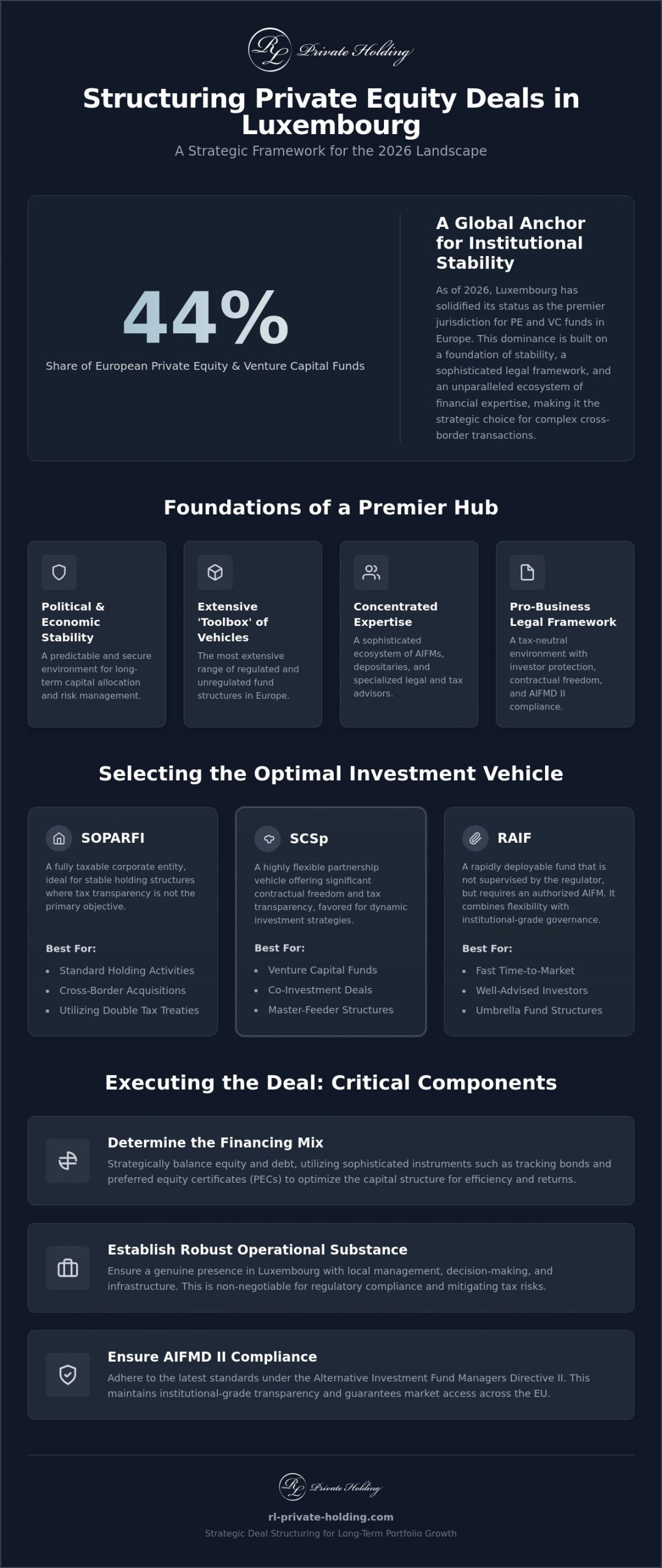
With Luxembourg holding a 44% share of all European private equity and venture capital funds as of June 2026, the jurisdiction has solidified its status as a global anchor for institutional stability. For fund managers and institutional partners, the process of structuring a private equity deal in Luxembourg has evolved into a sophisticated exercise that demands more than simple tax neutrality. It’s now a matter of aligning multi-layered governance with strict operational substance requirements. You likely find that the primary challenge lies in balancing these regulatory demands with the need for a flexible, efficient investment structure that satisfies both limited partners and local authorities.
This guide provides a comprehensive strategic framework for executing transactions within the current 2026 landscape. It’s designed to assist you in identifying the optimal vehicle for your specific deal, whether utilizing a RAIF, an SCSp, or a SOPARFI, while managing the technical financing mix of equity and debt. We will analyze the essential legal vehicles and the latest regulatory requirements under AIFMD II to ensure your structures maintain long-term compliance and professional integrity.
Key Takeaways
- Analyze the strategic advantages of Luxembourg’s political and economic stability as a foundational element for complex cross-border transactions.
- Compare the specific functions of the SOPARFI, SCSp, and RAIF to select the vehicle that best aligns with your operational and efficiency goals.
- Determine the appropriate financing mix between equity and debt, utilizing instruments such as tracking bonds when structuring a private equity deal in Luxembourg.
- Establish robust operational substance and ensure full compliance with AIFMD II standards to maintain institutional-grade transparency.
- Understand how to integrate these structural components into a broader wealth management and asset management strategy for long-term portfolio growth.
The Strategic Rationale for Luxembourg in Private Equity Deal Structuring
Luxembourg’s position as a premier hub for Foreign Direct Investment (FDI) remains undisputed in 2026. This status isn’t accidental. It’s built on a foundation of political, legal, and economic stability that provides a predictable environment for long-term capital allocation. When What is Private Equity? is considered as a strategic asset class, the choice of jurisdiction becomes a primary risk management decision. Luxembourg offers a “Toolbox” of investment vehicles that is the most extensive in Europe, allowing for precise tailoring to specific investor requirements. This variety ensures that the legal framework adapts to the deal, rather than the deal being constrained by the framework.
The concentration of expertise in the Grand Duchy is a significant competitive advantage. A sophisticated ecosystem of Alternative Investment Fund Managers (AIFMs), depositaries, and specialized legal experts supports the lifecycle of every transaction. This infrastructure is essential for structuring a private equity deal in Luxembourg with the necessary speed and technical precision. The presence of these professionals ensures that complex cross-border structures are managed with a high degree of transparency and regulatory alignment. The jurisdiction’s versatility is evidenced by several core features:
- Access to a wide range of regulated and unregulated vehicles, including the RAIF and SCSp.
- A stable legal framework that prioritizes investor protection and contractual freedom.
- A tax-neutral environment that facilitates efficient capital recycling for global portfolios.
- Proximity to major European financial markets and institutional decision-makers.
The 2026 Global Financial Landscape
In 2026, Luxembourg maintains its edge by proactively transposing EU directives such as AIFMD II, which took effect in April. This commitment to being a “white-listed” jurisdiction is vital for institutional limited partners who require absolute certainty regarding compliance and market access. The Grand Duchy serves as a strategic gateway for cross-border capital raising, offering efficient distribution channels that are recognized globally. Its regulatory maturity provides a shield against the volatility often found in less established financial centers, making it the logical choice for structuring a private equity deal in Luxembourg.
Stability and Exclusivity in Asset Management
Institutional investors prioritize the Grand Duchy for its culture of discretion and institutional gravity. The role of private wealth management firms in Luxembourg is central to this environment, facilitating sophisticated deal flow and providing the steady hand required for major investments. This “Silent Giant” approach to European private equity reflects a firm’s internal discipline and strategic focus. It’s a landscape where stability remains the priority over short-term disruption, ensuring that long-term investment objectives are met with quiet authority and professional distance.
Selecting the Optimal Vehicle: SOPARFI vs. SCSp vs. RAIF
Choosing the right legal form is the most critical step when structuring a private equity deal in Luxembourg. The decision typically centers on three primary vehicles: the SOPARFI, the SCSp, and the RAIF. Each serves a distinct purpose within Luxembourg’s Private Equity Ecosystem. The SOPARFI (Société de Participations Financières) remains the standard for holding company activities. It’s a fully taxable entity but benefits from Luxembourg’s extensive network of double tax treaties and the participation exemption regime. It’s often the preferred choice for simple holding structures where tax transparency isn’t the primary objective. Managers find it reliable for cross-border acquisitions where a stable, corporate presence is required.
The Rise of the Special Limited Partnership (SCSp)
The Luxembourg special limited partnership (SCSp) has seen significant adoption by 2026, particularly for venture capital and co-investment deals. Its primary appeal lies in its contractual freedom. Unlike corporate forms, the SCSp doesn’t have a separate legal personality, which allows for a high degree of flexibility in defining the rights and obligations of partners. This vehicle is tax-transparent, meaning income is taxed at the level of the partners rather than the fund itself. This structure simplifies the process of structuring a private equity deal in Luxembourg for international investors who need to avoid double taxation at the vehicle level. It’s particularly effective for complex waterfall distributions and carry arrangements in the current market.
Regulated vs. Unregulated Structures
A major strategic divide exists between regulated and unregulated structures. Regulated vehicles like the SIF (Specialised Investment Fund) or SICAR (Investment Company in Risk Capital) offer high levels of investor protection but require direct supervision and prior approval from the CSSF. By contrast, the Reserved Alternative Investment Fund (RAIF) provides a hybrid solution. It isn’t directly authorized by the regulator; instead, it is supervised through its authorized Alternative Investment Fund Manager (AIFM). This setup allows for a faster time-to-market while maintaining an institutional-grade profile. In 2026, the RAIF’s popularity continues to grow because it combines the structural benefits of a SIF with the operational speed of an unregulated entity.
Selecting between these options depends on the investor profile and the underlying asset type. Institutional investors often demand the oversight provided by a SIF, whereas smaller, more agile managers might prefer the speed of a RAIF or the transparency of an SCSp. Aligning these technical choices with the broader investment mandate is essential for long-term success. For those managing complex global portfolios, engaging with a disciplined investment partner can clarify which vehicle best suits the specific risk-return profile of the transaction. This ensures that the chosen structure remains robust against future regulatory shifts and maintains its strategic value.
Financing the Transaction: Balancing Equity, Debt, and Hybrid Instruments
The financial architecture of a transaction is as critical as the legal vehicle itself. When structuring a private equity deal in Luxembourg, the calibration between equity and debt must respect local administrative practices while achieving the specific commercial goals of the partnership. Luxembourg tax authorities generally expect a debt-to-equity ratio of 85:15 for holding activities. Maintaining these levels is essential for ensuring that the structure remains robust from a regulatory perspective. Sophisticated deal teams in 2026 utilize a combination of ordinary shares, preferred equity, and various debt instruments to optimize the capital stack and manage risk effectively across global portfolios.
Appropriate financing allows for the efficient recycling of capital. By integrating hybrid instruments such as mezzanine financing, managers can provide a risk-adjusted return profile that satisfies diverse investor mandates. This approach requires a deep understanding of how different instruments interact with Luxembourg’s corporate and tax framework, particularly when dealing with cross-border capital flows that involve multiple jurisdictions.
Equity Structuring Strategies
Equity serves as the foundation of structural integrity. In a SOPARFI or SCSp, managers frequently utilize different classes of shares to define voting rights and liquidation preferences. This differentiation is vital for managing carried interest and performance-based incentives. Under the law adopted on January 22, 2026, the tax framework for carried interest has been clarified for the 2026 tax year. Contractual carried interest not linked to direct participation is now taxed at an effective rate of approximately 11.45%. Equity-linked carry may qualify as a capital gain if held for more than six months. These clear parameters ensure an alignment of interests between general partners and limited partners, rewarding long-term value creation within the fund structure.
Debt Financing and Leverage
Luxembourg remains a central node for leveraged finance and asset-backed lending. Debt instruments, including tracking bonds and convertible loan notes, allow for flexible capital extraction. However, managers must account for interest limitation rules that restrict the deductibility of exceeding borrowing costs to 30% of EBITDA or a €3 million threshold. Consequently, the use of Preferred Equity Certificates (PECs) remains a staple for structuring a private equity deal in Luxembourg in 2026. PECs function as debt for local tax purposes, providing deductible interest payments, while often being treated as equity in the investor’s home jurisdiction. This hybrid nature facilitates efficient capital movement without compromising the firm’s institutional standing or regulatory compliance.
Operational Substance and Regulatory Compliance in Deal Execution
Operational substance isn’t a mere administrative checkbox; it’s the core of structural legitimacy. When structuring a private equity deal in Luxembourg, the focus has shifted from simple tax efficiency to demonstrable economic reality. This shift was solidified on April 16, 2026, when the majority of AIFMD II provisions entered into force. These rules demand enhanced transparency and robust governance, ensuring that investment vehicles aren’t just legal shells but active entities with real decision-making power. The CSSF maintains a vigilant presence, monitoring regulated structures to ensure that management functions are genuinely performed within the jurisdiction.
The Anti-Tax Avoidance Directive (ATAD III) has further intensified the scrutiny on shell entities. Structures that lack sufficient physical presence or local management risk losing the benefits of double tax treaties. This makes the choice of directors and the frequency of local board meetings critical components of deal execution. The regulatory landscape is continually refining these requirements, as seen with the law of May 18, 2026, which introduced more flexibility for SARL capital contributions, yet the demand for operational substance remains the primary focus for institutional integrity.
Substance Requirements for Holding Companies
The era of the “letterbox” company has ended. For a SOPARFI or any holding structure to be respected by international tax authorities, it must possess adequate substance. This includes having a physical office in the Grand Duchy and a board of directors where the majority are local residents. These individuals must have the technical expertise to make significant commercial decisions. Documentation must clearly reflect the commercial rationale behind every transaction. It’s no longer enough to simply record a deal; one must prove that the local management actively analyzed and approved the investment based on its economic merits.
Due Diligence and Risk Mitigation
Compliance extends beyond substance to include rigorous private equity risk management protocols. In the 2026 landscape, KYC and AML requirements for cross-border investors are more stringent than ever. Regulated vehicles face ongoing reporting obligations that require precise data management and constant oversight. Failure to meet these standards can lead to significant regulatory friction or the revocation of fund licenses. Ongoing monitoring ensures that the structure remains aligned with both local laws and international investor expectations.
Effective deal execution requires a partner who understands these nuances. Institutional investors must ensure their structures are built to withstand the evolving EU regulatory climate. For those requiring a disciplined approach to these complexities, securing institutional-grade investment management is a necessary step toward long-term structural stability.
Strategic Deal Structuring with RL Private Holding
RL Private Holding approaches the market as a principal investor, offering a perspective that extends beyond traditional legal advisory. The firm manages a diversified global portfolio from its Luxembourg headquarters, emphasizing institutional-grade governance and long-term value creation. By integrating the process of structuring a private equity deal in Luxembourg into a comprehensive wealth management framework, the firm ensures that every transaction is aligned with broader strategic objectives. This holistic method creates a natural synergy between private equity, venture capital, and real estate asset management, allowing for more resilient capital allocation in a complex 2026 environment.
The firm’s role as a steady hand in the background of major investments reflects a commitment to professional distance and strategic focus. Rather than pursuing short-term disruption, RL Private Holding prioritizes structures that maintain their integrity over multiple market cycles. This disciplined approach is essential for institutional partners who value stability and a well-ordered organizational framework. The focus remains on the structural components of the business, ensuring that each investment vehicle is built on a foundation of transparency and regulatory compliance.
A Disciplined Approach to Investment Management
Managing global assets requires more than just capital; it demands a sophisticated infrastructure. RL Private Holding leverages Luxembourg’s robust financial ecosystem to manage asset allocation with technical precision. The firm maintains a clear focus on institutional-grade wealth management, with a transparent approach to asset management fees and performance incentives. This commitment to clarity ensures that all stakeholders understand the underlying principles of the structure. By utilizing both regulated and unregulated structures, the firm remains agile while upholding the highest standards of institutional gravity in every transaction.
Partnering for Growth-Stage Success
The firm maintains a strategic focus on the technology and real estate sectors, identifying opportunities where structural expertise can drive operational value. As a disciplined global partner, RL Private Holding provides the stability required for growth-stage companies and institutional investors alike. The focus isn’t on aggressive self-promotion but on the delivery of consistent results through methodical planning. For those seeking to engage in bespoke structuring a private equity deal in Luxembourg, the firm offers a worldly and highly organized partnership model. The next steps for sophisticated investors involve aligning their specific mandates with a firm that understands the nuances of the 2026 regulatory landscape and the requirements of long-term portfolio growth.
Developing a Resilient Framework for 2026 and Beyond
The evolution of the Luxembourg financial landscape in 2026 emphasizes the necessity of institutional substance and technical precision. Success in this jurisdiction depends on a deep understanding of how specific vehicles like the SCSp or RAIF interact with evolving EU directives. The complexities of structuring a private equity deal in Luxembourg require a methodical approach that balances operational efficiency with long-term regulatory compliance. It’s no longer sufficient to prioritize tax neutrality alone; one must demonstrate a commitment to robust governance and economic reality.
RL Private Holding provides the stability and expertise required to manage these intricate requirements. With a focus on institutional-grade governance and a deep integration within the Luxembourg financial ecosystem, the firm manages a diversified global portfolio with understated confidence. You’re invited to Explore Strategic Investment Management with RL Private Holding to ensure your structures are built for permanence and strategic growth. Aligning your mandates with a disciplined partner is the final step in securing a robust investment framework.
Frequently Asked Questions
What is the most common vehicle for private equity deals in Luxembourg?
The SOPARFI and the Special Limited Partnership (SCSp) are the most utilized vehicles for private equity transactions. The SOPARFI remains the standard for holding company activities due to its access to double tax treaties and the participation exemption. Meanwhile, the SCSp is favored for fund structuring because it offers contractual flexibility and tax transparency without requiring a separate legal personality.
How long does it take to set up a private equity structure in Luxembourg?
The setup timeline depends on whether the chosen vehicle is regulated or unregulated. An unregulated structure, such as an SCSp, can often be established within a few weeks, provided all KYC and AML documentation is in order. Regulated structures like a SIF or SICAR require prior authorization from the CSSF, a process that typically spans several months depending on the complexity of the mandate.
What are the substance requirements for a Luxembourg holding company in 2026?
Substance requirements in 2026 demand a physical presence, local management, and demonstrable decision-making power within the jurisdiction. Companies must maintain a registered office in Luxembourg and appoint a board of directors where the majority are local residents. These requirements have been further reinforced by ATAD III and AIFMD II, which took effect in April 2026, to prevent the use of shell entities.
Can an unregulated vehicle be used for private equity transactions?
Yes, unregulated vehicles like the SCSp and the Reserved Alternative Investment Fund (RAIF) are frequently employed. These structures are particularly efficient for structuring a private equity deal in Luxembourg because they don’t require direct CSSF supervision. Instead, the RAIF is supervised through its authorized Alternative Investment Fund Manager (AIFM), which allows for a faster time-to-market while maintaining institutional-grade standards.
What is the difference between an SCSp and a SOPARFI for deal structuring?
The primary difference lies in their legal nature and tax treatment. An SCSp is a tax-transparent partnership that allows for significant contractual freedom in defining partner rights and profit distributions. A SOPARFI is a fully taxable corporate entity that acts as a holding company. While the SCSp is ideal for fund-level arrangements, the SOPARFI is better suited for acquiring and managing specific target participations.
How does the RAIF structure benefit private equity fund managers?
The RAIF structure offers fund managers the benefits of a regulated fund without the delays associated with direct regulator approval. It provides the same flexibility as a Specialised Investment Fund (SIF) regarding asset classes and diversification. By utilizing an authorized AIFM to oversee the fund, managers can launch new products quickly while satisfying the transparency and governance requirements demanded by institutional investors in 2026.
What are the tax implications of structuring a deal through Luxembourg?
Luxembourg offers a predictable tax environment, with a combined corporate income tax rate of 24.94% for companies in Luxembourg City with income exceeding €200,000. Under the participation exemption, dividends and capital gains may be exempt if specific holding criteria are met. Additionally, a new law effective from the 2026 tax year clarifies that contractual carried interest is taxed at an effective rate of approximately 11.45%.
How does RL Private Holding support institutional deal structuring?
RL Private Holding provides global portfolio management expertise and a disciplined approach to asset allocation. The firm assists institutional partners in structuring a private equity deal in Luxembourg by integrating technical requirements into a broader wealth management framework. Its deep integration in the Luxembourg financial ecosystem ensures that all structures maintain institutional-grade stability and comply with the latest regulatory standards like AIFMD II.