

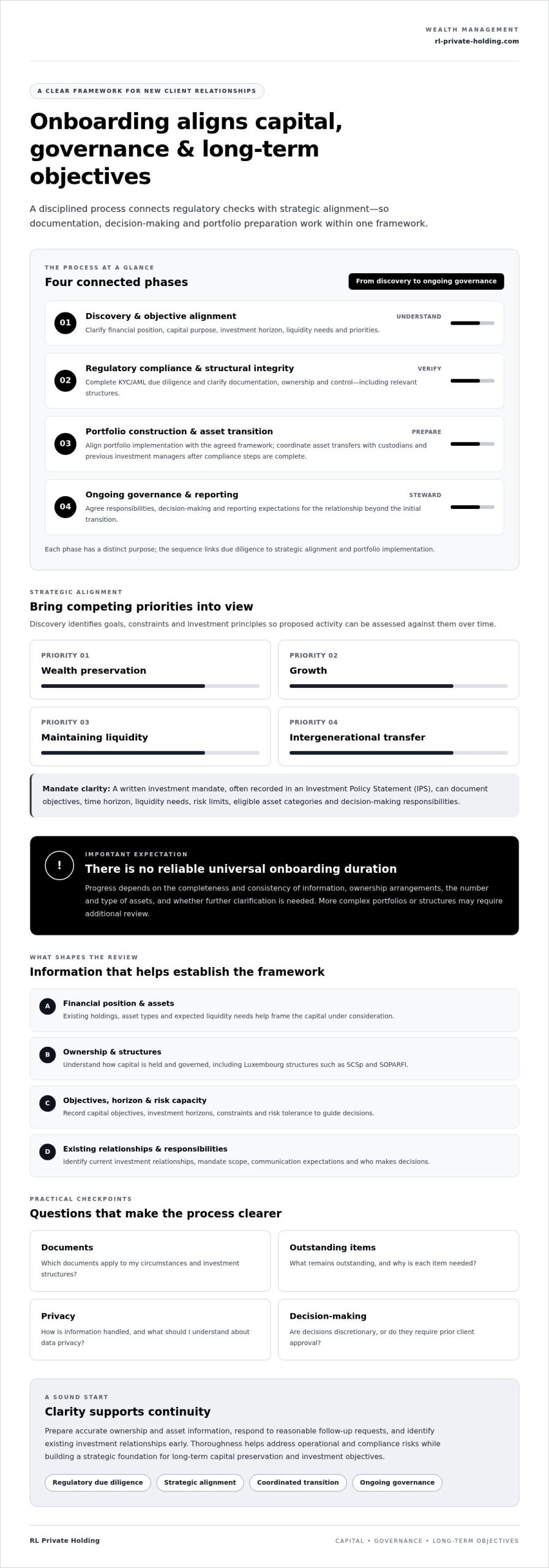
Onboarding is not just an administrative hurdle. It is the first test of whether capital, governance and long-term objectives are aligned. Investors are right to expect rigorous KYC/AML checks and discretion, yet unclear requirements and sequencing can delay progress before the relationship has a strategic foundation. A disciplined onboarding process for new wealth management clients brings these priorities into one framework.
In Luxembourg, international investors may use structures such as SCSp and SOPARFI. Their onboarding calls for careful attention to regulatory documentation, ownership and control, and investment objectives. This guide sets out the principal phases, from initial assessment and due diligence to mandate alignment and the transition of assets into a managed portfolio. It also explains what can affect progress, why documentation requests arise, and what to ask about data privacy and decision-making.
The aim is to replace uncertainty with a clear view of how onboarding supports long-term capital preservation and investment objectives. Each phase has a distinct purpose: confirming the relationship’s requirements, establishing strategic alignment and preparing for portfolio implementation with appropriate care.
Key Takeaways
- The onboarding process for new wealth management clients connects regulatory checks with strategic alignment, rather than treating documentation as a standalone task.
- Start by clarifying your financial position and long-term priorities, including wealth preservation and intergenerational objectives.
- Understand how KYC and AML reviews support due diligence, and confirm which documents apply to your circumstances and investment structures.
- Asset transitions require coordination with relevant custodians and previous investment managers once compliance steps are complete.
- Agree on governance and reporting expectations early so the relationship has a clear framework beyond the initial portfolio transition.
How the Onboarding Process for New Wealth Management Clients Works
The onboarding process for new wealth management clients is the transition from an initial conversation to an agreed investment framework. It connects an investor’s objectives with the documentation, controls and decision-making processes needed to manage capital. Unlike a retail banking sign-up, institutional onboarding involves a more detailed discussion of ownership, existing structures, investment horizons and risk capacity. Digital tools can support document handling, but they cannot replace analysis of complex objectives.
At this stage, both parties establish the basis for the relationship: the scope of the mandate, responsibilities, communication expectations and information needed to assess the proposed arrangement. A clear record of risk tolerance and capital objectives helps guide future decisions and reduces the chance that operational or compliance questions will undermine the strategy. The broader context of wealth management is useful here: it involves coordinating investment decisions around a client’s financial circumstances and aims, rather than treating each asset in isolation.
The Strategic Purpose of Professional Onboarding
Discovery establishes a baseline for alignment between the investor and the firm. The discussion should distinguish between goals that may compete, such as preserving capital, pursuing growth, maintaining liquidity and preparing for intergenerational transfer. It should also identify constraints and investment principles so that proposed activity can be assessed against them over time.
For investors with cross-border holdings or Luxembourg structures such as SCSp and SOPARFI, onboarding should account for how capital is held and governed. This helps shape an investment framework around the relevant structure instead of assuming that all assets are interchangeable. Investors comparing private wealth management firms in Luxembourg can use this stage to ask how each firm approaches strategic alignment, discretion and regulatory coordination.
What Affects the Onboarding Timeline
There is no reliable universal onboarding duration. The discovery and compliance phases depend on the completeness and consistency of the information supplied, the ownership arrangements involved, the number and type of assets, and whether further clarification is needed. More complex portfolios or structures may require additional review before the investment framework is ready to proceed.
Clients can help maintain momentum by preparing accurate ownership and asset information, responding promptly to reasonable follow-up requests, and identifying existing investment relationships early. Ask the firm to explain what remains outstanding and why each item is needed. This balances operational efficiency with the care required to establish a sound relationship. Thoroughness is not delay for its own sake; it helps address operational and compliance risks for both parties.
Phase 1: Discovery and Strategic Objective Alignment
The first phase establishes a reliable picture of the investor’s financial position and the purpose of the capital under consideration. An onboarding process for new wealth management clients should examine existing holdings, ownership arrangements, investment horizons and expected liquidity needs, not simply collect figures for a profile. For example, capital intended for a future transfer may have a different time horizon from assets that could be needed for near-term obligations.
Discovery also brings competing objectives into view. Wealth preservation, growth, liquidity and intergenerational transfer can coexist, but they may call for different investment decisions. Tax considerations and jurisdictional circumstances should be identified as constraints for appropriate professional review, rather than assumed or treated as investment objectives in themselves. Where assets sit within structures such as SCSp or SOPARFI, understanding their context helps frame how new capital may fit with existing arrangements.
Defining the Investment Mandate
A written investment mandate, often recorded in an Investment Policy Statement (IPS), can turn broad priorities into practical parameters. It may document objectives, time horizon, liquidity needs, risk limits, eligible asset categories and decision-making responsibilities. The investor and firm should also determine whether decisions are discretionary or require prior client approval. Clear boundaries reduce ambiguity when circumstances or markets change.
Performance benchmarks should reflect the mandate and the role of the portfolio, rather than rely on a single generic measure. For 2026, as in any review period, the relevant comparison depends on agreed objectives, asset mix and evaluation horizon. Investors considering private equity investment management should clarify how illiquidity, valuation practices and longer investment horizons will be considered in that framework.
Assessing Risk Capacity and Tolerance
Risk capacity and risk tolerance are related but distinct. Capacity concerns the investor’s financial ability to absorb potential losses, taking account of liquidity needs, liabilities and time horizon. Tolerance concerns the level of uncertainty the investor can accept without abandoning the agreed strategy. Discussing both is more informative than relying on a risk label alone.
Portfolio analysis can examine how different asset mixes may respond to adverse conditions, while discussion tests whether those outcomes are acceptable to the investor. This matters when considering alternative assets, including private equity and real estate, whose liquidity and valuation characteristics may differ from more readily traded holdings. The objective is not to promise a particular return, but to check that the desired objectives and accepted risks are coherent.
Investors can review RL Private Holding’s wealth management approach as they consider how their objectives and investment structures may fit within a disciplined mandate.
Phase 2: Regulatory Compliance and Structural Integrity
Once investment objectives are established, due diligence tests whether the proposed relationship and its ownership arrangements can be properly understood. KYC and AML reviews are central to the onboarding process for new wealth management clients, but they are more than administrative checks. They help establish who controls the assets, where they originated and whether the intended investment structure is coherent. In Luxembourg, requirements depend on the relevant entities, investor profile and applicable rules, so confirm the documents required for each case rather than assuming the list is identical for every client.
Source of Wealth (SoW) describes how an investor accumulated wealth over time, while Source of Funds (SoF) concerns the origin of assets involved in a particular transaction or relationship. Supporting information allows a firm to assess whether the financial background and proposed funding are consistent with the investor’s profile. Clear explanations and traceable records can reduce follow-up requests and help address compliance and reputational risks.
Documentation for Institutional Investors
For a corporate investor, due diligence may involve identifying the Ultimate Beneficial Owners (UBOs) and understanding the chain of ownership and control. Depending on the structure and circumstances, a firm may also request corporate records, financial statements, evidence supporting SoW and SoF, or tax residency information. Do not assume that audited statements or tax residency certifications are universal requirements. Ask which documents apply to the specific arrangement.
Documentation for structures such as SCSp or SOPARFI should be considered in context. Confirm current requirements with the firm and, where appropriate, relevant legal or tax professionals. A guide to Luxembourg investment structures can help frame questions about how an entity’s ownership and purpose relate to the proposed investment relationship.
Independent Review and Ongoing Monitoring
Compliance review provides a check of information supplied during onboarding. A compliance officer or designated review function may assess whether records are complete, consistent and sufficient for due diligence, and may request clarification where gaps remain. Exact responsibilities and procedures vary by firm and applicable requirements.
Review does not necessarily end when a mandate is established. Firms may have ongoing monitoring procedures to address relevant changes in ownership, investor circumstances or transaction activity. Ask how documents are submitted, who can access sensitive information, how updates are handled and what may prompt a request for further evidence. For current 2026 Luxembourg AML/KYC documentation requirements, verify the applicable list directly with the firm instead of relying on a generic checklist.
Phase 3: Portfolio Construction and Asset Transition
With due diligence complete, attention shifts from validating the relationship to implementing the agreed investment mandate. The Investment Policy Statement provides a reference point for initial asset allocation, including target exposures, liquidity parameters and agreed limits. This phase involves more than transferring account data: assets must be mapped to the intended portfolio, and differences between existing holdings and the approved strategy should be identified before action is taken.
Transition planning matters when capital spans multiple asset classes or jurisdictions. Coordination with relevant custodians and previous investment managers can clarify transfer instructions, outstanding transactions and the treatment of assets that may not be readily transferable. The approach should reflect the client’s objectives and the characteristics of each holding, not a preference for speed alone.
Executing the Allocation
A portfolio may use a core allocation to establish broad exposure alongside satellite positions intended to reflect more specific objectives. Whether this structure is appropriate depends on the mandate, risk capacity and liquidity needs established during discovery. Any allocation to private equity, venture capital or real estate should be assessed within the full portfolio context, including investment horizon, concentration and the terms of the relevant investment vehicle.
For a substantial cash position, the client and investment team may consider whether to deploy capital at once or in stages. Phased entry can be discussed as a way to manage timing considerations, but it does not eliminate market risk or ensure a better outcome. Investors exploring family office investment strategies in Luxembourg can use the mandate to assess how private equity and other exposures fit with existing holdings and long-term priorities.
Managing Asset Migration
Transfer mechanics vary by asset. Cash positions generally follow different instructions from in-specie holdings, where eligible assets move without being sold first. Confirm which holdings can transfer, whether any require separate processing, and how pending transactions or unavailable assets will be handled. Cross-border transfers may also involve coordination among multiple custodians and careful verification of account details.
Tax consequences depend on the investor’s circumstances, asset type and jurisdictions involved. A portfolio transition should not be assumed to be tax-efficient. Identify potential tax considerations before assets are sold, transferred or restructured, and consult qualified tax advisers where appropriate. Clear records of transferred positions and agreed allocation decisions also support later reconciliation and reporting.
To discuss how portfolio construction relates to wealth management objectives, explore RL Private Holding’s wealth management services.
Phase 4: Ongoing Governance and Reporting Integration
Onboarding moves into active management when the parties establish how decisions will be reviewed, communicated and recorded. Agree on reporting arrangements and governance at the outset of this phase, including who receives information, how often it is provided, and how questions or material changes are handled. For clients with holdings across private equity, real estate and other asset classes, a clear reporting framework can connect portfolio information to the objectives in the investment mandate.
Clients should also understand how the firm shares sensitive information. Ask how access is controlled, how information is protected and what procedures apply if account details or authorized contacts change. These are practical questions to raise when discussing reporting arrangements. Do not assume a particular platform or security feature is in place without confirming it.
Reporting and Governance Standards
Useful reporting should make performance and portfolio composition understandable across relevant asset classes, while explaining the basis and limitations of the information presented. For a multi-jurisdictional portfolio, ask whether data from different holdings can be consolidated, which items remain separate and how differences in valuation timing are handled. Consolidation can aid oversight, but it does not remove the need to understand the underlying investments.
Transparency also includes the financial terms of the relationship. Clients should be able to identify applicable fees and transaction costs, understand how they are calculated, and know where those details appear in reporting or account documentation. Agreeing on these expectations early can make subsequent reviews more focused and reduce ambiguity.
The Annual Strategic Review
A scheduled annual review provides a formal opportunity to assess whether the portfolio remains consistent with the client’s circumstances and long-term objectives. The discussion can consider changes in liquidity needs, investment horizon, ownership arrangements or risk capacity, alongside relevant market developments. An annual meeting should complement, not replace, communication about material changes that arise between reviews.
If objectives or circumstances have shifted, the investor and firm can determine whether the Investment Policy Statement, risk profile or allocation parameters need updating. Document any changes, including the rationale and agreed actions. The purpose is not to react automatically to short-term market movements, but to test whether the strategy remains coherent with the client’s priorities and capital preservation goals.
This governance stage completes the onboarding process for new wealth management clients by establishing a continuing cycle of review, reporting and accountable decision-making. The relationship has moved beyond setup, but alignment remains an ongoing responsibility shared by the investor and the firm.
Build a Durable Framework for Long-Term Capital
A disciplined onboarding process for new wealth management clients connects clear investment objectives with careful due diligence, considered asset transition and continuing governance. Its value lies not only in establishing a portfolio, but in creating a framework that can be reviewed as circumstances and priorities evolve.
For investors with complex holdings, early alignment matters. A well-defined mandate clarifies how capital should be managed, while structured reporting and regular reviews help keep decisions accountable to long-term goals. Familiarity with investment vehicles such as SCSp and SOPARFI can also inform how institutional capital is organized and assessed.
RL Private Holding provides wealth management and private equity services to institutional and private investors, alongside venture capital funding and real estate asset management. To discuss your objectives and investment management needs, contact RL Private Holding.
Frequently Asked Questions
How long does the onboarding process typically take for institutional clients in Luxembourg?
There is no standard timeline for institutional onboarding in Luxembourg. The onboarding process for new wealth management clients depends on factors such as ownership complexity, the completeness of documentation, the number and type of assets, and whether additional due diligence is needed. Ask the firm to outline its stages, identify outstanding items and explain what may affect progress. A document checklist can help reduce avoidable follow-up.
What specific documents are required for KYC compliance in 2026?
The documents required depend on the investor, ownership structure and circumstances, so a generic checklist cannot confirm every case. A firm may request identity and address evidence, corporate formation and ownership records, details of ultimate beneficial owners, information supporting Source of Wealth and Source of Funds, and tax residency information. Financial statements may also be relevant. Confirm the current 2026 document list directly with the firm and ask whether each item must be certified or updated.
Can I transition existing private equity holdings into a new wealth management structure?
Possibly, but a holding’s transferability must be assessed individually. Review the investment documents and ask whether the relevant fund or entity permits a transfer, whether approvals are needed, and how valuation, ownership and reporting would be handled. Some holdings may not be transferable or may require a different process from cash or listed assets. Discuss potential tax and legal implications with qualified advisers before agreeing to a transition plan.
How does the onboarding process differ for a family office versus a private individual?
Family office onboarding may involve more parties, entities and decision-making arrangements than an individual relationship. The firm may need to understand ownership and control across structures, identify authorized representatives, and clarify how investment decisions and reporting are coordinated. An individual’s review centers more directly on personal financial circumstances, objectives and asset ownership. The precise documentation and governance depend on the structure, mandate and applicable due diligence requirements.
What measures are in place to ensure data privacy during the onboarding phase?
Data privacy arrangements vary by firm, so ask how sensitive records are submitted, stored and accessed, and who is authorized to review them. It is also useful to ask how the firm handles document retention, secure communications, access changes and suspected data incidents. Before sending financial or identity records, confirm the correct submission channel with the firm. These questions help clarify how discretion is maintained throughout due diligence.
Is there a minimum asset threshold required for the institutional onboarding process?
Minimum asset thresholds can depend on the proposed relationship, investment structure and mandate. Ask the firm directly whether a minimum applies to your circumstances. Do not rely on thresholds associated with unrelated investor classifications or other jurisdictions as evidence of a firm’s onboarding criteria.
How often are strategic objectives reviewed after the initial onboarding is complete?
Strategic objectives should be reviewed on an agreed schedule and when material changes in circumstances make a review appropriate. An annual strategic review can provide a formal point to reassess objectives, risk capacity, liquidity needs and the Investment Policy Statement. The agreed cadence may vary by mandate. Confirm how reviews are scheduled and how changes to objectives or portfolio parameters are documented between formal review meetings.