

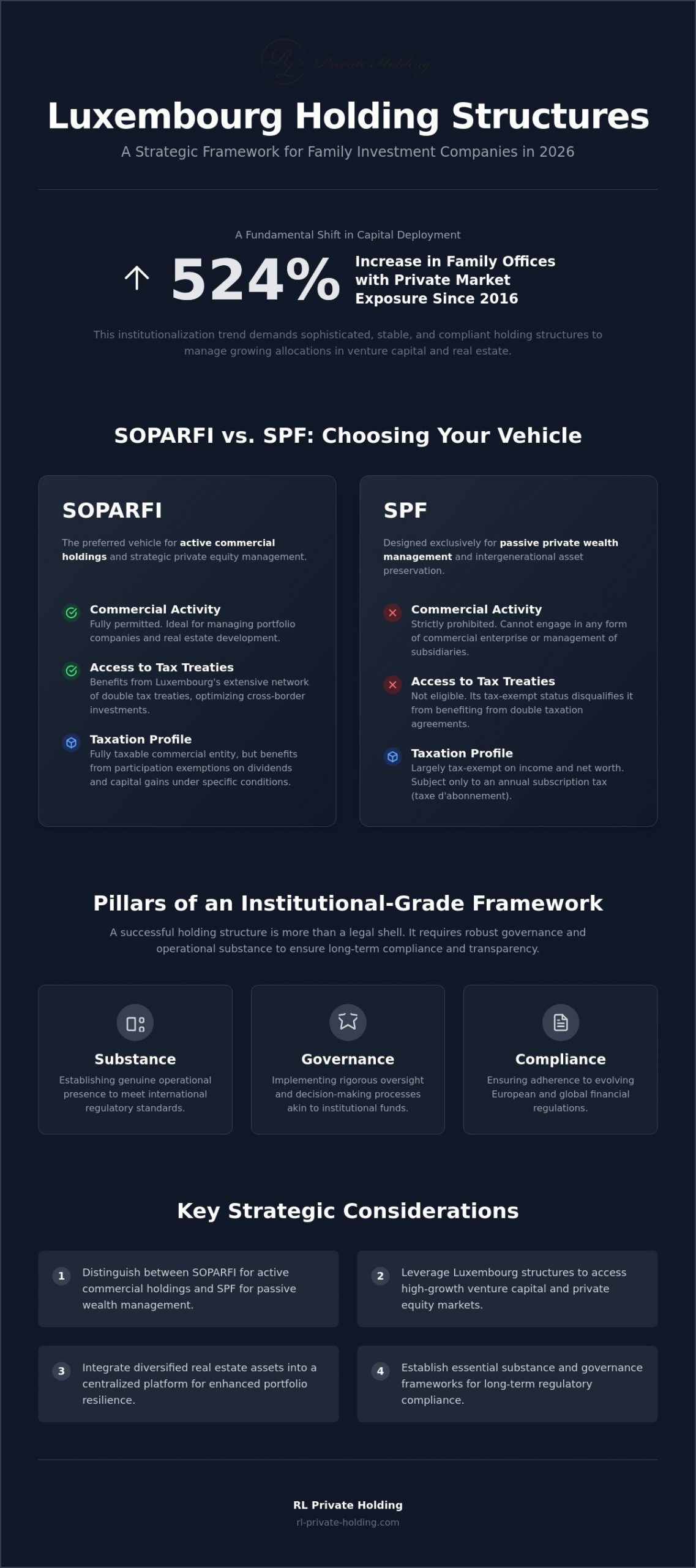
The number of family offices with exposure to private markets has increased by 524% since 2016, a statistic that underscores a fundamental shift in how sophisticated capital is deployed globally. As private portfolios move toward higher allocations in venture capital and real estate, the selection of a centralized holding platform becomes a critical decision for wealth preservation. Utilizing a family investment company Luxembourg offers an institutional-grade framework that addresses the need for both structural stability and regulatory compliance. This vehicle has evolved into a strategic necessity for those seeking to manage global assets within a transparent and highly professionalized jurisdiction.
Balancing the requirements for operational substance with the need for fiscal efficiency remains a primary concern for many principals and their advisors. You understand that a successful investment vehicle must provide more than just a legal shell; it must facilitate access to European co-investment opportunities while maintaining rigorous governance standards. This article provides a technical analysis of Luxembourg holding structures and strategic asset allocation for 2026. We examine the specific advantages of the SOPARFI and SPF frameworks, offering a clear overview of how to build a stable, tax-efficient platform for intergenerational wealth management.
Key Takeaways
- Understand the technical distinctions between SOPARFI and SPF structures to determine the most effective vehicle for active commercial holdings versus passive wealth management.
- Learn how to leverage a family investment company Luxembourg to access high-growth venture capital and private equity markets while maintaining institutional-grade oversight.
- Identify the essential substance requirements and governance frameworks necessary to ensure long-term regulatory compliance and operational transparency in the European landscape.
- Discover methods for integrating diversified real estate asset management into a centralized holding platform to enhance portfolio resilience and intergenerational stability.
- Analyze the role of carried interest and performance-based incentives in aligning the interests of family offices with professional investment management platforms.
The Evolution of the Family Investment Company in Luxembourg
The landscape of private capital has undergone a significant transformation. Historically, private wealth structures focused primarily on asset protection and passive inheritance planning. By 2026, the model has matured into a sophisticated institutional framework. A family investment company Luxembourg now functions as a centralized engine for strategic capital deployment, moving beyond simple preservation to engage actively in global private markets. This evolution reflects a broader trend where ultra-high-net-worth individuals seek the same operational rigor found in major institutional funds. It’s no longer sufficient to hold assets; they must be managed with professional discipline.
Defining the Institutional Holding Framework
A holding company serves as the structural foundation for managing diverse asset classes and subsidiary interests. Unlike traditional wealth management, which often relies on third-party discretionary mandates, the disciplined holding model provides direct control over investment decisions and operational substance. The Economy of Luxembourg underpins this model by providing a stable, highly regulated environment that offers legal certainty superior to many other global financial centers. While some jurisdictions prioritize secrecy, Luxembourg emphasizes transparency and compliance, aligning with modern international standards. A modern family investment company is a specialized corporate vehicle designed for the systematic allocation of capital across diverse global sectors.
The 2026 Landscape for Private Wealth Structures
Institutionalization is the defining characteristic of the current market. Family offices are increasingly adopting the standards of professional private equity firms, requiring structures that can facilitate complex transactions. Luxembourg’s “AA+” credit rating and its position as a founding member of the European Union provide a secure base for long-term holding. This stability is essential for portfolios with significant exposure to illiquid assets like venture capital and real estate.
Investors are moving away from the passive SPF model toward more flexible vehicles like the SOPARFI. While the SPF is suitable for private wealth management, it cannot engage in commercial activities or benefit from double tax treaties. The SOPARFI, by contrast, allows for active participation in the management of portfolio companies, a necessity in a high-stakes investment environment. For a detailed look at these transitions, practitioners should consult the Family Office Investment Strategies in Luxembourg. The professionalization of these structures ensures that governance remains robust across generations, providing a clear distinction between standard wealth management and a disciplined, institutional-grade family investment company Luxembourg.
Luxembourg Holding Structures: SOPARFI vs SPF in 2026
Selecting the optimal legal form is the most consequential decision when establishing a family investment company Luxembourg. In 2026, the regulatory environment demands a clear distinction between active commercial operations and passive wealth holding. While the Special Limited Partnership (SCSp) has gained significant traction for its tax transparency and contractual flexibility in private equity, the SOPARFI and SPF remain the primary pillars of Luxembourg’s wealth management ecosystem. Each structure serves a distinct strategic purpose, requiring careful alignment with the family’s long-term objectives.
The SOPARFI: Flexibility for Active Private Equity
The SOPARFI (Société de participations financières) is a fully taxable commercial company that offers extensive flexibility for active investors. It’s the preferred vehicle for managing private equity investment management mandates and complex real estate portfolios. Its primary advantage lies in the participation exemption regime. Under this framework, dividends and capital gains are 100% exempt from corporate income tax, provided the SOPARFI holds at least 10% of the subsidiary or a participation with an acquisition cost of at least €1.2 million for a minimum of 12 months. This allows for the efficient recycling of capital into new venture capital funding opportunities. However, as a fully taxable entity, it’s subject to an aggregate corporate tax rate of approximately 24.94% on non-exempt income and a net wealth tax of 0.5% on its net assets.
The SPF: A Dedicated Wealth Preservation Vehicle
For families focused on passive asset management, the SPF (Société de gestion de patrimoine familial) provides a streamlined alternative. It’s strictly reserved for private individuals, family entities, or fiduciary structures. The SPF is exempt from corporate income tax, municipal business tax, and net wealth tax. Instead, it’s subject to an annual subscription tax of 0.25% on its share capital and debts, capped at €125,000 per year. The trade-off for this simplicity is a strict prohibition on commercial activity. An SPF can’t grant interest-bearing loans to its subsidiaries or engage in the active management of portfolio companies. This makes it an ideal vehicle for holding diversified portfolios of liquid securities and passive real estate interests without the administrative complexity of a commercial entity.
Success in 2026 requires more than just selecting the right acronym. Substance requirements have intensified, making local management a necessity for tax residency. To benefit from Luxembourg’s extensive treaty network, a family investment company Luxembourg must demonstrate genuine economic activity. This includes maintaining physical office space, employing qualified local staff, and ensuring that strategic board meetings occur within the jurisdiction. Professional wealth management services can provide the institutional oversight required to navigate these substance rules while maintaining operational efficiency. Disciplined governance ensures these structures remain resilient against shifting international tax standards.
Strategic Asset Allocation: Venture Capital and Private Equity
The transition from legal structuring to active capital deployment defines the modern family investment company Luxembourg. In 2026, the primary objective of these entities has shifted toward capturing premium returns through private market participation. While the legal framework provides the necessary shell, the strategic allocation of assets drives long-term value. Data indicates that private equity and venture capital allocations in family office portfolios now frequently range from 10% to 25%, reflecting a disciplined move away from traditional public equities. This institutional approach requires a robust understanding of both growth-stage technology and tangible real estate assets.
Venture Capital and Technology Growth
Luxembourg has solidified its position as a central hub for European tech innovation, offering a sophisticated environment for venture capital in Luxembourg. Growth-stage technology investments provide a unique opportunity for portfolio diversification, particularly in sectors like fintech and green infrastructure. Identifying high-potential venture exits requires more than just capital; it demands deep sector expertise and a disciplined evaluation of scalability. By utilizing a centralized holding company, investors can participate in early-stage funding rounds while maintaining the structural integrity required for institutional-grade oversight.
Institutional Real Estate and Private Equity
Building a resilient portfolio necessitates the integration of real estate asset management in Luxembourg within the broader holding structure. Real estate serves as a stabilizer, providing tangible value and predictable cash flows that balance the higher volatility of venture investments. Within the legal framework for single family offices, private equity acts as a primary driver for value creation. This process involves more than simple acquisition. It’s about operational improvement and strategic repositioning of portfolio companies to ensure intergenerational wealth growth. A disciplined investment partner focuses on these operational levers to enhance the performance of underlying assets.
Managing liquidity and exit strategies is particularly vital in the high-interest-rate environment of 2026. The cost of capital remains elevated, making the timing of divestments a critical component of portfolio management. A family investment company Luxembourg must maintain a careful balance between illiquid private assets and liquid treasury management. This ensures that the entity can meet operational obligations while remaining agile enough to capitalize on distressed opportunities or secondary market transactions. Professional governance frameworks provide the necessary oversight to navigate these complex liquidity requirements without compromising the firm’s long-term strategic focus.
Governance, Fees, and Institutional Discipline
Institutional discipline distinguishes a professionalized family investment company Luxembourg from a simple private holding. In 2026, the complexity of global markets requires that private structures adopt the same rigorous financial governance found in the world’s leading asset management firms. This transition involves more than just a change in terminology; it necessitates a fundamental shift in how fees are structured, how risks are mitigated, and how decisions are documented. A well-ordered entity relies on a clear hierarchy of governance that prioritizes long-term stability over short-term opportunistic gains.
The Economics of Private Holding Management
The economics of private holding management are built on a foundation of performance and operational sustainability. While variations exist, many structures utilize a framework similar to the institutional 2/20 model. Assets under management (AUM) fees are essential for supporting the operational overhead of the entity, ensuring that the company maintains the necessary substance and professional staff required by Luxembourg law. These fees cover the costs of maintaining a physical office and the specialized expertise needed for global asset selection. Carried interest incentivizes superior performance by ensuring that the management team participates in the realized gains of private equity exits. This alignment of interests is crucial for maintaining a focus on high-quality value creation across the entire portfolio.
Risk Management and Regulatory Compliance
Compliance with European regulations, particularly the Alternative Investment Fund Managers Directive (AIFMD), has become a cornerstone of risk management. Even for structures that operate below specific regulatory thresholds, adopting these standards provides a layer of protection against jurisdictional risk and market volatility. Best practices for reporting and auditing must be integrated into the daily operations of the company. A disciplined governance framework ensures that every transaction is backed by a robust due diligence protocol, evaluating legal, financial, and operational risks before capital is committed. This level of institutional rigor is what allows a private structure to navigate the complexities of international finance with confidence.
Transparent reporting remains the most effective way to address concerns regarding regulatory scrutiny. By maintaining clear records and rigorous internal controls, a family investment company Luxembourg can demonstrate its commitment to international standards while preserving the necessary level of discretion for its principals. Implementing these standards ensures that the private nature of the structure does not compromise its regulatory standing or its ability to operate across borders. For those requiring institutional-grade oversight, wealth management services provide the professional framework needed to manage these complex economic and regulatory demands effectively.
RL Private Holding: A Disciplined Global Investment Partner
RL Private Holding functions as a centralized platform for sophisticated capital, bridging the gap between private family interests and the professional investment landscape. By establishing a family investment company Luxembourg, the firm provides a stable foundation for managing diversified global interests with institutional precision. The organizational framework is designed to support the complex requirements of multi-sector asset management while maintaining the discretion expected by high-net-worth principals. This structural approach ensures that the entity remains resilient across various market cycles, providing a steady hand in the background of major global allocations.
A Diversified Global Portfolio
The firm’s strategic focus is concentrated on sectors where operational expertise drives significant value. This includes Venture Capital Funding for growth-stage technology, Private Equity Investment Management for mature enterprises, and Real Estate Asset Management for tangible portfolio stability. From its base in Luxembourg, RL Private Holding manages assets on a global scale, utilizing the jurisdiction’s robust legal framework to facilitate complex cross-border transactions. The investment philosophy is rooted in a long-term perspective; the firm prioritizes structural integrity and sustainable growth over speculative returns. This methodical approach ensures that each portfolio company benefits from a disciplined oversight model that emphasizes operational excellence and institutional-grade due diligence.
Engagement and Strategic Partnership
Institutional partners seeking a reliable collaborator in the global financial landscape find a disciplined partner in RL Private Holding. The engagement process is characterized by transparency and a shared commitment to professional governance. Wealth Management Services provided by the firm focus on the structural health of the investment vehicle, ensuring that substance requirements and regulatory standards are consistently met. This quiet authority allows the firm to maintain an established presence in the global financial landscape without the need for aggressive self-promotion. By prioritizing long-term thinking and professional distance, the firm appeals to those who value stability and a well-ordered organizational framework.
To explore institutional investment management solutions and learn more about the firm’s strategic focus on technology, real estate, and private equity, visit RL Private Holding. The firm’s commitment to institutional professionalism ensures that every family investment company Luxembourg under its oversight operates with the highest level of internal discipline and strategic focus.
Securing Institutional Stability for the Next Generation
The transition toward more professionalized wealth structures reflects a broader institutionalization of private capital. Navigating the 2026 landscape requires a clear understanding of whether a SOPARFI or SPF best aligns with a family’s operational goals and asset diversity. By prioritizing substance and rigorous governance, a family investment company Luxembourg serves as a resilient platform for managing global interests within a secure, AA+ rated jurisdiction. This structural integrity ensures that portfolios remain capable of capturing premium returns in private markets while maintaining compliance with shifting European regulations.
RL Private Holding provides the disciplined oversight necessary for such complex structures. As a privately held holding company headquartered in the premier Luxembourg financial center, the firm offers specialized expertise in Venture Capital and Private Equity across a global portfolio. This institutional-grade approach bridges the gap between private family interests and professional investment platforms. We invite you to Explore Strategic Investment Management at RL Private Holding to learn how a structured approach can preserve and grow capital for decades to come. Establishing a firm foundation today provides the clarity required for long-term strategic success.
Frequently Asked Questions
What is the main difference between an SPF and a SOPARFI in Luxembourg?
The primary distinction lies in their operational scope and tax treatment. A SOPARFI is a fully taxable commercial company that can engage in active investment management and benefit from double tax treaties. Conversely, an SPF is a tax-exempt vehicle restricted to passive wealth management for private individuals and families, prohibiting any commercial activity or access to tax treaties.
How does a Luxembourg family investment company achieve tax efficiency?
Efficiency is primarily realized through the participation exemption regime for SOPARFIs, which allows for a 100% exemption on qualifying dividends and capital gains. For an SPF, efficiency is derived from its exemption from corporate income and net wealth taxes, replaced by a 0.25% annual subscription tax. These frameworks allow a family investment company Luxembourg to recycle capital with minimal fiscal friction.
Is a Luxembourg holding company regulated by the CSSF?
Standard holding companies like the SOPARFI or SPF are generally unregulated and don’t require authorization from the Commission de Surveillance du Secteur Financier (CSSF). However, if the vehicle is structured as a specialized investment fund or if its manager falls under the AIFM Directive, certain reporting and oversight requirements will apply. Most private family structures operate as unregulated entities to maintain operational flexibility.
What are the substance requirements for a Luxembourg investment company in 2026?
Substance requirements necessitate that the company demonstrates a genuine economic presence within the jurisdiction. This includes maintaining a physical office, employing qualified local personnel, and ensuring that strategic decisions are made during board meetings held in Luxembourg. These measures are essential to ensure the company is recognized as a tax resident and can benefit from the extensive European treaty network.
How is carried interest typically structured in a Luxembourg private equity vehicle?
As of January 2026, carried interest is categorized as either Contractual Carry or Participation Carry for tax purposes. Contractual carry is taxed at a reduced rate of approximately 11.5%, while participation carry may be fully exempt if specific holding periods and capital thresholds are met. This regime aligns the interests of investment professionals with the long-term performance of the holding company.
Can a family investment company hold real estate assets directly?
Direct ownership of real estate is legally permissible, though sophisticated structures often utilize specialized subsidiaries to isolate liabilities. Holding real estate through a family investment company Luxembourg allows for centralized management and can facilitate more efficient intergenerational transfers. Many principals prefer using a SOPARFI for active real estate development or an SPF for holding passive, long-term rental properties.
What are the typical investment management fees for a Luxembourg holding structure?
Fees are generally structured to cover operational overhead and incentivize performance, often following institutional frameworks such as the 2/20 model. This includes a base management fee calculated on assets under management and a performance fee based on realized gains. These structures ensure that the management team is appropriately resourced to conduct deep due diligence and maintain the entity’s regulatory standing.
Why is Luxembourg considered a preferred jurisdiction for venture capital funds?
The jurisdiction offers an unparalleled combination of political stability, an AA+ credit rating, and flexible legal structures like the Special Limited Partnership (SCSp). These features allow venture capital funds to operate with high levels of contractual freedom while benefiting from the European Union’s passporting rights. Luxembourg’s ecosystem provides immediate access to specialized service providers and a transparent regulatory environment conducive to technology and innovation growth.