

A multi-million euro venture capital agreement is rarely a simple transaction; it is a complex architectural blueprint that dictates the long-term governance and economic waterfall of a growth-stage enterprise. For many principals in the Luxembourg financial sector, the transition from a preliminary handshake to a definitive agreement reveals a landscape of intricate legal provisions that carry significant weight for future liquidity events. Institutional investors and founders alike often recognize that understanding venture capital term sheets is a prerequisite for protecting equity and ensuring that the true balance of power is maintained.
Misinterpreting a single clause regarding liquidation preferences or participation rights can lead to unexpected dilution or a misalignment of interests during subsequent funding rounds. It’s vital for stakeholders to approach these negotiations with a clear methodology that prioritizes long-term stability and professional distance. Without a disciplined framework, the original vision for the entity risks being overshadowed by the complexity of institutional requirements.
This analysis provides a sophisticated framework for evaluating the economic and control provisions that define growth-stage venture capital agreements. We will examine how governance structures shift after a capital injection and provide insights into maintaining strategic alignment between the investment holding company and the portfolio entity. Readers will gain a clear perspective on managing the technical nuances of these agreements with institutional precision.
Key Takeaways
- Distinguish between binding and non-binding provisions to establish a clear architectural blueprint for growth-stage investments.
- Analyze the mechanics of pre-money and post-money valuations to maintain precise control over the capital waterfall and founder equity.
- Evaluate the transition toward institutional governance through the strategic allocation of board seats and formal oversight structures.
- Coordinate unified exit strategies by leveraging drag-along and tag-along rights alongside right of first refusal (ROFR) mechanics.
- Prioritize long-term institutional alignment by understanding venture capital term sheets as strategic frameworks for partnership rather than simple economic transactions.
The Anatomy of a Venture Capital Term Sheet
The term sheet serves as the definitive architecture for a multi-million euro investment. It translates complex negotiations into a structured summary that dictates the future of the enterprise. Understanding venture capital term sheets requires a recognition that this document acts as a bridge. It connects the exhaustive due diligence phase with the final closing of the transaction. Institutional investors utilize this framework to establish stability and clarity before committing significant capital. This initial presentation reflects a firm’s institutional gravity. It signals a disciplined approach to asset management and a commitment to long-term value creation.
Binding vs. Non-Binding Clauses
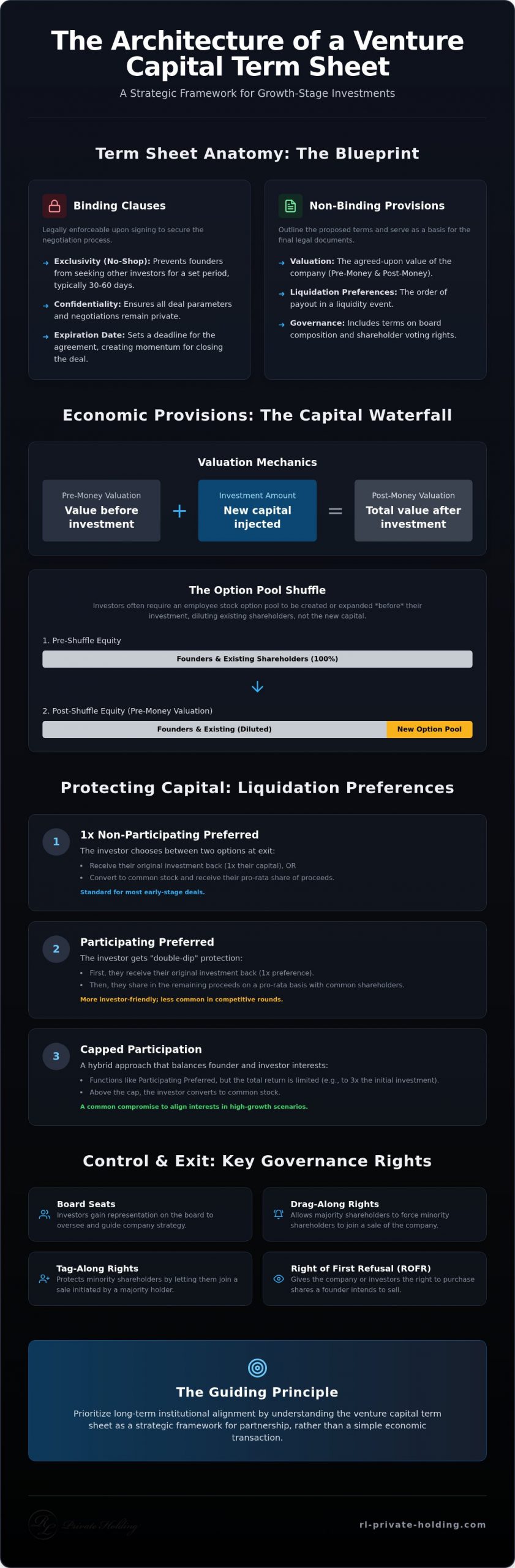
While the document outlines the economic waterfall, most of its contents are non-binding. This allows parties to refine technical details during the drafting of the final shareholders’ agreement. However, certain clauses are legally enforceable from the moment of signing. Exclusivity, often called the “no-shop” clause, prevents the founder from seeking alternative investors for a specific duration. It’s usually 30 to 60 days. Confidentiality ensures the deal’s parameters remain private. The strategic inclusion of an expiration date is also critical. It maintains momentum in a competitive funding environment. It ensures that both parties remain focused on a timely execution.
The Role of the Luxembourg Financial Framework
In the context of the Grand Duchy, term sheets must align with specific corporate structures. The Luxembourg special limited partnership (SCSp) is a frequent choice for venture capital funds due to its contractual flexibility. A term sheet for an SCSp or a SOPARFI must reflect local governance requirements and international regulatory standards. These documents are designed to meet the rigorous expectations of the Luxembourg financial ecosystem. They’re built to ensure that the investment entity operates within a recognized and stable legal environment. Aligning these objectives early in the process prevents friction during the transition to a fully operational holding structure. Understanding venture capital term sheets within this local framework is essential for maintaining compliance.
Economic Provisions: Valuation and the Capital Waterfall
Understanding venture capital term sheets requires a precise distinction between economic provisions, which dictate financial returns, and control provisions, which govern decision-making. The valuation of a growth-stage entity is the primary driver of the capital waterfall. Pre-money valuation represents the agreed value of the company before the investment, while post-money valuation includes the new capital injection. The effective ownership stake of an institutional investor is calculated by dividing the investment amount by the post-money valuation. This calculation determines the starting point for all future equity discussions.
A critical technical detail in these negotiations is the option pool shuffle. Investors typically require the creation or expansion of an employee option pool prior to the investment. This adjustment is usually factored into the pre-money valuation. It effectively dilutes the existing shareholders rather than the incoming investors. This mechanism ensures the company is capitalized to attract talent without impacting the institutional partner’s initial equity position. It’s a standard practice that preserves the value of the new capital entering the business.
Liquidation Preferences and Participation Rights
Liquidation preferences protect institutional capital by ensuring investors receive a specific return before common shareholders. A 1x non-participating preferred structure allows the investor to choose between their initial investment or their pro-rata share of the proceeds. Participating preferred stock allows the investor to receive their preference amount and then share in the remaining proceeds. Capped participation limits this upside in high-growth scenarios to maintain a fair distribution of wealth. These structures are essential for managing risk in multi-million euro deals within the Luxembourg financial ecosystem.
Anti-Dilution Mechanisms
Anti-dilution clauses protect the value of an investment during subsequent “down rounds” where the valuation decreases. Broad-based weighted average is a common standard. It adjusts the conversion price based on the size of the new round relative to the total capitalization. Full ratchet anti-dilution is more aggressive. It resets the conversion price to the lowest price offered in the new round regardless of the amount raised. Maintaining portfolio integrity requires a steady hand during these negotiations. Firms like RL Private Holding provide the private equity investment management expertise needed to align these technical mechanics with long-term strategic goals.
Control and Governance: Managing the Institutional Partnership
While economic provisions dictate the financial distribution of a deal, control provisions define the operational boundaries and decision-making hierarchy. Understanding venture capital term sheets involves recognizing that institutional investment introduces a formal governance layer that fundamentally alters the founder’s relationship with the entity. This shift moves the organization from a founder-led management style to a more structured system of institutional board oversight. It’s a necessary evolution for any growth-stage firm that seeks to maintain stability while scaling within a global financial ecosystem. A well-constructed governance framework ensures that the interests of all stakeholders remain aligned through various market cycles.
Board Composition and Observer Rights
The allocation of board seats is a critical component of the term sheet negotiation. Seats are typically categorized into common, preferred, and independent designations. Founders usually retain the common seats, while institutional investors secure preferred seats to ensure their capital is represented at the highest level of decision-making. An independent seat is frequently added to provide a balanced, objective perspective on the board. The lead investor often plays a proactive role in shaping the strategic direction of the board, offering a steady hand in the background. It’s common for investors to also request observer rights. These allow non-voting representatives to attend meetings and receive information, ensuring a high degree of transparency and reporting frequency. Institutional partners often require quarterly financial reviews and annual audits to maintain a clear overview of the portfolio entity’s health.
Veto Rights and Protective Provisions
Protective provisions act as a set of veto rights that require the explicit consent of preferred shareholders for specific, high-impact corporate actions. These provisions are designed to protect the institutional investor’s stake from being undermined by unilateral decisions. Critical matters that typically require approval include mergers and acquisitions (M&A), the issuance of new debt, or changes to the company’s certificate of incorporation. It’s also standard for investors to have a say in the creation of new classes of shares that might rank senior to their current position. The objective is to strike a balance between operational autonomy for the founders and institutional risk management for the investors. Drafting these provisions requires precision to ensure they facilitate growth rather than creating operational bottlenecks. When these rights are aligned with venture capital Luxembourg standards, they provide a reliable framework for managing complex, multi-million euro investments. Understanding venture capital term sheets through this lens allows founders to anticipate the requirements of institutional discipline.
Operational and Legal Mechanics of the Agreement
The technical execution of a deal extends beyond valuation and board seats. It involves the specific legal mechanics that dictate how shares are traded and how the eventual exit is orchestrated. Understanding venture capital term sheets requires a granular look at the provisions that maintain liquidity and protect the long-term interests of the holding company. These clauses ensure the investment remains professional and predictable, even as the company moves through various stages of growth. Institutional investors rely on these mechanics to provide a steady hand in the background of major strategic shifts.
Exit Alignment: Drag-Along and Tag-Along Rights
Drag-along rights are essential for facilitating a clean exit. They empower a defined majority of shareholders to compel the minority to participate in a company sale. This prevents a single minority holder from obstructing a multi-million euro strategic acquisition that benefits the broader group. Conversely, tag-along rights protect minority shareholders by allowing them to join a sale initiated by a majority holder on the same terms. These provisions ensure that founders and investors exit the entity together, maintaining a unified front. This level of coordination is a cornerstone of private equity investment management. It ensures that the exit strategy remains aligned with the firm’s overarching portfolio objectives.
Information and Inspection Rights
Institutional gravity demands a high level of transparency. Information rights grant investors access to the company’s books and records, including quarterly management reports and audited annual financial statements. For growth-stage technology firms in the Luxembourg financial hub, maintaining institutional-grade governance is not optional. It’s a requirement for future funding and eventual public offerings. Standardizing data delivery ensures that the holding company can monitor performance with precision. These rights often include the ability to visit the company’s facilities and discuss its affairs with senior management, providing the oversight necessary for disciplined asset management.
Secondary market transactions are governed by the Right of First Refusal (ROFR) and co-sale rights. A ROFR gives the company or its investors the option to purchase shares before they’re sold to an outside party. Co-sale rights allow investors to sell a portion of their own shares alongside a founder’s sale. Registration rights further prepare the company for liquidity by dictating the process for a potential public offering. These rights allow investors to require the company to register shares for sale on a public exchange. This structured path toward an IPO or a major sale is vital for understanding venture capital term sheets in a professional context.
Managing these complex legal requirements is a core competency for firms focused on long-term stability. If you’re seeking a disciplined partner to oversee your growth-stage assets, explore our private equity investment management services to ensure your portfolio remains strategically aligned.
Strategic Negotiation: The RL Private Holding Perspective
Negotiation should not be viewed as a zero-sum game where one party’s gain is another’s loss. Instead, it’s a strategic exercise in establishing institutional stability and long-term alignment. Understanding venture capital term sheets requires a shift in perspective. The goal is to create a framework that supports the entity through multiple growth phases. At RL Private Holding, we prioritize the integrity of the partnership over short-term economic advantages. We design deal structures that ensure the portfolio company is capitalized for success while maintaining the discipline required by global financial standards. Finalizing the agreement marks the transition from a preliminary understanding to a definitive purchase agreement. This process demands precision and a steady hand to ensure every provision reflects the shared vision of the stakeholders.
The Value of Sophisticated Partnership
A sophisticated partnership offers more than just capital; it provides access to a global financial ecosystem. Leveraging Luxembourg’s position as a premier financial hub allows growth-stage firms to navigate international expansion with confidence. The institutional gravity of an established holding company acts as a stabilizing force, especially in volatile markets. We operate as a discreet expert in the background, ensuring that the organizational hierarchy and governance structures remain robust. This professional distance allows founders to focus on operational excellence while we manage the complexities of the investment structure. It’s about building an environment where growth is both sustainable and measurable. Understanding venture capital term sheets within this broader context helps stakeholders appreciate the value of institutional permanence.
Next Steps in the Investment Lifecycle
Once the term sheet is signed, the process moves into the confirmatory due diligence phase. This stage involves a deep dive into the company’s financials, legal standing, and operational health to verify the assumptions made during the initial talks. The timeline for moving from a signed term sheet to a definitive closing typically spans several weeks. It’s a period of intense focus where the technical details of the shareholders’ agreement are refined. If you’re looking for a disciplined partner to support your growth-stage venture, we invite you to reach out for a professional inquiry. Our team specializes in providing the structural framework and venture capital funding necessary for global scale. This transition is a critical milestone in a long-term journey of strategic value creation.
Advancing Strategic Alignment in Growth-Stage Investment
Mastering the technical complexities of venture capital documentation is essential for maintaining the long-term integrity of a growth-stage enterprise. As examined in this framework, the term sheet is far more than a preliminary agreement; it’s a strategic blueprint that defines the economic waterfall and governance structures of the partnership. By prioritizing institutional discipline and professional distance over short-term gains, both founders and investors ensure that the organization remains resilient through various market cycles. It’s this methodical approach that preserves equity value during subsequent funding rounds and eventual liquidity events.
RL Private Holding provides a specialized focus on technology and growth-stage investments, supported by our Luxembourg-based institutional expertise. As a disciplined global investment holding company, we operate as a steady hand in the background, offering the structural stability necessary for international expansion. Understanding venture capital term sheets is the first step toward a successful, multi-million euro partnership. We invite you to explore strategic venture capital funding opportunities with RL Private Holding to advance your entity’s long-term objectives. A well-ordered and transparent framework is the foundation of enduring success.
Frequently Asked Questions
What is the primary difference between a term sheet and a final purchase agreement?
A term sheet acts as a non-binding summary of deal terms, whereas a final purchase agreement is the definitive, legally binding contract. The term sheet establishes the architectural framework for the investment and guides the drafting of the definitive agreements. It allows both parties to align on core economic and control provisions before committing to the significant legal expenses associated with a final closing.
How does a 1x liquidation preference impact founder proceeds during an exit?
A 1x liquidation preference ensures that investors receive their initial capital back before common shareholders receive any proceeds during a liquidity event. In a €10 million exit with a €5 million investment, the investor receives their €5 million first. This mechanism protects institutional capital in scenarios where the exit valuation is lower than anticipated, ensuring a baseline return for the holding company.
Are venture capital term sheets legally binding in Luxembourg?
Most provisions in venture capital term sheets are non-binding in Luxembourg, though exclusivity and confidentiality clauses remain legally enforceable. Understanding venture capital term sheets in the Grand Duchy requires recognizing that economic and control terms are subject to final documentation. These preliminary documents establish the intent of the parties before moving toward a formal shareholders’ agreement under the local financial framework.
What are protective provisions and why do investors require them?
Protective provisions are specific veto rights that require investor consent for major corporate actions such as mergers, debt issuance, or share class changes. Investors require these to protect their minority stake from being diluted or undermined by unilateral decisions. They ensure that significant strategic shifts align with the institutional risk management standards and the long-term stability of the investment holding company.
How does the option pool shuffle affect the pre-money valuation?
The option pool shuffle effectively lowers the pre-money valuation by requiring the company to create an employee equity pool before the investment. If an investor requires a 10% pool, the existing shareholders bear the dilution. This practice ensures the company is capitalized for talent acquisition without diluting the new institutional partner’s ownership stake, maintaining the agreed post-money valuation for the incoming capital.
What is the significance of a “No-Shop” clause in a term sheet?
A “No-Shop” clause is a binding provision that prevents founders from negotiating with other potential investors for a set period. This exclusivity period, typically 30 to 60 days, allows the lead investor to conduct confirmatory due diligence without the risk of the deal being intercepted. It provides the professional distance and stability needed for both parties to move toward a definitive closing of the transaction.
How do anti-dilution provisions protect institutional investors?
Anti-dilution provisions protect institutional investors by adjusting their conversion price if the company issues shares at a lower valuation in the future. These clauses maintain the investor’s relative ownership percentage during “down rounds.” Understanding venture capital term sheets involves evaluating whether a weighted average or full ratchet approach is used to maintain the integrity of the portfolio entity’s capitalization table over time.
Why is board composition a critical element of the term sheet negotiation?
Board composition dictates the governance hierarchy and strategic oversight of the entity post-investment. Negotiations focus on the balance between common, preferred, and independent seats to ensure a disciplined management structure. A well-structured board provides a steady hand in the background, facilitating professional distance and objective decision-making. This arrangement is vital for maintaining institutional stability and alignment throughout the investment lifecycle.