

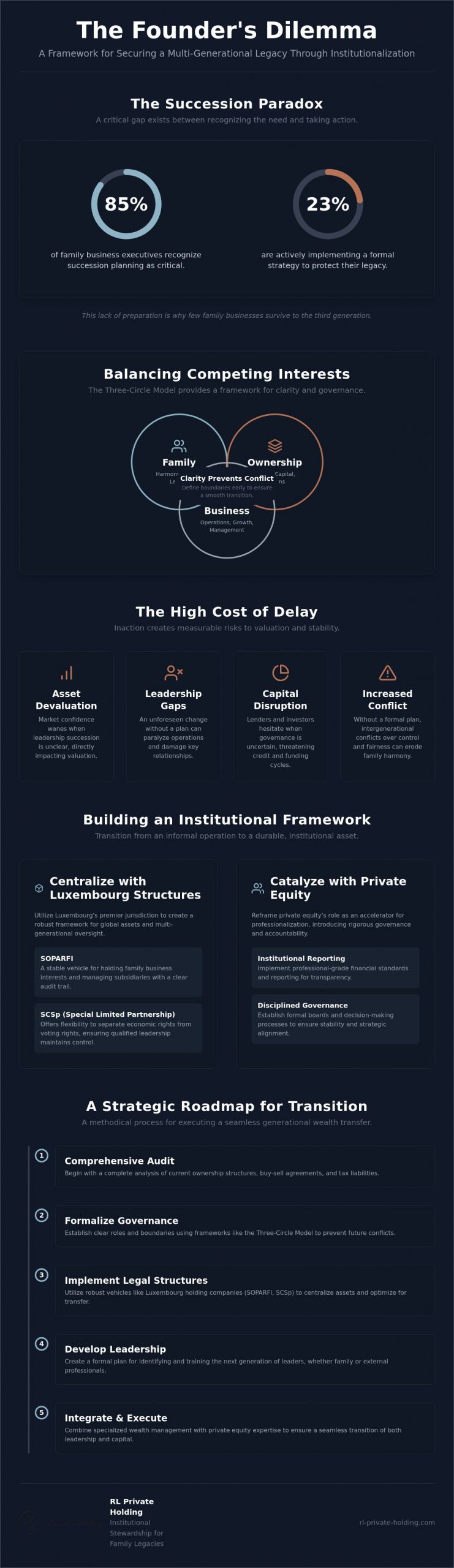
While 85% of family business executives recognize that succession planning is critical, a mere 23% are actively implementing a strategy to protect their legacy. This gap, often called the Succession Paradox, creates significant risks for the long-term stability of private enterprises. You likely understand the weight of this responsibility and the complexity it entails. Ensuring that a lifetime of growth isn’t eroded by intergenerational conflict or inefficient tax structures is a primary concern for any established founder. Effective succession planning for family-owned businesses requires more than just a change in leadership; it demands a fundamental shift toward institutionalization.
This guide provides a sophisticated framework to help you transition from a family-led operation to a durable, institutional asset. We’ll explore how the One Big Beautiful Bill Act (OBBBA) affects your $15 million federal estate tax exemption and how to restructure buy-sell agreements following the Connelly v. United States ruling. You’ll learn to optimize your holding structures for global efficiency and implement professional management models that preserve family harmony while securing multi-generational wealth. Our objective is to provide a clear roadmap for professionalizing your organization to ensure it survives the founder and thrives for decades to come.
Key Takeaways
- Analyze the Three-Circle Model to effectively balance the distinct interests of family members, owners, and business management.
- Utilize Luxembourg investment structures to centralize global assets and create a robust framework for succession planning for family-owned businesses.
- Reframe the role of private equity as a catalyst for professionalization, introducing the rigorous governance necessary for institutional longevity.
- Follow a methodical roadmap that begins with a comprehensive audit of ownership structures and proceeds to formal leadership development.
- Integrate specialized wealth management with private equity expertise to ensure a seamless transition of both leadership and capital.
The Strategic Imperative of Succession Planning for Family-Owned Businesses
Succession planning for family-owned businesses is the formal, multi-stage process of transitioning leadership and ownership to ensure long-term viability. It’s not a singular event but a strategic realignment that requires years of preparation. The Three-Circle Model provides the necessary framework to balance the often-competing interests of the family, the owners, and the management. Conflict typically arises when these roles overlap without clear boundaries, leading to operational friction during a transition. By defining these circles early, founders can establish a governance structure that survives their personal involvement.
The statistical reality of these transitions remains a significant challenge for private enterprises. Deloitte reported in February 2026 that while 85% of executives view succession as critical, only 23% are actively implementing a plan. This lack of preparation explains why so few family-owned businesses successfully reach the third generation. In 2026, the core growth requirement has shifted from founder-led agility to institutional stability. This evolution ensures the firm can withstand market volatility and maintain a competitive stance in global markets through disciplined governance.
Defining Generational Wealth Transfer Strategies
Management succession focuses on the operational leadership of the firm, while ownership succession addresses the legal transfer of equity and assets. A family office often acts as the central coordinator, overseeing the complex legal and fiscal requirements of the transition. Generational wealth transfer is a multi-decade strategic alignment of legal, fiscal, and operational frameworks. By integrating private equity investment management principles, families can introduce the reporting standards and accountability required for institutional-grade portfolios. This professionalization allows for a smoother handover, whether the next leader is a family member or an external professional manager.
The Consequences of Procrastination in Private Enterprise
Delaying the formalization of succession planning for family-owned businesses often results in a measurable decline in asset valuation. Market confidence frequently wanes when external partners perceive a leadership vacuum, which can disrupt ongoing capital cycles and credit facilities. Leadership gaps are particularly damaging when they affect institutional partnerships or banking relationships that rely on stable governance. Establishing emergency succession protocols is a vital risk management step. These protocols provide a clear roadmap for governance if an unforeseen leadership change occurs, protecting the firm’s reputation and financial health while a permanent solution is finalized.
Structural Frameworks for Generational Wealth Transfer
Succession planning for family-owned businesses necessitates a transition from informal arrangements to robust, institutional legal frameworks. Luxembourg has established itself as a premier jurisdiction for centralizing global family assets through its sophisticated regulatory environment and diverse corporate vehicles. The SOPARFI (Société de Participations Financières) remains a primary vehicle for holding family business interests. It provides a stable environment for managing participation in subsidiaries while maintaining a clear audit trail for multi-generational oversight. This structure allows for the efficient repatriation of capital and the consolidation of diverse business lines under a single administrative roof.
For families requiring more granular control over capital allocation and governance, the Luxembourg special limited partnership (SCSp) offers significant flexibility. This structure allows the general partner to manage day-to-day operations while limited partners maintain their economic interests without interfering in management. This is particularly effective for separating economic rights from voting rights. It ensures that leadership remains in the hands of qualified successors or professional managers while wealth is distributed equitably among all family members. Such a distinction is vital for maintaining operational continuity during periods of leadership transition.
The Role of Holding Companies in Asset Preservation
A centralized holding structure simplifies cross-border wealth transfer by consolidating disparate interests into a single legal entity. This consolidation is essential when managing portfolios that span multiple jurisdictions and asset classes. Integrating real estate asset management Luxembourg into the broader succession framework ensures that physical property assets are managed with the same institutional rigor as liquid investments. This approach helps mitigate many of the SBA on Family Business Challenges, specifically those related to the erosion of value through fragmented ownership. It also provides a unified platform for reporting and risk management.
Governance Mechanisms for Multi-Generational Stability
The drafting of family constitutions provides a moral compass for the enterprise, but these documents must be strictly aligned with the holding company’s legal bylaws to ensure enforceability. A formal Board of Directors acts as a critical buffer between family dynamics and business operations, introducing a layer of objective scrutiny. Implementing comprehensive shareholder agreements is equally vital. These agreements prevent the fragmentation of ownership and establish clear protocols for the buy-back of shares if a family member wishes to exit. Families who prioritize these structures often find that wealth management services provide the necessary technical support to maintain this institutional discipline over several decades.
Professionalization and the Role of Private Equity in Family Transitions
Private equity is often misunderstood in the context of succession planning for family-owned businesses. It’s not merely a mechanism for a complete exit. Instead, institutional capital functions as a powerful catalyst for institutionalization. Engaging in private equity investment management introduces a level of rigorous reporting and structural accountability that’s frequently absent in founder-led organizations. This transition shifts the internal culture from one based on historical precedent to one driven by data and market benchmarks. Such a transformation is essential for businesses seeking to remain competitive in the 2026 global economy.
One primary concern for founders involves the perceived loss of control. Minority private equity investments address this by providing a bridge to professional management without requiring the family to relinquish its majority stake. These partnerships allow the family to leverage institutional expertise to prepare the entity for future capital events, such as a strategic sale or an initial public offering. By aligning with a partner who understands institutional standards, the business gains access to a broader network of executive talent and sophisticated debt markets. It’s a strategic move that secures the firm’s future while maintaining its legacy.
Institutionalizing the Family Office
Transitioning from informal family oversight to a family office investment strategies Luxembourg model provides the structural discipline required for multi-generational wealth preservation. This shift necessitates the appointment of independent directors and the establishment of external investment committees. These bodies ensure that capital allocation decisions are based on objective financial criteria rather than internal family dynamics. External capital partners act as objective arbiters in family-led businesses, providing a neutral perspective on performance and strategic direction.
Value Creation Through Structured Professionalization
Succession planning for family-owned businesses must involve the standardization of key performance indicators (KPIs) and operational workflows. This systematic approach reduces the organization’s reliance on the founder’s personal intuition, making the business a more attractive asset for future investors. Attracting top-tier non-family executive talent requires the implementation of performance-based incentive structures that align with global market standards. According to Harvard Business Review succession models, the balance between meritocracy and family inheritance is vital for long-term health. Aligning the family legacy with global standards for transparency and ESG compliance ensures the business remains a viable, institutional-grade asset for decades to come.
A Strategic Roadmap for Executing a Generational Wealth Transfer
Executing a successful transition requires a methodical, multi-phase approach that transcends simple legal documentation. Succession planning for family-owned businesses follows a rigorous, multi-year lifecycle, starting with a comprehensive audit of all current ownership and legal structures. This first phase identifies potential liabilities and ensures that the existing foundation can support a more complex holding format. Once the baseline is established, the focus shifts to the identification and development of the next generation of leadership. Whether the successor is a family member or an external professional, this phase requires a disciplined training and mentorship period to ensure operational continuity.
The third phase involves restructuring the business into a professionalized holding format, often utilizing the Luxembourg structures discussed previously to centralize control. This is followed by the implementation of formal governance and communication protocols, such as family councils and independent boards. The final phase is the gradual transfer of economic and voting interests. In 2026, this process is significantly influenced by the One Big Beautiful Bill Act (OBBBA), which has made the $15 million federal estate tax exemption permanent. This provides a stable environment for founders to transfer assets without the immediate pressure of shifting regulatory thresholds.
Evaluating Succession Readiness
Before initiating structural changes, the firm must undergo a governance stress test to identify potential points of failure. This evaluation assesses how the organization handles decision-making during crises and whether current protocols can withstand a leadership vacuum. A critical component of this readiness check is the assessment of liquidity needs. The financial requirements of retiring founders often differ significantly from those of active family members who are reinvesting in growth. Determining the optimal timing for these structural changes is equally vital; founders should align the transition with market cycles to maximize the valuation of the transferred interests.
Mitigating Risks During the Transition Period
Cross-border wealth transfer within Europe requires sophisticated tax optimization strategies to prevent the erosion of family capital. It’s essential to maintain the continuity of institutional relationships during this handover. Engaging with private wealth management firms Luxembourg ensures that the family’s investment strategy remains consistent as leadership changes. Clear communication is the final safeguard against transition risk. The firm must proactively inform key stakeholders, lenders, and employees about the roadmap to maintain market confidence and internal morale. Contact RL Private Holding to integrate wealth management services into your multi-generational strategy.
RL Private Holding: Institutional Stewardship for Family Legacies
RL Private Holding serves as a discreet and authoritative partner for families seeking to transition their enterprises into institutional-grade assets. Our firm integrates specialized private equity expertise with sophisticated wealth management to address the complex requirements of multi-generational transitions. This dual approach ensures that the operational integrity of the business is preserved while the family’s capital is structured for long-term growth. We recognize that succession planning for family-owned businesses is a high-stakes endeavor that requires a steady hand and a global perspective. By institutionalizing family-owned assets, we help principals secure their legacy against the volatility of shifting market cycles and regulatory environments.
Our firm provides access to exclusive global networks, including venture capital Luxembourg and private equity sectors. These connections allow family businesses to drive growth through strategic acquisitions or capital injections that might otherwise be unavailable to private firms. We design customized investment structures that prioritize stability and exclusivity. These frameworks are built for generational horizons, moving beyond short-term gains to focus on the preservation of purchasing power and the expansion of the family’s global footprint. In an era where the One Big Beautiful Bill Act has stabilized the federal estate tax exemption at $15 million, the focus can shift from tax mitigation to strategic institutionalization.
A Multi-Disciplinary Approach to Succession
Our methodology combines asset management, legal structuring, and strategic investment oversight into a single, cohesive service model. As a Luxembourg-based partner, we offer a unique vantage point on global capital markets and cross-border regulatory requirements. This multi-disciplinary approach allows us to manage the intricate details of a transition while maintaining a focus on the broader strategic vision. RL Private Holding’s commitment to preserving family legacy is demonstrated through the implementation of disciplined institutional governance that transcends individual personalities. This ensures the business remains a durable entity capable of supporting future generations.
Engaging with RL Private Holding
The engagement process begins with a comprehensive evaluation of the family business portfolio to determine its alignment with institutional standards. We look for opportunities to professionalize management and optimize asset holding structures for maximum efficiency. Our focus remains on stability, exclusivity, and the creation of long-term value for our partners. Principals who seek to professionalize their generational wealth transfer will find a disciplined partner in our firm. We provide the strategic focus and professional distance required to navigate the complexities of succession without the interference of internal family dynamics. This methodical transition ensures that the firm’s silent authority continues to grow across decades.
Securing the Institutional Future of the Family Enterprise
Successful succession planning for family-owned businesses requires a definitive shift from personal oversight to disciplined institutional governance. By adopting sophisticated legal vehicles such as the Luxembourg SOPARFI or SCSp, families can centralize global assets while maintaining essential distinctions between economic rights and operational management. This structural professionalization ensures the entity isn’t merely surviving a leadership change but is actively evolving into a durable asset class. It provides the stability required to navigate the complexities of the 2026 regulatory environment with confidence.
RL Private Holding offers the discreet, authoritative stewardship required for such high-stakes transitions. Our firm manages a diverse global portfolio spanning technology, real estate, and private equity, providing the stability and exclusivity that institutional and private investors demand. We serve as a disciplined partner in executing the strategic roadmap necessary for long-term wealth preservation. Explore our institutional wealth management and private equity frameworks for family offices. Implementing these frameworks today secures the firm’s position as a permanent fixture in the global financial landscape.
Frequently Asked Questions
How early should a family-owned business begin succession planning?
A firm should ideally begin the process five to ten years before an anticipated transition. This timeframe provides the necessary lead time to identify and develop successors while allowing for the restructuring of legal and fiscal frameworks. Early preparation ensures that the handover is a deliberate strategic choice rather than a reactive response to unforeseen circumstances. It also allows stakeholders to test governance protocols under various market conditions before the founder exits.
Can a Luxembourg SOPARFI be used for family business succession?
The SOPARFI is a highly effective vehicle for centralizing and transferring participation in subsidiary companies. It provides a stable legal framework for holding equity interests while offering significant flexibility in how capital gains are distributed among family members. This structure simplifies the consolidation of global assets under a single governance umbrella. It’s particularly useful for families with diverse interests who require a transparent and institutionalized holding format for their legacy assets.
What is the difference between leadership succession and ownership succession?
Leadership succession focuses on the selection and training of the individuals who will manage the firm’s daily operations and strategic direction. Ownership succession addresses the legal transfer of equity and the economic rights to the company’s assets. While these two processes often overlap, they require distinct legal and operational strategies. Effective succession planning for family-owned businesses ensures that the entity remains functional and stable while the underlying equity is transferred to the next generation.
How does private equity involvement affect family control of a business?
Private equity can be structured as a minority investment to provide growth capital without requiring the family to relinquish majority control. This partnership introduces institutional rigor and professional reporting standards that can actually strengthen the family’s oversight. It acts as a catalyst for professionalization, preparing the organization for a future where management and ownership are clearly separated. Such involvement often increases the firm’s valuation by aligning it with global market benchmarks for governance.
What are the primary tax considerations for generational wealth transfer in Luxembourg?
Primary considerations include the efficient management of capital gains and the strategic use of the participation exemption regime for dividends. Luxembourg’s stable tax environment allows for clear multi-decade planning, especially when assets are held through institutional structures like the SOPARFI or SCSp. These vehicles are designed to facilitate cross-border transfers while maintaining strict compliance with international transparency standards. This stability is vital for preserving the purchasing power of the family’s wealth over several generations.
Is it better to appoint a family member or an external CEO for succession?
The decision depends on the readiness of the next generation and the scale of the enterprise. WSJ data from June 2026 indicates that 63% of companies with over $1 billion in revenue expect the next CEO to be a professional manager. For smaller firms, family members remain a common choice. The priority should always be the candidate’s ability to maintain institutional stability and execute the long-term vision, regardless of their last name or family status.
How can a family office help in the succession planning process?
A family office acts as the central coordinator for succession planning for family-owned businesses by aligning legal, fiscal, and personal objectives. It provides an objective platform for governance and manages the complex documentation required for a smooth handover. By centralizing these functions, the family office ensures that the transition remains disciplined and transparent for all stakeholders. This professional distance helps mitigate the emotional friction that often complicates intergenerational wealth transfers and leadership changes.
What happens to a family business if there is no succession plan in place?
The absence of a formal plan often leads to a leadership vacuum and a measurable erosion of family wealth. Unplanned transitions can trigger immediate tax liabilities and cause a loss of confidence among lenders, employees, and institutional partners. Without clear protocols, internal conflicts regarding the business vision can escalate quickly. This instability frequently results in the forced liquidation of assets or a significant decline in the company’s market valuation during a period of crisis.