

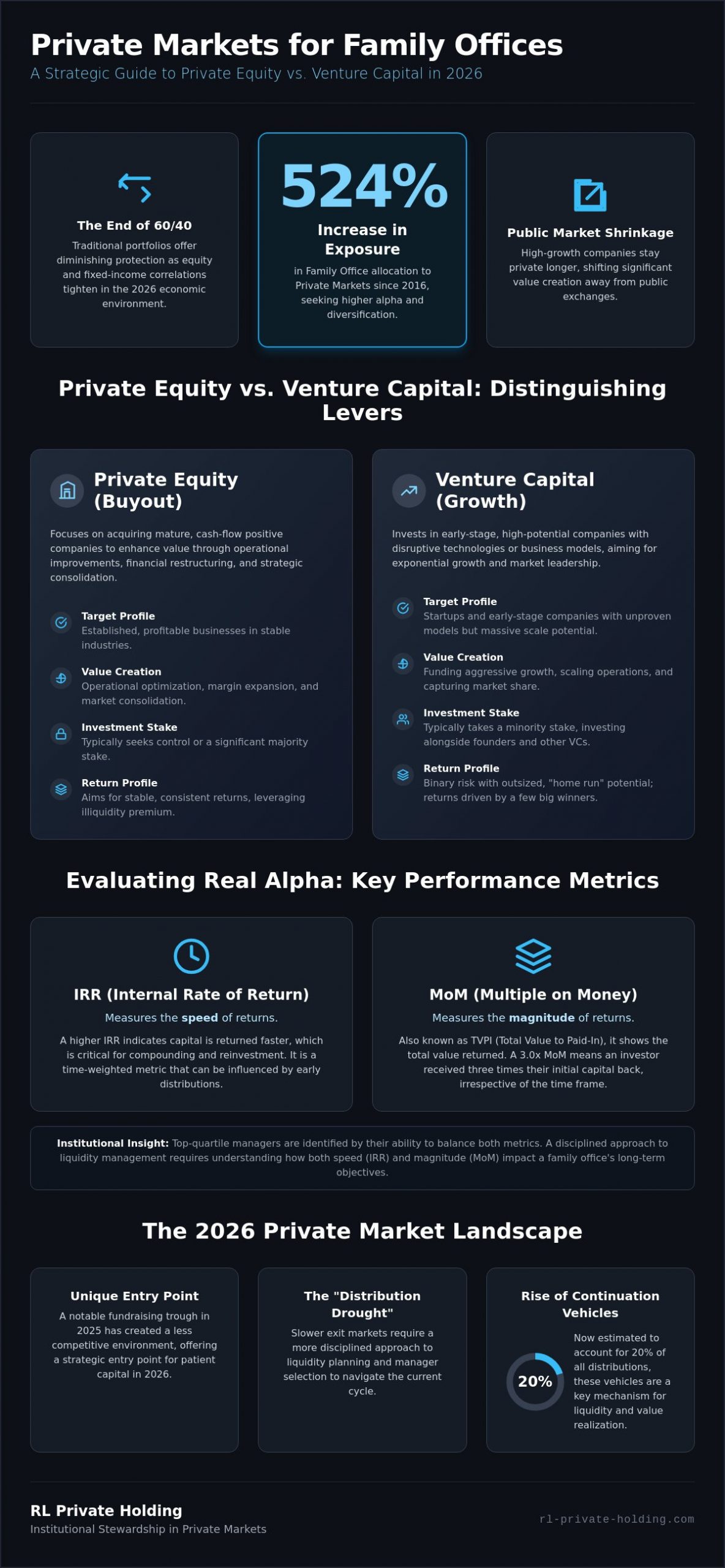
The number of family offices maintaining exposure to private markets has increased by 524 percent since 2016. This substantial shift underscores a broader institutional migration away from the volatility of public indices, where alpha continues to decrease. For sophisticated investors in Luxembourg and across the Eurozone, the decision isn’t whether to allocate to private markets, but how to balance the specific mechanisms of private equity vs venture capital for family offices to ensure long-term wealth preservation. Institutional fundraising in these sectors reached a notable trough in 2025, which has created a unique entry point for patient capital in 2026.
We recognize that the current distribution drought requires a more disciplined approach to liquidity and manager access. This analysis provides a data-driven justification for private market allocations and a clear framework for distinguishing between the return profiles of buyout and venture strategies. You’ll gain an understanding of the 2026 selection gap and the rising importance of continuation vehicles, which are estimated to account for 20 percent of distributions this year. The following sections outline the strategic allocation frameworks necessary for institutional-grade family offices to navigate this complex landscape.
Key Takeaways
- Understand why traditional 60/40 portfolios no longer provide sufficient protection in the 2026 economic environment and how public market shrinkage necessitates a shift toward private assets.
- Evaluate the structural differences between private equity vs venture capital for family offices to align risk-return profiles with long-term wealth preservation goals.
- Learn to distinguish between Internal Rate of Return (IRR) and Multiple of Money (MoM) to better manage liquidity requirements and identify top-quartile managers.
- Develop a framework for balancing high-growth venture allocations with stable yield through strategic real estate asset management and sector diversification.
- Discover the benefits of an institutional-grade investment philosophy that prioritizes fundamental value and operational improvement over market speculation.
The Evolution of Asset Allocation: Why Public Markets Alone May Be Insufficient
The traditional 60/40 portfolio, once the cornerstone of institutional wealth management, has reached a point of diminishing efficacy in the 2026 economic environment. As correlations between global equities and fixed-income instruments tighten, the historical diversification benefits of public markets have largely eroded. For the modern family office, relying solely on public indices often results in exposure to heightened volatility without a corresponding increase in alpha. This shift is driven by a fundamental change in how companies scale and when they choose to access public capital.
Public market shrinkage is no longer a theoretical concern but a structural reality. High-growth companies are staying private for significantly longer periods, often reaching multi-billion euro valuations before considering an initial public offering. Consequently, much of the value creation that previously occurred on public exchanges now takes place within private ecosystems. Navigating the nuances of private equity vs venture capital for family offices requires a departure from the passive indexing strategies that dominated the previous decade. While public markets are frequently swayed by short-term sentiment and macroeconomic headlines, private market valuations remain rooted in fundamental operational performance and long-term strategic milestones.
The Structural Shift in Global Capital Markets
The number of publicly traded companies has declined steadily over the last two decades, particularly in developed Western markets. This contraction means that public indices are increasingly concentrated in mature, legacy sectors. Late-stage venture capital has effectively replaced the traditional growth phase that investors once accessed through small-cap public stocks. Investors who limit their mandate to public exchanges essentially opt out of the most aggressive growth sectors of the global economy. This exclusion creates a significant alpha gap, as the most innovative disruptions in technology and healthcare are funded and scaled entirely within private structures before the public can participate.
Defining the Private Market Premium
The illiquidity premium is the excess return required by investors to compensate for the inability to liquidate assets immediately. In 2026, this premium remains a primary driver for family offices seeking to outperform standardized benchmarks. Unlike public market returns, which are largely dictated by market beta, private market success depends on manager skill and operational intervention. The distinction between skill-based alpha and market-based beta is critical when evaluating private equity vs venture capital for family offices. While venture capital seeks outsized returns through binary risk and massive scalability, private equity focuses on enhancing cash-flow positive enterprises through disciplined financial oversight and structural improvements. Both strategies leverage the illiquidity of the asset class to implement changes that public market scrutiny often prevents.
Private Equity vs Venture Capital for Family Offices: Distinguishing Investment Levers
The distinction between private equity vs venture capital for family offices lies primarily in the maturity of the underlying asset and the specific mechanism of value creation. Private equity typically involves the acquisition of mature, cash-flow positive companies where the objective is to optimize existing operations or consolidate fragmented markets. In contrast, venture capital focuses on early-stage disruption, targeting companies with high growth potential but unproven business models. For institutional investors in Luxembourg, understanding these levers is essential for constructing a portfolio that balances immediate cash flow with long-term capital appreciation.
Family offices are increasingly shaking up private equity and venture capital by leveraging their indefinite investment horizons. Unlike traditional funds that operate on a rigid ten-year cycle, family offices can provide patient capital, allowing for more flexible exit strategies. This alignment of interests is particularly valuable for multi-generational wealth preservation. While private equity firms typically use three to six times leverage to enhance returns, many family offices prefer a more conservative approach, often utilizing zero to three times leverage to protect against interest rate volatility in the 2026 market. Refining these allocations often involves professional wealth management services to ensure alignment with specific generational goals.
Operational Levers in Private Equity
In the current economic environment, the focus of private equity vs venture capital for family offices has shifted from financial engineering toward operational excellence. Top-tier firms now utilize specialized operating partners to drive EBITDA growth through process optimization and supply chain resilience. Strategic private equity investment management in 2026 also emphasizes buy-and-build strategies. By acquiring smaller competitors and integrating them into a larger platform, investors can capture valuation arbitrage. However, the increased cost of debt in the Eurozone requires a disciplined approach to capital structures to maintain the illiquidity premium.
Venture Capital as a Growth Engine
Venture capital serves as a high-risk growth engine, providing exposure to transformative technologies that are largely absent from public exchanges. For those utilizing venture capital Luxembourg structures, the focus in 2026 remains on early-stage AI, Biotech, and Fintech. Because venture returns are governed by the power law, where a small percentage of investments generate the majority of returns, portfolio diversification is critical. Investors must balance aggressive seed-stage bets with more stable, late-stage growth equity to mitigate the risk of total capital loss in any single venture.
Performance Metrics: Evaluating Real Alpha in Private Markets
Evaluating real alpha in the private domain requires a technical precision that goes beyond the standard metrics used in public equities. For those navigating the nuances of private equity vs venture capital for family offices, the Internal Rate of Return (IRR) often serves as the primary headline figure. It’s a time-weighted measurement that accounts for the size and timing of cash flows. However, IRR can be influenced by the strategic use of subscription lines of credit, which can artificially inflate returns by delaying capital calls. Consequently, sophisticated investors in 2026 are increasingly prioritizing Distributed to Paid-In (DPI) and Multiple of Money (MoM) to assess actual cash-on-cash realizations. These metrics provide a clearer picture of wealth preservation and growth, particularly when distinguishing investment levers across different asset stages.
Understanding the impact of vintage years is also essential. A fund’s performance is often a byproduct of the entry valuations available during its deployment phase. In the current environment, dry powder remains at record levels, which can lead to price competition. Performance data must therefore be normalized to account for these external factors. Using Public Market Equivalent (PME) allows family offices to determine if the illiquidity of a private commitment actually yielded a premium over a liquid public index.
The Complexity of Private Market Metrics
While IRR measures speed, MoM measures the absolute magnitude of wealth creation. This distinction is vital for family offices with multi-generational horizons who may value a 3.0x return over fifteen years more than a 30 percent IRR over three years. Public Market Equivalent (PME) is a methodology that benchmarks private fund cash flows against a hypothetical investment in a public index. This helps investors see through the “noise” of market cycles. In 2026, Total Value to Paid-In (TVPI) remains a standard for reporting, yet the true test of a manager’s skill remains their ability to convert paper gains into realized liquidity through DPI.
The Manager Selection Imperative
The “selection gap” in private markets is far more pronounced than in public equities. Data analysis consistently shows a spread of over 2000bps between top and bottom quartile private equity funds. This dispersion makes indexing impossible; you can’t simply “buy the market” in private equity or venture capital. Identification of sustainable alpha requires rigorous due diligence into a manager’s operational history.
- Top-Quartile Access: Persistence of returns is higher in private markets, meaning past winners are statistically more likely to win again.
- Proprietary Deal Flow: Managers with deep sector expertise in Luxembourg or the broader EU often see opportunities before they reach a broad auction.
- Vintage Diversification: Spreading commitments across different years mitigates the risk of deploying all capital at a market peak.
Identifying these factors is the only way to ensure that a private equity vs venture capital for family offices strategy delivers on its promise of outperformance.
Portfolio Construction in 2026: Balancing Growth, Yield, and Liquidity
The “denominator effect” remains a primary challenge for institutional investors in 2026. When public market valuations contract, the relative percentage of private assets within a portfolio can involuntarily exceed target limits, creating a perceived over-allocation. Managing this imbalance requires a sophisticated understanding of private equity vs venture capital for family offices and how each asset class behaves during varying economic cycles. Luxembourg serves as a critical hub for these structures, providing the regulatory stability and fund vehicles needed for cross-border private market allocations. Consistent pacing through vintage year diversification is the most effective way to smooth out these cycles, ensuring that capital isn’t deployed entirely at market peaks.
Sector diversification is equally vital for maintaining a resilient portfolio. While venture capital provides exposure to high-growth technology and innovation, it lacks the immediate yield necessary for many family mandates. Balancing growth equity with institutional real estate asset management provides a necessary counterweight. This approach offers predictable cash flows to offset the long-term illiquidity of venture commitments. By diversifying across geography and asset type, investors can mitigate the sector-specific risks that often plague concentrated public market holdings.
Strategic Allocation Frameworks
Optimal percentages for alternatives often range between 15 and 25 percent, depending on the specific liquidity requirements of the family office. Integrating family office investment strategies Luxembourg with traditional wealth preservation ensures that growth-oriented venture capital is balanced by stable, yield-generating assets. This often involves a mix of managed funds for broad exposure and direct investments or co-investments for greater control. Co-investments, in particular, allow families to avoid the traditional fee structures of blind-pool funds while gaining deeper insight into specific portfolio companies.
The 2026 Macroeconomic Outlook
The 2026 landscape is defined by stabilized but higher interest rates compared to the previous decade. This environment necessitates a shift in exit strategies, as cheap debt no longer fuels aggressive valuations. Secondaries have emerged as a vital liquidity tool, allowing investors to rebalance portfolios without waiting for a traditional trade sale. Continuation vehicles are estimated to account for at least 20 percent of private equity distributions this year, providing a structured path for liquidity in a slower IPO market. Investors who committed to 2026 vintage funds may benefit from more disciplined entry valuations and realistic growth projections. For those seeking to optimize their private market exposure in this new regime, engaging with private equity investment management specialists is a logical step for long-term success.
Institutional Stewardship: The RL Private Holding Approach to Private Markets
RL Private Holding operates under a philosophy of Quiet Authority, a principle that prioritizes fundamental value and institutional discipline over the transient volatility of global markets. This methodical approach is essential when navigating the complexities of private equity vs venture capital for family offices, where the distinction between speculative growth and sustainable wealth preservation is often blurred. By maintaining a sober, factual perspective on asset performance, we ensure that our global partners benefit from a steady hand in the background of major capital allocations. Our strategy focuses on identifying institutional-grade opportunities that align with long-term objectives, moving beyond simple financial engineering to foster genuine operational improvement.
We mitigate sector-specific risks through a disciplined diversification strategy that encompasses Technology, Real Estate, and Private Equity. This multi-asset approach allows us to balance the high-growth potential of venture capital with the stable, yield-generating characteristics of mature private equity and real estate assets discussed in previous sections. For sophisticated investors, our Luxembourg-based institutional framework provides a secure and transparent environment for capital deployment. This structural advantage is essential for managing the high-stakes nature of private market investments, where the margin for error in manager selection and asset governance is exceptionally thin.
Institutional Governance and Global Scale
Our commitment to transparency is reflected in a rigorous due diligence process that scrutinizes every aspect of a potential investment, from management alignment to underlying cash flow stability. We utilize the Luxembourg Special Limited Partnership (SCSp) to provide our partners with flexible and robust investment structures. This vehicle is particularly well-suited for the sophisticated requirements of global family offices, offering a clear organizational hierarchy and a predictable regulatory environment. By managing diversified portfolios at a global scale, we provide the stability and professional distance that institutional-grade stewardship requires.
Wealth Management for the Sophisticated Investor
RL Private Holding provides customized allocation strategies that integrate specialized private equity services within a broader framework typical of leading private wealth management firms Luxembourg. Our focus remains on institutional-grade asset selection to ensure both capital protection and steady growth. As we move through 2026, the necessity for a disciplined rebalancing of private market exposure has never been more critical. Institutional partners seeking to refine their strategic allocations or evaluate their current private equity vs venture capital for family offices mix are encouraged to engage with our team to explore frameworks built for the next generation of wealth.
Strategic Capital Allocation for the Next Decade
The structural shift toward private assets is a defining characteristic of the 2026 financial landscape. As public markets offer diminishing alpha, the ability to accurately evaluate private equity vs venture capital for family offices remains essential for multi-generational wealth preservation. Success in this environment depends on a disciplined approach to manager selection and a sophisticated understanding of how different private market mechanisms contribute to overall portfolio resilience. Balancing the high-growth potential of early-stage disruption with the stable yield of mature enterprises ensures a robust defense against market volatility.
RL Private Holding offers the institutional gravity and global perspective required to manage these complex allocations. Headquartered in Luxembourg, our firm provides performance-driven management focused on institutional-grade asset selection. We maintain a global portfolio diversified across technology, real estate, and private equity to mitigate sector-specific risks for our partners. Explore RL Private Holding’s Strategic Investment Portfolios to learn more about our methodical approach to private market growth. We remain committed to providing the stability and strategic focus necessary for long-term institutional success.
Frequently Asked Questions
How much higher are private market returns compared to public markets historically?
Historically, private equity has outperformed public benchmarks by approximately 300 to 500 basis points annually. This outperformance is often attributed to the illiquidity premium and the ability of managers to implement operational improvements that aren’t possible in the public domain. While public markets are prone to sentiment-driven volatility, private asset returns are more closely tied to fundamental EBITDA growth and long-term strategic execution.
What is the Public Market Equivalent (PME) and why is it used for family offices?
Public Market Equivalent is a methodology used to benchmark the performance of private fund cash flows against the returns of a public index. It effectively calculates what the return would’ve been if the same capital had been invested in a liquid index like the MSCI World at the same time. Family offices use PME to determine if the inherent illiquidity of private equity vs venture capital for family offices is justified by a significant return premium over public alternatives.
Is private equity more risky than investing in a public index like the S&P 500?
Private equity carries a different risk profile than the S&P 500, characterized by higher illiquidity and idiosyncratic risk rather than daily price volatility. While public indices are highly liquid, they’re susceptible to market-wide sell-offs and macroeconomic sentiment. Private equity investments are shielded from daily mark-to-market fluctuations but require a long-term commitment. The primary risk in private markets is the potential for permanent capital loss if a specific portfolio company fails to execute its business plan.
How does the Selection Gap impact private market returns for family offices?
The selection gap is the wide dispersion in returns between top-quartile and bottom-quartile managers, which is significantly more pronounced in private markets than in public equities. In the context of private equity vs venture capital for family offices, the difference in performance can exceed 2,000 basis points. This makes manager access and due diligence the most critical factors in achieving outperformance. Unlike public markets, where indexing provides average returns, poor manager selection in private markets can lead to significant underperformance against public benchmarks.
What are the typical fee structures for managed private equity funds in 2026?
Typical fee structures in 2026 generally follow the traditional “two and twenty” model, though larger institutional family offices often negotiate more bespoke terms. This usually includes a 1.5 to 2.0 percent management fee on committed capital and a 20 percent performance fee once a preferred return hurdle is met. These fees compensate managers for the intensive operational oversight and proprietary deal sourcing that characterize top-tier private market strategies.
How long is the typical lock-up period for a private equity or venture capital fund?
The typical lock-up period for a private equity or venture capital fund ranges from seven to ten years, with potential extensions for asset liquidation. This duration aligns the investment horizon with the time required to implement operational changes or scale early-stage technologies. While this illiquidity is a challenge for some investors, it prevents the forced selling of assets during temporary market downturns, allowing for more disciplined exits at optimal valuations.
How do interest rates affect the return profile of private equity and venture capital?
Interest rates directly impact the cost of acquisition financing in private equity and the discount rates used for venture capital valuations. In the 2026 environment of stabilized but higher rates, private equity firms must rely more on EBITDA growth than financial leverage to drive returns. For venture capital, higher rates generally lead to more conservative entry valuations. This shift favors managers with deep operational expertise who can create value without relying on the cheap debt cycles of the previous decade.
What are the benefits of a Luxembourg SCSp structure for family office private equity?
The Luxembourg Special Limited Partnership (SCSp) offers a highly flexible, tax-transparent vehicle that is ideal for cross-border private market investments. It provides a robust legal framework that allows family offices to tailor governance rights and capital contribution rules to their specific needs. Because it doesn’t have a separate legal personality, it’s often the preferred structure for sophisticated investors seeking an institutional-grade environment that is recognized by global regulatory authorities.