

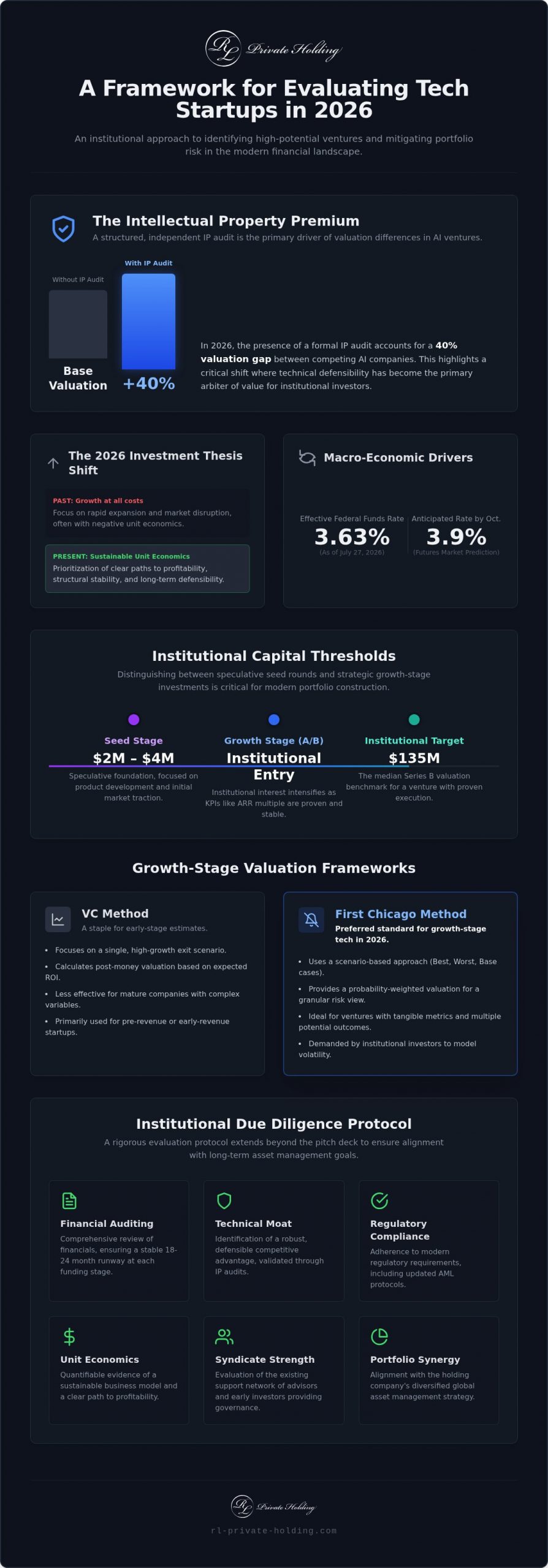
In 2026, the presence of a structured, independent intellectual property audit accounts for a 40 percent valuation gap between competing artificial intelligence ventures. This statistic highlights a broader shift in the private equity sector where technical defensibility has become the primary arbiter of value. Many institutional partners recognize that the traditional reliance on founder intuition is no longer sufficient to mitigate the risks of information asymmetry or poor go-to-market execution. Successfully evaluating tech startups for venture capital investment now requires a disciplined, evidence-based approach that prioritizes long-term stability over speculative growth metrics.
This article provides a comprehensive framework for identifying and validating high-potential technology investments using the rigorous standards of a global holding company. You’ll learn to quantify intangible assets like proprietary data and navigate the complexities of modern regulatory requirements, including the updated AML protocols. By implementing these objective methodologies, firms can reduce portfolio risk and ensure that each technology acquisition aligns with their overarching asset management goals. We’ll examine the specific quantitative benchmarks and qualitative indicators that define successful growth-stage ventures in the current economic environment.
Key Takeaways
- Investors must prioritize sustainable unit economics and clear paths to profitability over rapid expansion to navigate the recalibrated financial landscape of 2026.
- A comparative analysis of quantitative frameworks, such as the VC Method and the First Chicago Method, provides a structured basis for objective growth-stage valuations.
- Identifying a robust technical moat through intellectual property audits is essential for mitigating risk and validating long-term market scalability.
- Establishing a rigorous institutional protocol for evaluating tech startups for venture capital investment ensures that due diligence extends beyond the initial pitch to include comprehensive financial auditing.
- Integrating technology ventures within a diversified global asset management strategy allows for optimized risk-adjusted returns and enhanced portfolio synergy.
The Strategic Landscape of Tech Startup Evaluation in 2026
Evaluating tech startups for venture capital investment is the systematic process of assessing a firm’s market potential, technical moat, and execution capability. This discipline has evolved significantly as the global economy recalibrates following years of rapid digital expansion. In 2026, the emphasis has shifted from “growth at all costs” toward sustainable unit economics. Institutional investors now seek structural stability over the disruptive volatility that characterized earlier cycles. This transition reflects a more mature approach to asset management, where technology is viewed as a core component of a balanced portfolio rather than a peripheral high-risk bet.
The stability of global financial centers like Luxembourg plays a vital role in this new landscape. By providing a sophisticated regulatory environment, these hubs allow for a more sober and factual presentation of investment opportunities. Professional firms rely on these frameworks to conduct due diligence that meets institutional standards. This structured approach helps mitigate the risks associated with information asymmetry in early-stage technology, allowing for a more predictable path to capital appreciation.
Macro-Economic Drivers for Tech Allocation
The stabilization of interest rates has redefined venture capital valuations. As of July 27, 2026, the effective federal funds rate stands at 3.63%, with futures markets anticipating a slight rise toward 3.9% by October. This environment demands higher financial discipline from founders. Technology now serves as a critical diversifier for traditional private equity portfolios, offering growth potential that complements more stable asset classes. An investment holding company is a corporate entity that maintains a controlling or significant interest in a diverse array of subsidiary companies to centralize management and optimize capital allocation across different sectors.
Defining the Growth-Stage Threshold
Distinguishing between seed-stage speculation and growth-stage strategic investment is a fundamental component of modern portfolio construction. Seed rounds in 2026 typically range between $2 million and $4 million, but institutional interest intensifies during the Series A and B phases. A startup is considered ready for institutional capital when it demonstrates specific KPIs, such as a stable ARR multiple and a clear trajectory toward the median Series B valuation of $135 million. The venture capital Luxembourg framework provides the necessary rigor to validate these metrics. This ensures that only companies with proven execution capabilities and defensible market positions receive significant capital allocations.
Core Quantitative and Qualitative Evaluation Frameworks
Structural rigor in evaluating tech startups for venture capital investment requires a balance between mathematical projections and institutional judgment. While the VC Method remains a staple for early-stage estimates, the First Chicago Method has become the preferred standard for growth-stage technology in 2026. This scenario-based approach accounts for the probability-weighted outcomes of best, worst, and base cases, providing a more granular view of potential volatility. With interest rates stabilizing near 3.63 percent, institutional investors now demand higher risk-adjusted returns, often prioritizing ventures that demonstrate an 18 to 24 month runway at each funding stage.
The success of these investments often hinges on the “Syndicate” factor. This involves evaluating the existing support network of advisors and early investors who surround the startup. A strong syndicate provides more than just capital; it offers a layer of governance and strategic oversight that mitigates operational risk. When a startup’s board includes seasoned industry veterans, the probability of successful go-to-market execution increases significantly, making the venture a more attractive prospect for institutional allocation.
Advanced Startup Valuation Methodologies
Applying the Practical Scorecard allows firms to adjust baseline valuations by weighing specific risk factors such as product-market fit and competitive intensity. In 2026, sector-specific multiples have recalibrated. Median ARR multiples for public software companies sat at 3.2x in April, though high-growth SaaS ventures with strong unit economics still command 4x to 5x. These methodologies are often refined by private equity investment management principles, which prioritize long-term cash flow and structural stability over speculative exit multiples. If you’re looking to refine your own portfolio strategy, our private equity services offer a disciplined approach to these complex valuations.
The Human Element: Founder and Executive Assessment
Qualitative assessment remains a critical pillar of any investment framework. In the current climate, we prioritize execution capabilities over visionary genius. A management team’s ability to scale is evidenced by their operational discipline and previous exit experience. We look for leaders who can navigate the transition from a founder-led organization to an institutional-grade company. This assessment includes:
- Operational Track Record: Evidence of managing growth through varied economic cycles.
- Governance Alignment: A willingness to work with the syndicate to implement institutional-grade reporting.
- Technical Depth: The ability to maintain a technical moat while scaling commercial operations.
These human factors, when combined with rigorous quantitative modeling, ensure that evaluating tech startups for venture capital investment remains a predictable and repeatable process.
Intellectual Property and Market Scalability Analysis
In the 2026 environment, evaluating tech startups for venture capital investment requires an exhaustive analysis of the entity’s technical moat. Proprietary data and algorithms now serve as the primary drivers of competitive advantage, moving beyond simple software functionality. The distinction between a generic application and a defensible platform often rests on the quality of its trade secrets and the robustness of its patent portfolio. Institutional investors prioritize ventures that can demonstrate a clear separation from competitors through high-level technical barriers that are difficult and costly to replicate. This technical depth is particularly critical in the artificial intelligence sector, where proprietary data sets provide the second-highest weighted factor in long-term valuation models.
Regulatory compliance has also become a non-negotiable component of technology valuation. The impact of the EU AI Act and evolving GDPR standards means that a startup’s go-to-market strategy must be built on a foundation of legal and ethical transparency. Non-compliance at the growth stage can lead to significant financial penalties and operational halts, effectively devaluing the asset. A thorough due diligence process must verify that the technology stack is not only scalable but also fully aligned with the stringent requirements of global financial jurisdictions.
Maximizing Intellectual Property Value
A sophisticated IP strategy involves more than just filing defensive patents; it requires an offensive approach that secures market positioning and blocks competitive entry. This is a vital consideration for private equity firms looking toward a liquid exit. Research from July 2026 indicates that late-stage AI startups with structured, audited IP portfolios achieve median revenue multiples of 25.8x, while those lacking such defensibility average only 18.2x. This significant delta proves that IP valuation directly dictates the final exit multiple by providing a tangible asset that justifies a premium price during acquisition or public offering.
Market Dynamics and Competitive Positioning
Analyzing the Total Addressable Market (TAM) versus the Serviceable Obtainable Market (SOM) provides a realistic view of a startup’s growth ceiling. We focus on the “fast-follower” advantage in saturated markets, where a company can improve upon the inefficiencies of first-movers to capture a more sustainable market share. Evaluating the scalability of the technology stack ensures that the platform can handle global expansion without a linear increase in customer acquisition costs. Utilizing family office investment strategies Luxembourg allows firms to leverage established global networks, facilitating a smoother entry into international markets. This strategic alignment ensures that the startup’s growth trajectory remains both aggressive and disciplined.
The Institutional Due Diligence Protocol: Beyond the Pitch Deck
The timeline for evaluating tech startups for venture capital investment has elongated significantly in 2026. While previous cycles favored rapid deployment, current institutional protocols prioritize a methodical, multi-stage review process that typically spans 18 to 24 weeks. This extension reflects a structural recalibration within the market, as investors demand deeper evidence of financial discipline and category leadership. The process moves from an initial screening through various specialized audits before reaching the final investment committee for approval.
Financial auditing remains the cornerstone of this protocol. We verify recurring revenue figures and burn rates with surgical precision to ensure the startup maintains a sufficient runway. In 2026, the median time between a Series A and Series B round has increased to 22-28 months, making cash preservation a primary metric for success. High-level governance is often facilitated by private wealth management firms Luxembourg, which provide the structural oversight necessary to manage these complex assets within a broader portfolio.
The Financial and Operational Audit
A rigorous audit involves more than a balance sheet review. We conduct a deep analysis of Customer Lifetime Value (CLV) and Churn Rate metrics to assess the long-term viability of the user base. As the conversion rate from seed to Series A has dropped to approximately 38 percent, operational efficiency is paramount. Our team evaluates the robustness of financial reporting systems to ensure they can handle the requirements of institutional-grade reporting and international tax compliance. If you require professional oversight for your technology allocations, our venture capital funding services provide the necessary expertise.
Technical and Legal Verification
Technical due diligence has evolved into a comprehensive assessment of security protocols and technical debt. We perform deep-dive code reviews and infrastructure stress tests to confirm the platform’s ability to scale without significant reinvestment. Legal verification ensures clear title to all intellectual property and full compliance with both Luxembourg and EU law. This includes verifying that a Form D was filed within 15 days of previous sales and that the entity adheres to the updated FinCEN AML program requirements that took effect on January 1, 2026. A clean cap table and transparent funding history are essential for securing a favorable investment decision.
Strategic Asset Allocation and the RL Private Holding Approach
RL Private Holding integrates technology ventures into a diversified global portfolio by applying the same institutional gravity used in traditional asset classes. Evaluating tech startups for venture capital investment is not a standalone activity but a critical component of a broader wealth preservation strategy. By leveraging Luxembourg’s sophisticated financial infrastructure, we ensure that every allocation is supported by a stable regulatory backdrop and professional oversight. This disciplined approach allows for the identification of high-potential ventures that align with long-term capital appreciation goals while maintaining the firm’s reputation for stability and exclusivity.
There is a distinct synergy between our technology allocations and real estate asset management Luxembourg. While technology provides the potential for high-growth alpha, real estate offers the structural stability and predictable cash flow necessary to balance a sophisticated portfolio. This multi-sector alignment ensures that the volatility inherent in growth-stage tech is mitigated by the permanence of tangible assets. Our presence in the Luxembourg market allows us to utilize specialized investment vehicles that optimize tax efficiency and regulatory compliance across these diverse sectors, providing a secure environment for global capital.
Building a Multi-Sector Investment Strategy
Startups serve as the satellite components in a core-satellite portfolio, providing the growth necessary to outperform traditional benchmarks in a 3.63 percent interest rate environment. We balance liquidity requirements by maintaining a strategic mix of private equity and venture capital. Institutional frameworks are used to manage the risks associated with information asymmetry, ensuring that each investment contributes to the overall health of the holding. This methodical allocation prevents overexposure to any single sector while capturing the upside of digital transformation. We prioritize ventures that demonstrate financial discipline and a clear path to profitability, ensuring they fit within a low-risk portfolio structure.
The Value of an Institutional Partner
A global holding company provides more than just capital. We offer a robust network and a level of governance that individual investors or smaller firms cannot replicate. Our perspective extends beyond the traditional 10-year fund lifecycle, focusing on institutional permanence and strategic growth. This long-term focus is essential when evaluating tech startups for venture capital investment, as it allows for the patience required to see a category leader reach its full market potential. We act as a steady hand in the background, providing the discipline necessary to navigate market recalibrations and technical shifts. To discuss how these methodologies can be applied to your specific objectives, Contact RL Private Holding to explore strategic investment opportunities.
Advancing Institutional Rigor in Technology Allocation
The 2026 venture capital landscape requires structural discipline. Successful outcomes depend on a firm’s ability to validate technical moats through extended due diligence. By integrating growth-stage ventures into a diversified strategy, investors capture alpha without compromising stability. This methodical approach to evaluating tech startups for venture capital investment ensures each acquisition supports long-term wealth preservation. It’s a process that demands institutional patience and deep technical expertise.
RL Private Holding provides the Luxembourg-based institutional expertise necessary for these complex markets. Our firm maintains a global portfolio across diversified sectors. We prioritize professional governance and wealth management to protect and grow capital. We invite you to Explore Strategic Investment Opportunities with RL Private Holding. A steady, evidence-based approach remains the most reliable path to securing high-potential assets in the global financial landscape.
Frequently Asked Questions
What are the primary criteria for evaluating tech startups in 2026?
The primary criteria center on sustainable unit economics and the existence of a defensible technical moat. Institutional investors prioritize ventures that demonstrate a clear path to profitability and high financial discipline rather than rapid, subsidized growth. Evaluation also focuses on the entity’s ability to maintain a category leader position within a specific domain, supported by proprietary data sets and infrastructure scalability that can handle global expansion.
How do institutional investors calculate the valuation of a pre-revenue startup?
Pre-revenue startups are typically valued using a combination of the VC Method and the Scorecard Valuation Method. These frameworks adjust a baseline valuation by weighing specific factors such as the quality of the management team and the total addressable market. As of July 2026, median seed rounds range between $2 million and $4 million, with valuations determined by the competitive intensity of the sector and the maturity of the underlying technology.
What is the role of intellectual property in venture capital due diligence?
Intellectual property serves as the primary arbiter of technical defensibility and long-term valuation premiums. During due diligence, independent audits are conducted to verify the existence of patents, trade secrets, and proprietary algorithms. This process is essential for evaluating tech startups for venture capital investment, as ventures with structured IP portfolios command significantly higher revenue multiples than those relying on generic or open-source software architectures.
How much weight should be given to the founding team versus the technology?
Institutional investors weigh execution capability and previous operational experience more heavily than visionary concepts alone. While a robust technology stack is necessary for a defensible moat, the founding team’s ability to navigate complex regulatory environments and manage institutional-grade governance is the primary predictor of success. We prioritize leaders who have successfully managed previous exits or demonstrated the discipline required to scale a growth-stage venture through varied cycles.
What are the common pitfalls in evaluating growth-stage technology companies?
Common pitfalls include overvaluing visionary potential at the expense of unit economics and failing to account for significant technical debt. Many firms struggle with information asymmetry in early-stage technology, leading to an underestimate of the capital required for effective go-to-market execution. Additionally, neglecting to verify the cleanliness of the cap table or overlooking regulatory compliance issues can result in significant devaluations during subsequent funding rounds or exit events.
Why is Luxembourg a preferred location for venture capital investment structures?
Luxembourg is a preferred location due to its sophisticated financial infrastructure and stable regulatory environment. The jurisdiction provides specialized investment vehicles that are fully aligned with ESMA and CSSF guidelines, offering a secure framework for evaluating tech startups for venture capital investment. This stability is vital for global holding companies that require institutional-grade oversight and tax-efficient structures for managing diversified technology allocations alongside traditional asset classes.