

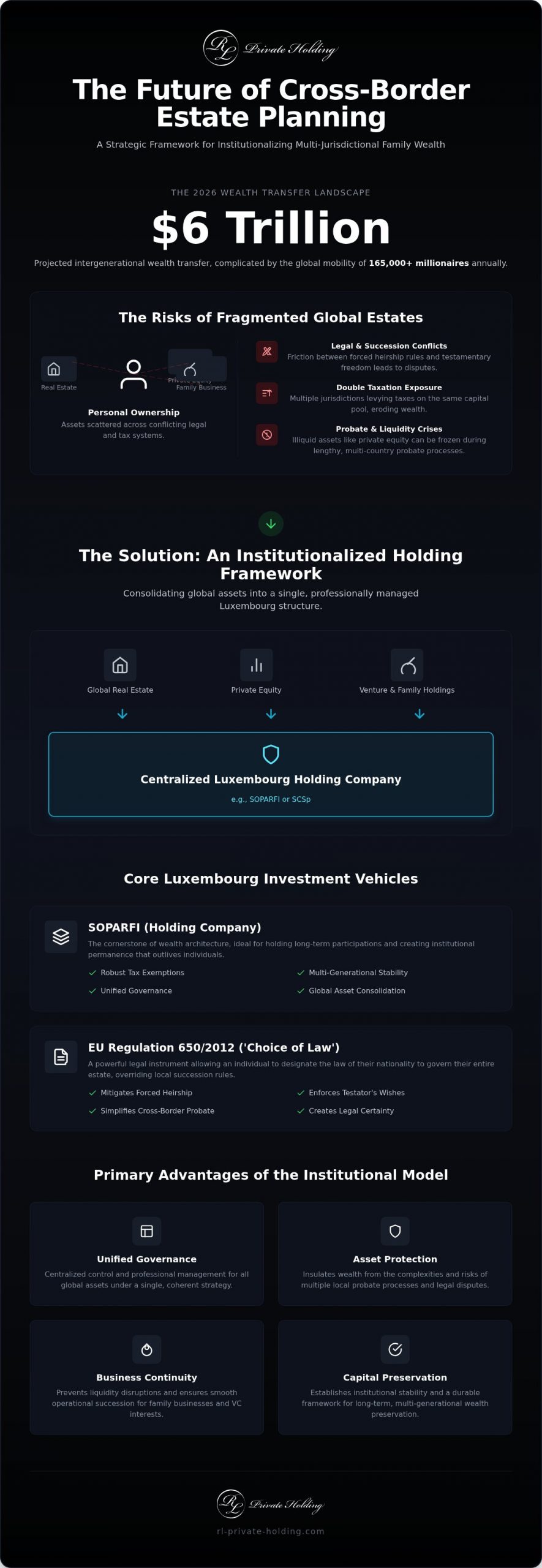
An estimated US$6 trillion in intergenerational wealth is projected to be transferred in 2026, yet many global estates remain vulnerable to the fragmentation of multi-jurisdictional legal frameworks. For international families, the friction between conflicting succession laws and the tax exposure on illiquid private equity holdings presents a genuine risk to long-term capital preservation. Effective cross-border estate planning for HNWIs Luxembourg requires a transition from personal asset ownership to a sophisticated, institutionalized holding company model.
This article provides a comprehensive analysis of how these structures create a unified governance framework to mitigate legal conflicts and consolidate diverse global holdings. It’s understood that maintaining control over forced heirship requirements while optimizing for tax efficiency requires a disciplined approach to asset location and entity selection. We will evaluate the 2026 strategic framework for leveraging Luxembourg’s legal stability, including the integration of private equity and real estate assets into a professionalized management hierarchy. This examination covers the latest regulatory updates and the technical nuances of institutionalized family wealth management.
Key Takeaways
- Understand the mechanisms for transitioning fragmented global assets into a professionalized institutional framework using Luxembourg SOPARFI and SCSp structures.
- Identify how to leverage the ‘Choice of Law’ clauses within EU Regulation 650/2012 to mitigate the risks associated with conflicting succession laws and forced heirship.
- Develop a strategic approach to cross-border estate planning for HNWIs Luxembourg that consolidates diverse private equity and real estate holdings under a single governance model.
- Establish protocols to protect venture capital interests and family businesses from liquidity disruptions during the probate process across multiple jurisdictions.
- Evaluate the advantages of shifting toward a professionally managed holding company to ensure institutional stability and long-term capital preservation for multi-generational estates.
The Complexity of Cross-Border Wealth Transfer for HNWIs
Cross-border estate planning is the strategic harmonization of legal, tax, and administrative frameworks across multiple jurisdictions to facilitate the seamless transfer of wealth to future generations. In the 2026 regulatory environment, the scale of global wealth migration has reached unprecedented levels, with approximately 165,000 millionaires projected to relocate internationally this year. This mobility necessitates a shift from traditional individual wills toward institutionalized holding structures. Luxembourg serves as a primary hub for this consolidation due to its political stability and sophisticated investment vehicles. By centralizing assets within a single jurisdiction, individuals can implement comprehensive Wealth management strategies that transcend the limitations of local probate processes.
The primary risks in multi-jurisdictional transfers include double taxation on a single capital pool and the conflict between civil law forced heirship and common law testamentary freedom. These legal frictions often lead to protracted litigation and the erosion of family capital. Consequently, sophisticated investors are increasingly adopting the “Luxembourg Advantage,” using entities like the SOPARFI to create a layer of institutional permanence that survives the individual. This approach provides a unified governance framework that mitigates the unpredictability of diverse local regulations.
Domicile vs. Residence: The 2026 Landscape
Residency in Luxembourg significantly influences an individual’s global tax exposure. Tax authorities increasingly apply the “center of vital interests” test, which evaluates personal, economic, and social ties rather than mere physical presence. The 2026 bilateral tax treaty updates between Luxembourg and major EU partners have refined these definitions to prevent tax arbitrage. Understanding these nuances is critical for effective cross-border estate planning for HNWIs Luxembourg, as it determines which jurisdiction holds the primary taxing rights over worldwide income and inheritance. It’s essential to establish a clear fiscal domicile to avoid the complexities of dual residency claims.
The Challenge of Fragmented Global Assets
Managing an estate that includes real estate in one country and private equity in another creates significant legal friction. Differing valuation standards often lead to inconsistent inheritance tax calculations, which can create liquidity crises for heirs during the probate period. For instance, a property in a civil law jurisdiction may be subject to rigid forced heirship rules that contradict the distribution plan of a private equity portfolio held in a common law territory. Cross-border estate planning for HNWIs Luxembourg is the process of resolving these jurisdictional discrepancies to ensure that a unified distribution strategy remains legally enforceable across all borders. This professionalized oversight ensures that asset valuation remains consistent, regardless of the physical location of the underlying holdings.
Leveraging Luxembourg Investment Structures for Estate Institutionalization
Institutionalizing family wealth through Luxembourg investment vehicles transforms individual asset ownership into a structured corporate framework. This shift is vital for effective cross-border estate planning for HNWIs Luxembourg, as it allows for the transfer of equity units or partnership interests rather than the physical assets themselves. By holding global real estate, private equity, and venture capital within a single entity, families avoid the administrative burden of multiple local probate procedures. Centralized management under a Luxembourg holding company ensures that governance remains consistent, regardless of the geographic location of the underlying investments. This model provides a layer of institutional permanence that individual wills cannot replicate.
The SOPARFI as a Multi-Generational Vehicle
The SOPARFI (Société de Participations Financières) remains the cornerstone of Luxembourg’s wealth architecture. It provides a robust tax participation exemption regime, which typically exempts dividends and capital gains from qualifying participations. As of January 2026, the aggregate corporate tax rate for a SOPARFI in Luxembourg City is approximately 23.87%, while the annual net wealth tax is 0.5% on worldwide net assets. These structures allow for the distinct segregation of asset classes, ensuring that high-risk venture capital holdings don’t compromise the security of core real estate portfolios. Governance is further professionalized through the allocation of board seats and specific voting rights, which serve as precise tools for succession control. This level of technical oversight is often highlighted in the OECD report on inheritance taxation as a method for maintaining fiscal transparency across borders.
Alternative Investment Funds (AIFs) in Succession
For ultra-high-net-worth individuals requiring bespoke governance, the Luxembourg Special Limited Partnership (SCSp) offers unparalleled flexibility. Unlike traditional corporations, the SCSp allows for a contractual definition of management rights and profit distributions. This is particularly effective when integrating private equity investment management into the family’s long-term strategy. In 2026, the Reserved Alternative Investment Fund (RAIF) has become increasingly popular for family offices due to its rapid time-to-market, as it doesn’t require direct CSSF approval. However, the implementation of AIFMD II has introduced enhanced requirements for liquidity risk management and transparency. Utilizing these institutional vehicles provides the “quiet authority” necessary to manage complex global estates. Families often utilize professional wealth management services to ensure these structures maintain institutional gravity and comply with evolving international standards.
Harmonizing EU Succession Regulations with Global Portfolios
EU Regulation 650/2012, known as Brussels IV, remains the cornerstone of multi-jurisdictional succession management in 2026. It establishes that the law of the state in which the deceased had their habitual residence at the time of death governs the succession as a whole. For international families, this default rule can lead to unintended consequences, particularly when moving between common law and civil law jurisdictions. Cross-border estate planning for HNWIs Luxembourg focuses on the “Choice of Law” provision, which allows individuals to designate the law of their nationality to govern their entire estate. This election provides a vital mechanism for maintaining testamentary freedom and ensures that a single legal framework applies to assets distributed across various borders.
The Choice of Law Provision
Drafting a choice of law clause requires precision to ensure it is recognized by both Luxembourg authorities and foreign courts. While Brussels IV provides a unified framework within the EU, its reach is often limited by the principle of lex rei sitae regarding real estate located in third-party countries such as the United States or the United Kingdom. For example, a UK national residing in Luxembourg may elect English law to govern their global estate, yet British courts may still apply local law to UK-situated land. A common strategic solution involves harmonizing a UK-based trust with a Luxembourg holding company. By transferring the title of foreign real estate to a Luxembourg entity, the asset is reclassified as movable property, which then falls under the scope of the elected national law.
Forced Heirship and Asset Protection
Luxembourg civil law mandates a “reserve” portion, which is a protected share of the estate that must pass to direct descendants. This requirement often conflicts with the objectives of individuals who prefer discretionary distribution. To mitigate these restrictions, practitioners utilize specific financial instruments and corporate structures within the context of cross-border estate planning for HNWIs Luxembourg. Life insurance contracts issued by Luxembourg providers are frequently employed because the death benefits generally fall outside the legal scope of the estate’s reserve calculation. Additionally, the use of institutional holding companies allows for the professionalized management of family wealth through equity units that are transferred according to the entity’s bylaws rather than rigid civil codes. The 2026 legal consensus confirms that public policy exceptions are rarely invoked to override a valid choice of law, provided the election is not manifestly incompatible with fundamental legal principles.
Strategic Asset Protection and Business Succession Planning
Effective cross-border estate planning for HNWIs Luxembourg must account for the high-stakes nature of private equity and venture capital portfolios. Unlike liquid equities, these assets often carry complex valuation requirements and restrictive transfer provisions. As of January 2026, Luxembourg’s new carried interest regime classifies performance-based income as extraordinary income, which significantly alters the tax profile of an estate during transition. Professionalizing the management of these holdings through a centralized structure prevents the liquidity crises that typically occur when individual owners pass away. This ensures that capital calls and operational decisions continue without interruption, maintaining the institutional gravity of the family office.
The integration of diverse asset classes into a unified governance framework protects the family business from the fragmentation of probate. In multi-jurisdictional contexts, the absence of a clear succession plan for unquoted shares can lead to a total freeze of voting rights. By utilizing a Luxembourg holding entity, families can establish clear protocols for the transfer of management authority. This structural permanence is essential for preserving the value of venture capital Luxembourg holdings, where the timing of exits and reinvestment is critical to portfolio performance.
Succession in Private Equity and VC Portfolios
Valuing growth-stage technology firms within an estate requires a sophisticated methodology that accounts for market volatility and future funding rounds. In 2026, the transition of General Partner (GP) and Limited Partner (LP) interests is best managed through a Luxembourg Special Limited Partnership. This structure allows for the seamless transfer of economic rights to heirs while retaining the investment strategy under the control of professional managers. Continuity is maintained through:
- Pre-defined governance clauses that dictate voting power upon the death of a key principal.
- The use of sub-funds to segregate specific vintage years of private equity investments.
- Alignment of next-generation beneficiaries with the long-term investment horizon of the portfolio.
Institutional families seeking to professionalize their succession protocols should consider wealth management services that specialize in these complex alternative asset classes.
Real Estate Asset Protection
International real estate portfolios are frequently exposed to ‘Situs’ tax risks, where foreign jurisdictions impose heavy inheritance taxes based on the physical location of the property. Using Luxembourg PropCos (Property Companies) to hold these assets reclassifies the ownership from direct real property to movable equity units. This strategy is particularly effective for managing commercial holdings across Europe and North America. It allows for the professionalized real estate asset management of the family’s global footprint under a single jurisdiction. Governance frameworks within these PropCos can be tailored to include next-generation members in advisory roles, facilitating a gradual transfer of responsibility without compromising the stability of the core assets.
The Role of a Private Holding Company in Wealth Preservation
The transition from a family-led model to a professionally managed governance structure is a defining characteristic of successful wealth preservation in 2026. For international families, the risks of informal management are amplified by the complexity of multi-jurisdictional tax and legal requirements. Cross-border estate planning for HNWIs Luxembourg increasingly relies on the institutional gravity provided by private holding companies. These entities act as a steady hand, ensuring that strategic focus remains on long-term capital preservation rather than short-term family dynamics. RL Private Holding provides the structural framework necessary for long-term strategic exits, managing the transition of private equity and real estate portfolios with the discipline required for institutional-grade assets.
Institutional Governance vs. Family Management
Adopting a corporate governance model within a family office involves the appointment of independent directors and professional asset managers. This separation of ownership from management reduces the potential for family conflict by establishing clear corporate bylaws and investment mandates. Professional oversight ensures that fiduciary duties are met with technical precision, which is particularly important when dealing with the increased substance requirements of 2026. By engaging with private wealth management firms Luxembourg, families can access the specialized expertise needed to maintain structural integrity across diverse sectors. This institutionalized approach provides the professional distance required to make objective decisions regarding asset allocation and risk management.
Preparing the Next Generation
Effective succession requires more than the transfer of legal title; it demands a comprehensive educational framework for heirs. Holding company structures allow for phased transition plans where next-generation members are gradually introduced to institutional asset management through observer roles or junior board positions. This methodical approach ensures that beneficiaries understand the governance protocols and investment principles that underpin the family estate. The final step in any robust strategy for cross-border estate planning for HNWIs Luxembourg is conducting a 2026 “stress test” of the current structure. This process evaluates the estate’s resilience against hypothetical liquidity crises, regulatory shifts, and jurisdictional conflicts.
Before finalizing a strategic framework, HNWIs should review the following technical checklist:
- Verify the validity of the “Choice of Law” clause under the latest Brussels IV interpretations.
- Assess the substance and economic presence of all Luxembourg-based SOPARFI or SCSp entities.
- Ensure sufficient liquidity is available within the holding structure to cover potential inheritance tax liabilities on illiquid assets.
- Review corporate bylaws to confirm that voting rights and management authority are clearly defined for all succession scenarios.
- Confirm that all bilateral tax treaty updates for 2026 have been integrated into the global distribution plan.
Professionalized management transforms a collection of private assets into a durable institutional legacy, providing the stability and exclusivity required for the modern global financial landscape.
Advancing Toward Institutional Wealth Governance
The 2026 regulatory landscape demands a shift from personal wealth management to a disciplined, institutionalized framework. By centralizing global portfolios within Luxembourg’s sophisticated legal environment, families can successfully mitigate the risks of conflicting succession laws and fragmented asset distribution. Effective cross-border estate planning for HNWIs Luxembourg requires the integration of private equity and real estate holdings into a unified governance model. This approach ensures that capital preservation remains the priority throughout the intergenerational transfer process. Establishing structural permanence through specialized SOPARFI and SCSp vehicles provides the stability necessary to navigate complex international requirements.
RL Private Holding is headquartered in the global financial hub of Luxembourg and provides institutional-grade wealth and private equity management for sophisticated portfolios. We offer the professionalized oversight required to maintain structural integrity across diverse sectors and jurisdictions. Explore Strategic Investment Management with RL Private Holding to professionalize your family’s legacy and secure a durable institutional future.
Frequently Asked Questions
What is the primary benefit of cross-border estate planning in Luxembourg for HNWIs?
The primary benefit is the consolidation of fragmented global assets into a single, stable jurisdiction that offers institutional-grade governance. This centralization simplifies the administration of multi-jurisdictional holdings, such as private equity and international real estate. It’s an essential component of cross-border estate planning for HNWIs Luxembourg, as it provides a unified legal framework. This structure reduces the risks associated with conflicting local probate laws and ensures consistent management across the entire estate.
How does EU Regulation 650/2012 (Brussels IV) affect my Luxembourg estate?
EU Regulation 650/2012 establishes that the law of your habitual residence governs your succession unless you formally elect the law of your nationality. This “Choice of Law” provision is a critical tool for HNWIs who wish to maintain testamentary freedom over their global assets. Without this election, Luxembourg’s civil law and forced heirship rules might apply by default. The regulation provides a predictable framework for assets located across the European Union, excluding certain third-party real estate.
Can I avoid forced heirship in Luxembourg using a holding company?
Utilizing a holding company reclassifies immovable assets as movable property, which can provide greater flexibility under specific succession laws. While Luxembourg civil law protects the “reserve” share for direct descendants, corporate structures like the SOPARFI allow for the transfer of equity units rather than physical assets. This reclassification, combined with the strategic use of life insurance contracts, helps mitigate rigid forced heirship restrictions. These vehicles ensure that the distribution of wealth aligns with the principal’s long-term objectives.
What are the tax implications of transferring private equity interests to my heirs?
Transferring private equity interests in 2026 involves navigating the new carried interest regime, which classifies such gains as extraordinary income. Under Luxembourg law, inheritance tax for direct descendants and surviving spouses is generally 0% on their legal share. However, the valuation of growth-stage technology holdings requires technical precision to ensure compliance with international tax standards. Professionalized management of these interests prevents liquidity disruptions for heirs during the valuation and probate process.
How does a Luxembourg SOPARFI help with international real estate succession?
A Luxembourg SOPARFI reclassifies foreign real estate into movable equity shares, which helps mitigate “Situs” tax risks in jurisdictions like the United Kingdom or the United States. This reclassification ensures that the property is governed by the holding company’s bylaws rather than the local probate laws of the country where the asset is physically located. It simplifies the succession process by avoiding multiple local administrative requirements. This centralized approach is a cornerstone of cross-border estate planning for HNWIs Luxembourg.
Is a Luxembourg trust or a holding company better for estate planning in 2026?
A holding company structure is typically preferred over a trust in 2026 due to its clear recognition within civil law jurisdictions and its ability to demonstrate economic substance. While trusts are common in common law regions, Luxembourg’s SOPARFI and SCSp vehicles provide comparable flexibility with greater institutional gravity. These corporate structures are better suited for managing active private equity and real estate portfolios. They offer a transparent framework that aligns with modern EU transparency and reporting requirements.
How often should an HNWI review their cross-border estate structure?
HNWIs should conduct a comprehensive review of their estate structure at least every two years or whenever significant regulatory changes occur. The 2026 updates to bilateral tax treaties and EU succession interpretations necessitate a “stress test” of existing frameworks to ensure ongoing compliance. Changes in family circumstances or the acquisition of assets in new jurisdictions also require immediate professional evaluation. Regular reviews maintain the resilience of the estate against evolving global fiscal policies and legal precedents.
What role does professional management play in family business succession?
Professional management ensures the continuity of investment strategies and reduces the potential for family conflict during the transition of authority. By implementing clear corporate bylaws and investment mandates, an institutional manager provides the “quiet authority” needed to govern complex portfolios. This transition from family-led to professionally-managed governance is vital for preserving the value of unquoted shares and venture capital holdings. It secures the family’s legacy by applying disciplined, objective standards to all succession decisions.