

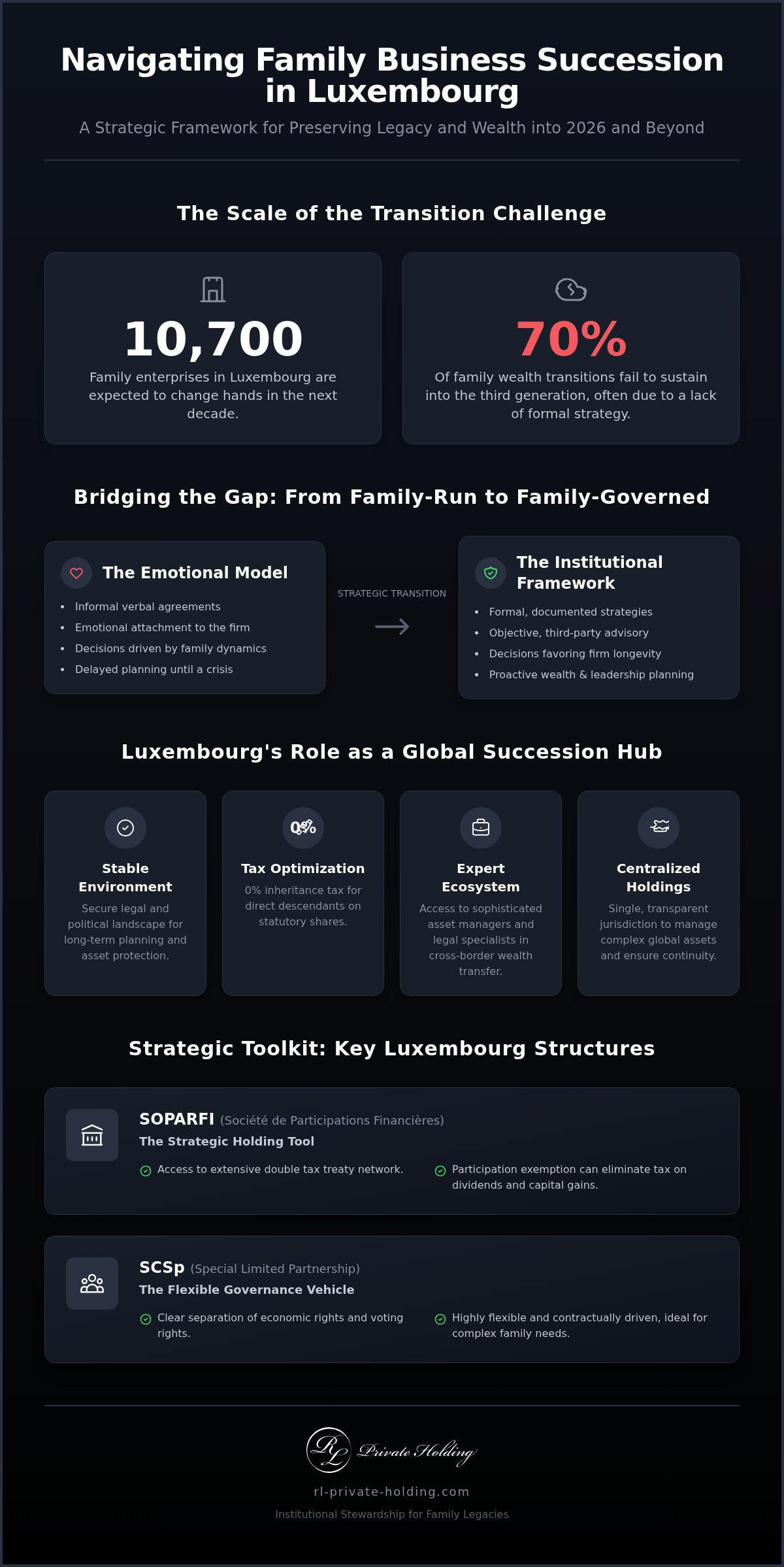
Approximately 10,700 family enterprises in Luxembourg are expected to change hands over the next decade. Despite the immense value held within these organizations, research suggests that a significant portion of firms lack a confirmed successor or a formal roadmap for the future. Effective succession planning for family businesses Luxembourg requires more than a simple handoff. It demands a sophisticated institutional framework to preserve wealth and operational integrity across generations.
You likely recognize that the preservation of a legacy involves balancing sensitive family dynamics with rigorous legal and fiscal requirements. The fear of family conflict or the erosion of assets through high tax exposure is a legitimate concern for any established principal. This guide provides a strategic framework for 2026, offering a path toward seamless management transfer and tax optimization. We’ll examine how to leverage Luxembourg’s stable financial environment, including the 0% inheritance tax for direct descendants on statutory shares, to ensure your enterprise maintains its momentum and long-term institutional continuity.
Key Takeaways
- Identify the critical factors driving the necessity for formal transition strategies within the 2026 Luxembourg regulatory environment.
- Compare the technical utility of SOPARFI and SCSp structures for consolidating family assets and facilitating flexible governance.
- Navigate the complexities of succession planning for family businesses Luxembourg by integrating institutional-grade wealth management and asset protection.
- Learn how to transition a legacy enterprise into a professional investment holding to enhance long-term portfolio resilience.
- Define the role of family constitutions and professional management in ensuring a seamless transfer of leadership and vision.
The Imperative of Strategic Succession Planning in Luxembourg
Succession planning is the institutionalized process of transferring both management leadership and equity ownership from one generation to the next. In the 2026 economic environment, this is no longer a matter of simple inheritance or informal verbal agreements. Family enterprises face heightened global competition and rigorous regulatory scrutiny, necessitating a move toward formal, documented strategies. A well-structured plan ensures that the firm’s core values remain intact while adapting to modern market demands.
Statistics from industry research suggest that roughly 70% of family wealth transitions fail to sustain themselves beyond the third generation. This failure often stems from a lack of structural frameworks rather than business insolvency. In Luxembourg, where approximately 10,700 family businesses are projected to change hands within the decade, the risk of value erosion is high. Effective succession planning for family businesses Luxembourg requires a clear distinction between ownership succession, which involves the transfer of equity and control, and management succession, which focuses on operational leadership. Separating these two functions allows a family to retain control through ownership while potentially employing external professional management to drive growth.
The Emotional vs. Institutional Gap
Founders frequently encounter psychological barriers when contemplating a departure from a firm they built. This emotional attachment can delay critical decision-making, often until a crisis occurs. Transitioning from a “family-run” model to a “family-governed” framework allows the business to function as an independent institution. It’s vital to establish clear boundaries between family interests and corporate requirements. Objective third-party advisors play a critical role here. They mediate generational transitions and ensure that decisions favor the firm’s longevity over interpersonal dynamics, helping to bridge the gap between legacy and future strategy.
Luxembourg’s Role as a Global Succession Hub
The stability of the Luxembourg legal and political landscape provides a secure foundation for long-term planning. Its sophisticated ecosystem of asset managers and legal experts offers specialized knowledge in cross-border wealth transfer. As a global financial center, Luxembourg enables families to centralize their holdings within a single, transparent jurisdiction. This centralization is essential for managing the complexities of modern wealth while maintaining institutional continuity across different markets. The jurisdiction’s predictable regulatory environment and access to diverse investment vehicles make it an ideal base for families seeking to protect their assets for multiple generations.
Structural Vehicles for Multi-Generational Wealth Preservation
Selecting the appropriate legal vehicle is a foundational step in succession planning for family businesses Luxembourg. The choice of structure determines how assets are protected, how taxes are optimized, and how control is maintained during a generational shift. Luxembourg offers a suite of specialized entities designed to accommodate the complex requirements of multi-generational wealth, each serving a specific strategic purpose within a broader framework.
The SOPARFI as a Strategic Holding Tool
The Société de Participations Financières (SOPARFI) remains the standard vehicle for holding family business shares. It functions as a fully taxable commercial company, providing access to Luxembourg’s extensive double tax treaty network. A primary advantage lies in the participation exemption regime. This regime can eliminate taxes on dividends and capital gains if specific holding criteria are met, significantly reducing the costs associated with asset reorganization. By integrating private equity investment management into a SOPARFI, families can manage their core business alongside a diversified portfolio of alternative investments. This structure supports a professionalized approach to wealth, treating the family enterprise as a high-value asset within a global investment strategy.
The Special Limited Partnership (SCSp) for Governance
The Special Limited Partnership (SCSp) has become increasingly popular for its flexibility in family governance. Unlike traditional corporate structures, the SCSp allows for a clear separation between economic rights and voting rights. This enables founders to transfer the financial benefits of the business to the next generation while retaining management control through the General Partner (GP) role. Partnership agreements can be drafted with high precision to reflect specific family values or conflict resolution protocols. For those requiring technical depth on this vehicle, our Luxembourg special limited partnership guide provides detailed structural insights. Using the SCSp ensures that leadership remains in capable hands while the broader family benefits from the enterprise’s success.
The Société de gestion de Patrimoine Familial (SPF) offers an additional layer for managing private wealth. While it cannot engage in commercial activities, it serves as a tax-exempt vehicle for holding financial instruments, cash, and precious metals. It’s an effective tool for separating private family liquidities from the operational risks of the business. These structures, when combined, facilitate a tax-efficient wealth transfer. In 2026, direct descendants in Luxembourg continue to benefit from a 0% inheritance tax rate on their statutory shares. Utilizing these vehicles correctly ensures that this exemption is maximized while institutional stability is preserved. Strategic wealth management services can help align these legal structures with your long-term family objectives.
Transitioning from Family Business to Family Investment Holding
The evolution of a family enterprise often culminates in its transformation into a professional investment holding. This strategic shift requires principals to view the operating company as a single component within a diversified institutional portfolio. Such a transition is a critical phase of succession planning for family businesses Luxembourg, as it decouples family wealth from the operational risks of a specific industry. By centralizing assets within a Luxembourg holding structure, families can facilitate the reinvestment of business proceeds into high-growth sectors, such as venture capital Luxembourg, ensuring the legacy remains relevant in a changing global economy.
This model also addresses the common challenge of providing liquidity to non-active family members. While some heirs may wish to lead the firm, others may prefer a purely financial interest. A holding company structure allows for the distribution of dividends sourced from a diversified range of assets. This mechanism satisfies the financial needs of all stakeholders without compromising the capital required for the core operating business. It transforms the family’s relationship with the business from one of direct employment to one of institutional oversight.
Diversification as a Risk Mitigation Strategy
Over-reliance on a single operating entity creates significant vulnerability to market shifts. Professionalizing the management of non-core assets, including real estate asset management Luxembourg and private equity, creates a buffer against sector-specific downturns. This approach transforms the family legacy from a single-revenue stream into a resilient multi-asset class portfolio. Private equity, in particular, offers a mechanism for capital preservation across generations by providing exposure to non-correlated markets. Such diversification is essential for maintaining the family’s purchasing power over long time horizons.
Institutionalising the Family Office
Moving away from informal management requires a structured family office investment strategy. This institutionalization involves the creation of an Investment Policy Statement (IPS), which defines the family’s risk tolerance, return objectives, and ethical values for future generations. Consolidated reporting and professional oversight ensure that all assets are monitored with the same level of rigor as the original family business. This discipline projects stability and transparency; it’s essential for maintaining family cohesion during complex wealth transfers. By establishing these frameworks, the family ensures that its investment decisions are based on objective criteria rather than emotional consensus.
Establishing Robust Family Governance and Professional Management
Succession planning for family businesses Luxembourg requires more than just the selection of a legal vehicle; it demands a robust governance framework to manage the human capital of the enterprise. While the SOPARFI or SCSp provides the structural hardware, governance acts as the essential software that directs decision-making and preserves family unity. Transitioning from a founder-led model to an institutionalized holding company requires a disciplined approach to leadership that balances family interests with commercial necessity.
The Family Constitution and Charter
A Family Constitution serves as the foundational document for defining the rules of engagement between the family and the business. It formalizes the family’s values and vision, providing a roadmap for future generations. This charter should clearly define the criteria for family members to enter the business, as well as the protocols for those wishing to exit their shareholdings. Establishing a family council is a critical step in this process. This body acts as a forum for strategic alignment, allowing family members to voice concerns and reach consensus without disrupting the operational management of the firm.
Professionalising the Board of Directors
As a family enterprise grows in complexity, the board of directors must evolve beyond a collection of relatives. Professionalizing the board involves selecting members with complementary skill sets in legal, financial, and operational disciplines. Integrating independent directors is particularly valuable; they provide an objective perspective that family members may lack. This independent oversight is essential for preventing deadlock and ensuring that the board remains focused on long-term wealth management Luxembourg goals rather than short-term emotional interests.
Effective boards in 2026 prioritize the education and onboarding of the “Next Gen.” This involves structured programs that prepare heirs for their future roles as either active managers or responsible shareholders. Key focus areas for these programs include:
- Fiduciary responsibilities and corporate governance principles.
- Understanding the financial reporting of a Luxembourg holding company.
- Conflict resolution and collaborative decision-making techniques.
- The strategic role of the family’s Investment Policy Statement.
The presence of external experts on the board ensures that the firm adheres to international standards of transparency and accountability. This institutional discipline is vital for maintaining the business’s momentum during and after a leadership transition. To discuss the governance requirements of your multi-generational enterprise, contact the specialists at RL Private Holding.
RL Private Holding: Institutional Stewardship for Family Legacies
RL Private Holding serves as a disciplined partner for families seeking to institutionalize their legacies. Our firm approaches the transition of wealth through the lens of institutional-grade portfolio management, ensuring that the core values of the family are preserved within a modern corporate framework. Succession planning for family businesses Luxembourg is viewed not merely as a transfer of assets but as a strategic evolution from an operating entity to a diversified investment holding. We provide the technical expertise required to navigate this shift, allowing principals to step back with confidence in the firm’s long-term stability.
Our team leverages extensive experience in Private Equity and Real Estate Asset Management to drive growth within the family portfolio. By treating the family business as a high-value asset among a broader range of investments, we help mitigate the risks associated with industry-specific volatility. This discreet advisory service is tailored to the unique requirements of high-net-worth structures, focusing on capital preservation and the seamless integration of next-generation leaders into the governance framework. It’s a methodical process that ensures the family enterprise remains a viable engine for wealth creation across multiple generations.
A Global Partner with National Expertise
Headquartered in Luxembourg, RL Private Holding serves global families with a level of precision that only a local presence can provide. We offer access to institutional-grade investment management, utilizing a performance-based fee structure that aligns our interests with the long-term success of the family enterprise. Our commitment to transparency and stability ensures that the family’s assets are managed with the highest degree of professional rigor. We operate as a steady hand in the background, providing the strategic focus necessary to navigate the complexities of global financial markets while maintaining a clear focus on the family’s underlying principles.
Next Steps for Your Succession Strategy
Developing a robust framework for the future requires a methodical approach to both current operations and long-term objectives. A successful transition is typically the result of a multi-year roadmap that addresses the following critical areas:
- A comprehensive audit of the current business and wealth structure to identify potential vulnerabilities.
- The definition of a transition roadmap that aligns with the family’s specific values and time horizons.
- The establishment of formal governance protocols to manage generational leadership shifts.
- The implementation of tax-efficient structures to protect and optimize family assets.
Establishing a legacy that lasts for generations doesn’t happen by accident. It requires a clear plan and a high level of internal discipline. For a confidential consultation regarding the institutional stewardship of your family’s legacy and the advancement of your succession planning for family businesses Luxembourg, reach out to the advisors at RL Private Holding.
Securing the Institutional Future of the Family Enterprise
Effective succession planning for family businesses Luxembourg requires a shift from informal, founder-led management to a structured, institutional framework. By leveraging specialized vehicles like the SOPARFI and SCSp, families can navigate the 2026 regulatory landscape while maintaining control and optimizing tax exposure. The transformation of a legacy business into a diversified investment holding company ensures that capital remains resilient across multiple generations. This evolution allows for the professionalization of non-core assets and the implementation of robust governance through formal family constitutions.
RL Private Holding provides the discreet expertise necessary to manage these complex transitions with precision. Our firm specializes in Luxembourgish holding structures and offers institutional-grade Private Equity and Real Estate management to drive long-term growth. As a global investment holding company, we prioritize stability and capital preservation for high-stakes family legacies. Our methodical approach ensures that your strategic objectives are met with transparency and institutional discipline.
Partner with RL Private Holding for institutional succession planning and wealth management. Your commitment to early and strategic planning today will serve as the foundation for your family’s enduring prosperity.
Frequently Asked Questions
What are the primary tax implications of succession planning for family businesses in Luxembourg?
The primary tax advantage in Luxembourg is the 0% inheritance tax rate applied to the statutory shares of direct descendants and surviving spouses. For taxable inheritances exceeding €10,000, a surcharge is applied, which can reach a multiplier of 3.2 for amounts over €1,750,000. Lifetime transfers are subject to gift tax rates for direct descendants ranging from 1.8% to 2.4%, depending on the specific registration requirements.
How can a Luxembourg SOPARFI facilitate a smoother business transition?
A SOPARFI facilitates a transition by centralizing diverse business interests under a single holding entity, which simplifies the eventual transfer of equity to heirs. It allows the family to utilize the participation exemption regime to minimize taxes on dividends and capital gains from subsidiaries. This structure provides a stable framework for consolidating international assets and professionalizing the management of the family’s global portfolio.
What is the difference between management and ownership succession in a family firm?
Management succession involves the transfer of operational leadership and daily decision-making responsibilities, whereas ownership succession concerns the transfer of equity and voting control. It’s common in succession planning for family businesses Luxembourg to separate these functions to ensure the firm is led by the most capable individuals while the family retains long-term control. This distinction allows for the appointment of external professional managers without relinquishing the family’s underlying ownership rights.
When should a family business start the succession planning process?
A family business should ideally begin the succession planning process at least five years before the intended transfer of leadership or ownership. This lead time is necessary to complete legal restructurings, optimize tax positions, and prepare the next generation for their future responsibilities. Given that approximately 10,700 family businesses in Luxembourg are expected to change hands within the decade, early preparation is critical to avoid a succession gap that could threaten business continuity.
Succession planning for family businesses Luxembourg is a multi-year commitment that requires regular reviews to adapt to changing regulatory environments. Starting early ensures that all legal and financial frameworks are robustly tested before a formal transition occurs.
Can an SCSp structure help maintain founder control while transferring ownership?
The Special Limited Partnership (SCSp) is specifically designed to allow for the separation of management control from economic rights. A founder can retain full decision-making authority by acting as the General Partner, while the next generation receives economic interests as Limited Partners. This flexibility enables a gradual transition of financial benefits without the founder immediately losing the ability to direct the firm’s strategic vision.
How does professional wealth management assist in intergenerational continuity?
Professional wealth management assists in continuity by protecting family assets from market volatility and diversifying wealth beyond the core operating business. It provides an institutional framework for managing liquidities, real estate, and private equity investments under a unified strategy. This discipline ensures that the family’s purchasing power is preserved and that the legacy is not overly dependent on the performance of a single industry.
What role does independent directorship play in family business governance?
Independent directors bring objective expertise to the board, which is essential for mitigating emotional bias and preventing family deadlocks during critical transitions. They provide specialized knowledge in finance, law, or operations that may not be present within the family circle. Their presence enhances the firm’s institutional credibility and ensures that decision-making remains aligned with the long-term goals of the holding company.
How can private equity strategies be integrated into a family succession plan?
Private equity strategies are integrated by reinvesting business proceeds into a diversified range of non-correlated assets to enhance the resilience of the family portfolio. This approach shifts the family’s focus from a single operating company to a broader investment holding model managed with institutional rigor. By adopting private equity principles, families can drive growth and capital preservation, ensuring the legacy remains relevant as market conditions evolve.