

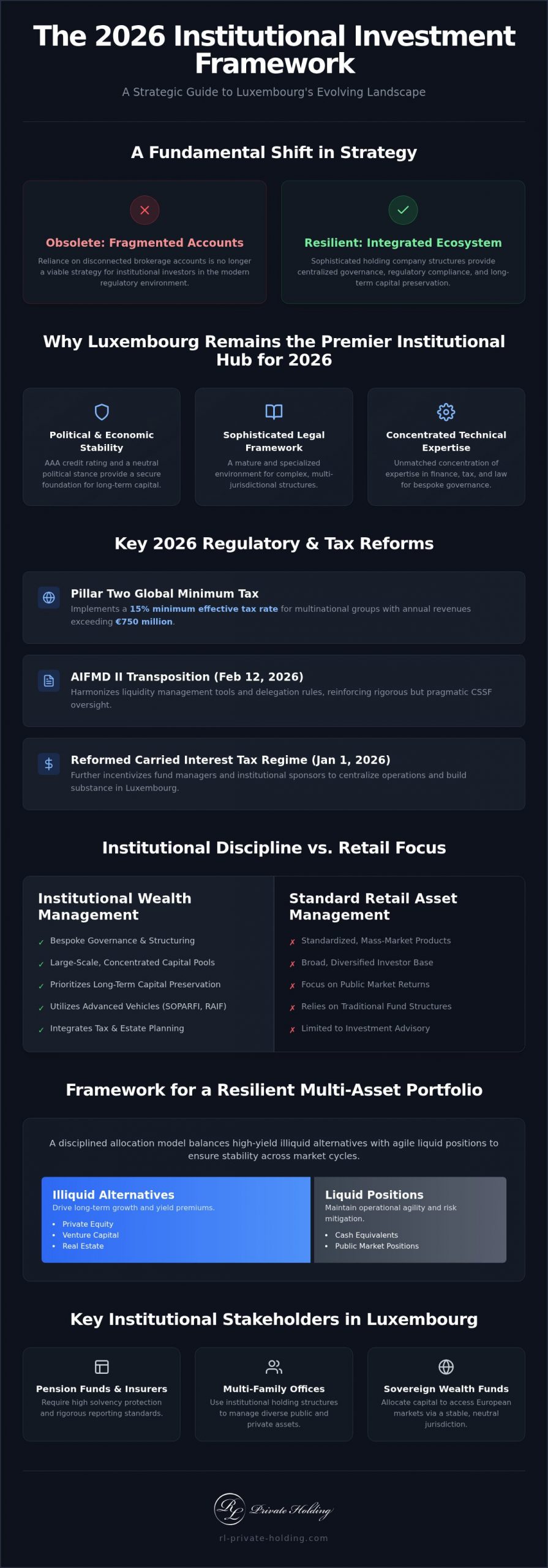
The traditional reliance on fragmented brokerage accounts has become an obsolete strategy for the modern institutional investor. As global markets transition toward a more integrated model of asset governance, the most resilient capital structures are no longer defined by simple diversification, but by the sophistication of the underlying holding company ecosystem. You likely recognize that the 2026 regulatory environment, characterized by the implementation of the Pillar Two global minimum tax and the recent transposition of AIFMD II, demands a more rigorous and centralized approach to institutional wealth management Luxembourg.
This article provides an authoritative analysis of the current landscape, offering a strategic framework for multi-asset portfolio structuring that prioritizes both growth and regulatory compliance. We will examine how the January 2026 reforms to the carried interest tax regime and the 15% minimum effective tax rate for large groups necessitate a shift in how private equity and venture capital assets are managed. By the conclusion of this review, you will possess a clear understanding of Luxembourg investment structures and a disciplined blueprint for identifying a stable, long-term investment partner within this evolving jurisdiction.
Key Takeaways
- Understand why Luxembourg remains the premier hub for institutional capital in 2026 and how to distinguish institutional strategies from standard retail asset management.
- Learn how to construct a resilient multi-asset portfolio that balances high-yield illiquid alternatives, such as private equity and venture capital, with liquid market positions.
- Identify the operational and tax-neutral advantages of utilizing a SOPARFI holding vehicle as a cornerstone for institutional wealth management Luxembourg compared to traditional private banking accounts.
- Gain a strategic framework for navigating the complexities of AIFMD II and integrating SFDR Article 8 and 9 requirements into your governance and reporting models.
- Evaluate the principles of institutional discipline and quiet authority required to manage a global portfolio across diverse sectors including technology and real estate.
Defining Institutional Wealth Management in the Luxembourg Context
Luxembourg has solidified its position as the primary European gateway for global capital. By 2026, the jurisdiction has moved far beyond its origins as a retail fund hub, emerging instead as a specialized environment for complex, multi-jurisdictional structures. This evolution is driven by a unique combination of political stability, a sophisticated legal framework, and a concentration of technical expertise that few other financial centers can match. For the sophisticated investor, institutional wealth management Luxembourg represents a shift away from standardized products toward bespoke governance models that prioritize long-term capital preservation.
Distinguishing between retail services and Wealth management at the institutional level is essential for strategic planning. While retail asset management focuses on standardized products for a broad investor base, the institutional approach involves the bespoke structuring of large-scale capital pools. It’s a discipline that integrates investment advisory with advanced estate planning and tax services. These structures prioritize controlled growth through sophisticated vehicles like the SOPARFI or Reserved Alternative Investment Funds (RAIF), ensuring that assets remain protected across diverse market cycles.
The Evolution of the Luxembourg Financial Centre
The transition from traditional private banking toward alternative investment dominance is now complete. The adoption of the revised AIFMD and UCITS frameworks on February 12, 2026, has harmonized liquidity management tools and delegation rules, reinforcing the CSSF’s role as a rigorous yet pragmatic regulator. This regulatory maturity ensures that institutional trust remains high, even as global tax standards like Pillar Two introduce new layers of complexity for multinational groups with revenues exceeding €750 million. The current landscape doesn’t just offer a place to store capital; it provides a platform for active, disciplined management.
Key Institutional Stakeholders
The 2026 landscape is defined by three primary capital drivers that utilize Luxembourg’s infrastructure for cross-border efficiency. These stakeholders value the jurisdiction’s ability to provide substance and transparency in an increasingly scrutinized global market.
- Pension Funds and Insurance Companies: These entities require high levels of solvency protection and clear reporting standards. Luxembourg’s regulatory environment provides the necessary safeguards for these long-term liability holders.
- Multi-Family Offices: There’s a visible shift toward using institutional-grade holding structures to manage private equity and venture capital interests alongside traditional liquid assets.
- Sovereign Wealth Funds: Global funds continue to allocate significant capital through Luxembourg to access the European market, valuing the country’s “AAA” credit rating and neutral political stance.
The reformed carried interest tax regime, effective since January 1, 2026, has further incentivized fund managers and institutional sponsors to centralize their operations here. It’s not just about tax efficiency; it’s about the operational substance required to meet modern international standards. This environment fosters a level of institutional gravity that appeals to those who prioritize stability over short-term disruption.
Strategic Asset Allocation for Institutional Portfolios
The 2026 financial landscape necessitates a transition from reactive portfolio adjustments to a proactive, multi-asset framework. This strategy is central to institutional wealth management Luxembourg, where the focus remains on capital preservation across diverse economic cycles. By balancing highly liquid cash equivalents with illiquid alternatives, institutions can maintain the agility needed for operational requirements while securing the premiums associated with long-term commitments. A disciplined allocation model ensures that volatility in public markets doesn’t compromise the overall integrity of the capital pool.
Private Equity and Venture Capital Integration
In a low-yield environment, effective growth is increasingly found within private markets. Utilizing private equity investment management provides a structured methodology for accessing mature, cash-flow-positive enterprises that operate outside of public volatility. This is complemented by venture capital Luxembourg frameworks, which target technological alpha by funding growth-stage companies in sectors like fintech and green energy.
Managing the J-curve is a critical component of this integration. It requires a methodical approach to capital calls and distributions to ensure that the early-stage valuation dips don’t disrupt liquidity. Success in these high-barrier sectors depends on sector-specific expertise; a generic approach often fails to identify the outliers capable of delivering institutional-grade returns. By focusing on disciplined entry points and clear exit strategies, investors can build a private market sleeve that serves as a powerful engine for long-term appreciation.
Real Estate as a Stabilizing Institutional Asset
Real estate continues to serve as a primary inflation hedge within a diversified portfolio. In the 2026 European market, real estate asset management Luxembourg offers both direct and indirect exposure to commercial and residential sectors. Direct ownership provides maximum control and long-term yield, while indirect structures through regulated vehicles offer enhanced diversification and professional oversight. The Commission de Surveillance du Secteur Financier (CSSF) oversees these structures, ensuring they meet the high governance standards required by institutional capital.
Current trends indicate a preference for strategic property acquisitions that prioritize sustainability and operational efficiency. These assets provide steady rental income and potential for capital gain, acting as a stabilizer against the more aggressive growth targets of venture capital. A well-ordered portfolio is the foundation of institutional permanence. Those seeking to refine their allocation strategies may benefit from a disciplined approach to wealth management services that integrates these diverse asset classes into a single, cohesive framework.
Structural Advantages: Holding Companies vs. Traditional Wealth Management
Traditional private banking models often fail to meet the requirements of sophisticated capital pools. While a standard brokerage account provides market access, it lacks the structural integrity needed to manage diverse subsidiaries or illiquid private market interests. In the context of institutional wealth management Luxembourg, the shift toward holding company ecosystems represents a move toward greater operational transparency and fiscal efficiency. These structures provide a level of control that’s simply unavailable through retail-oriented banking platforms.
The SOPARFI (Société de participations financières) remains the primary vehicle for consolidating global assets. Unlike a traditional bank account, a SOPARFI allows an institution to manage its technology and real estate holdings under a single, tax-neutral umbrella. For those requiring even greater contractual flexibility, the Luxembourg special limited partnership offers a transparent framework that’s particularly suited for private equity and venture capital allocations. This structure provides the agility to adjust to market shifts without the administrative friction of traditional banking.
The SOPARFI: The Institutional Gold Standard
The participation exemption is a cornerstone of the Luxembourg holding model. By meeting specific conditions, such as a 10% participation or a €6 million acquisition cost held for at least 12 months, entities can qualify for a full exemption on capital gains. In 2026, maintaining economic substance is no longer optional. It requires physical offices and local decision-making functions to ensure compliance with international tax standards. This structural rigor ensures that the entity remains resilient against evolving global reporting requirements and the Pillar Two minimum tax rules for large multinational groups.
The Role of Private Wealth Management Firms
Selecting private wealth management firms Luxembourg involves evaluating their ability to execute tactical strategies within these complex structures. The industry is moving away from opaque fee structures toward performance-based models that align the interests of the manager with those of the institution. This alignment is often achieved through carried interest structures, which were clarified by the 2026 tax reforms to provide reduced taxation for non-invested carry schemes. This shift reinforces a culture of discreet authority, where the focus remains on disciplined execution and long-term stability rather than short-term market noise.
Governance, Compliance, and Risk Mitigation in 2026
Governance in 2026 is defined by a shift from passive compliance to active risk oversight. The transposition of AIFMD II on February 12, 2026, has introduced stricter requirements for liquidity management and delegation; these updates are fundamental for those engaged in institutional wealth management Luxembourg. Effective risk mitigation requires a framework that anticipates regulatory shifts before they manifest as operational hurdles. This proactive stance ensures that multi-asset portfolios remain resilient in a landscape where transparency is the primary currency and institutional trust is maintained through rigorous adherence to evolving standards.
Regulatory Reporting and Transparency
The implementation of the Pillar Two global minimum tax requires a sophisticated reporting infrastructure. Multinational groups with consolidated revenues exceeding €750 million must register with tax authorities by June 30, 2026. This deadline underscores the importance of maintaining genuine economic substance for institutional wealth management Luxembourg. Holding companies must demonstrate physical presence and local decision-making to avoid the risk of regulatory friction. Ensuring transparency in family office investment strategies Luxembourg is no longer just a best practice; it’s a structural necessity. Automated reporting tools have become essential for managing these burdens, allowing institutions to focus on capital allocation rather than administrative backlog.
ESG as a Risk Management Tool
Sustainable Finance Disclosure Regulation (SFDR) Article 8 and 9 classifications have transitioned from marketing labels to core risk management tools. Institutional investors now utilize these frameworks to benchmark portfolio performance against sustainability goals. This is particularly evident in venture capital funding, where there’s a growing demand for impact alongside traditional financial alpha. ESG integration allows managers to identify long-term risks associated with climate transition and social governance that traditional metrics might overlook. By aligning investment strategies with these rigorous standards, institutions protect their reputations and secure their positions in a global market that increasingly values ethical capital.
Achieving this level of governance requires a partner with a deep understanding of the local regulatory environment. For organizations seeking to fortify their portfolios against these evolving risks, a disciplined approach to Wealth Management Services provides the necessary governance framework to ensure long-term stability and compliance.
RL Private Holding: A Disciplined Partner for Institutional Growth
RL Private Holding operates with a philosophy of quiet authority, providing the stability and institutional discipline required to manage complex capital pools in an increasingly volatile global market. As a Luxembourg-based investment holding company, the firm specializes in Venture Capital, Private Equity, and Real Estate Asset Management. This diversified approach allows for the centralization of global interests under a single strategic umbrella, which remains a cornerstone of effective institutional wealth management Luxembourg. The firm’s presence in the global financial landscape is defined by its methodical execution and its commitment to providing a steady hand in the background of major investments.
The firm presents itself as a disciplined global partner, secure in its position and focused on institutional permanence. This persona is built on a foundation of sophisticated, worldly, and highly organized operations. By prioritizing structural integrity and logical precision, RL Private Holding appeals to those who value stability and professional distance. The firm does not attempt to persuade through marketing hyperbole; instead, it projects exclusivity through a sober, factual presentation of its organizational framework and sectoral expertise.
Our Multi-Sector Investment Strategy
The investment strategy focuses on growth-stage technology and private equity, where technical expertise is utilized to identify long-term value. This is balanced by a robust real estate asset management arm designed to provide institutional stability and inflation hedging. By leveraging the technical advantages of the Luxembourg ecosystem, such as the SOPARFI and specialized investment vehicles, the firm optimizes global portfolios for both growth and compliance. The integration of technology and real estate sectors ensures that the portfolio remains resilient against market shifts while maintaining a clear focus on capital preservation.
- Growth-Stage Technology: Focusing on sectors with high barriers to entry and proven scalability.
- Private Equity: Utilizing structured methodologies to access mature, cash-flow-positive enterprises.
- Real Estate: Direct and indirect management of assets designed for long-term yield and stability.
Partnering for Long-Term Value
Alignment of interests is maintained through performance-based incentive structures, specifically utilizing the reformed carried interest regime that became effective on January 1, 2026. This ensures that the firm’s objectives are directly linked to the long-term success of the capital pool. The onboarding process begins with a comprehensive strategic portfolio review, followed by the implementation of institutional-grade governance and reporting frameworks. This methodical approach ensures that all institutional wealth management Luxembourg requirements are met with precision.
Transparency is prioritized throughout the partnership, ensuring that all stakeholders have a clear understanding of the organizational hierarchy and structural components. The firm maintains a high formality register, focusing on the structural components of the business rather than using descriptive adjectives to embellish achievements. This rhythmic consistency suggests a firm that operates with a clear plan and a high level of internal discipline. Those seeking a factual overview of current portfolio sectors and strategic focus areas may contact the team for a professional review of our institutional framework.
Strategic Governance for the Future of Institutional Capital
The evolution of the financial landscape in 2026 highlights the necessity of structural discipline. As regulatory requirements like the Pillar Two global minimum tax and AIFMD II updates redefine the operational environment, the transition from fragmented accounts to centralized holding company ecosystems is no longer optional. A robust framework for institutional wealth management Luxembourg prioritizes the integration of diversified assets, ranging from growth-stage technology to stable real estate holdings, within a tax-neutral and transparent structure.
RL Private Holding provides the Luxembourg-based institutional expertise and diversified global portfolio required to manage these complexities. Our approach is built on performance-aligned incentive structures, ensuring that our strategic focus remains consistent with the long-term objectives of our partners. By maintaining a clear organizational hierarchy and a methodical investment rhythm, we offer the stability necessary for navigating the global economy. Explore our institutional investment frameworks at RL Private Holding to secure a disciplined foundation for your capital. We look forward to supporting your strategic goals with professional distance and institutional gravity.
Frequently Asked Questions
What are the primary benefits of institutional wealth management in Luxembourg in 2026?
Primary benefits include a stable “AAA” rated environment and a sophisticated legal framework that facilitates cross-border capital preservation. By 2026, the jurisdiction provides enhanced protection through the revised AIFMD II and UCITS frameworks. These structures support institutional wealth management Luxembourg by offering clear governance and a predictable tax environment for global holding companies. This allows for the efficient consolidation of diverse international subsidiaries under a single, well-regulated jurisdiction.
How does a Luxembourg SOPARFI differ from a traditional investment fund?
A SOPARFI is a fully taxable commercial holding company that utilizes the participation exemption to achieve tax neutrality on dividends and capital gains. Unlike a traditional investment fund, which is a regulated vehicle for collective investment, a SOPARFI is designed for the management of private participations. This structure offers greater operational flexibility for institutions that don’t require the collective investment framework of a RAIF or SIF but need a robust corporate vehicle for global asset management.
What is the role of the Special Limited Partnership (SCSp) in institutional wealth management?
The Special Limited Partnership (SCSp) provides an agile, tax-transparent vehicle with significant contractual freedom for institutional investors. It’s particularly effective for private equity and venture capital allocations because it allows for bespoke governance arrangements. The SCSp lacks legal personality, which simplifies the tax reporting process for international partners. This structure ensures that management remains efficient while providing the necessary transparency required by global regulatory standards in 2026.
How does RL Private Holding manage risk across diversified asset classes?
RL Private Holding manages risk by maintaining a diversified portfolio across technology, real estate, and private equity sectors. This multi-sector approach reduces exposure to any single market volatility while ensuring steady capital appreciation. The firm utilizes institutional discipline and a methodical investment rhythm to identify growth-stage opportunities with high barriers to entry. By prioritizing structural integrity and performance-based alignment, the firm protects the capital pool against both market cycles and operational risks.
What are the substance requirements for a Luxembourg holding company in 2026?
Substance requirements in 2026 necessitate a genuine economic presence, including a physical office and qualified local personnel in Luxembourg. Decision-making must occur locally, meaning board meetings should be held in the jurisdiction with a majority of resident directors. These measures are essential to benefit from Luxembourg’s extensive tax treaty network and to comply with the Pillar Two global minimum tax rules. Organizations must demonstrate that their holding structures are not mere conduits but active management entities.
How is private equity carried interest structured for institutional partners?
Carried interest is structured as a performance-based incentive that aligns the interests of managers with those of institutional partners. As of the January 2026 tax reforms, the regime provides reduced taxation at one-quarter of the ordinary rate for certain non-invested carry schemes. This alignment ensures that the management team is incentivized to achieve long-term capital growth rather than short-term gains. It reinforces a culture of accountability and professional excellence within the institutional framework.
Can institutional investors access venture capital funding through RL Private Holding?
Institutional investors can access venture capital funding and private equity management through the strategic frameworks provided by RL Private Holding. The firm targets growth-stage technology companies that demonstrate proven scalability and technological alpha. By participating in these high-barrier opportunities, investors gain exposure to sectors that traditional retail platforms cannot access. This access is managed with the same institutional gravity and discipline applied to the firm’s real estate and private equity portfolios.
What impact does SFDR have on institutional asset allocation in Luxembourg?
The Sustainable Finance Disclosure Regulation (SFDR) requires institutions to classify their portfolios under Article 8 or Article 9 to ensure transparency in sustainability reporting. This mandate has transformed ESG from a compliance burden into a primary tool for risk management and value creation. In 2026, institutional asset allocation in Luxembourg is increasingly benchmarked against these sustainability goals. Investors prioritize vehicles that demonstrate measurable impact, particularly within the venture capital and private equity sectors.