

With Luxembourg commanding a 44% share of all European private equity and venture capital funds as of June 2026, the sheer volume of available partners can often obscure the pursuit of genuine quality. Institutional investors and family offices frequently find that traditional metrics fail to account for the nuanced regulatory shifts that define the current market. You likely recognize that the transition to AIFMD II and the updated 2026 carried interest tax regime have added layers of complexity to an already opaque environment. Evaluating private equity firms in Luxembourg now requires a sophisticated lens that looks beyond assets under management to scrutinize operational substance and structural discipline.
This article provides a comprehensive framework for selecting partners who demonstrate institutional gravity and long-term strategic focus. We’ll outline a rigorous due diligence process designed to mitigate risk in a €2.45 trillion alternative investment landscape. You’ll gain a clear understanding of how to benchmark performance across asset classes while navigating the latest CSSF circulars and tax reporting requirements. This guide serves as a technical roadmap for those seeking to align with firms that prioritize transparency and disciplined capital management.
Key Takeaways
- Understand how the 2026 implementation of AIFMD II and the updated carried interest tax regime redefine operational substance requirements for Luxembourg-domiciled funds.
- Develop a rigorous methodology for evaluating private equity firms in Luxembourg by prioritizing management stability and historical performance over marketing hyperbole.
- Recognize the strategic shift toward sector-specific expertise as generalist models lose ground in increasingly complex global technology and real estate markets.
- Identify critical alignment indicators within fee structures and carried interest mechanics to ensure long-term synchronization between general and limited partners.
- Implement a strategic due diligence checklist that addresses governance, liquidity management, and sophisticated exit strategies within the current regulatory framework.
The Luxembourg Private Equity Landscape in 2026
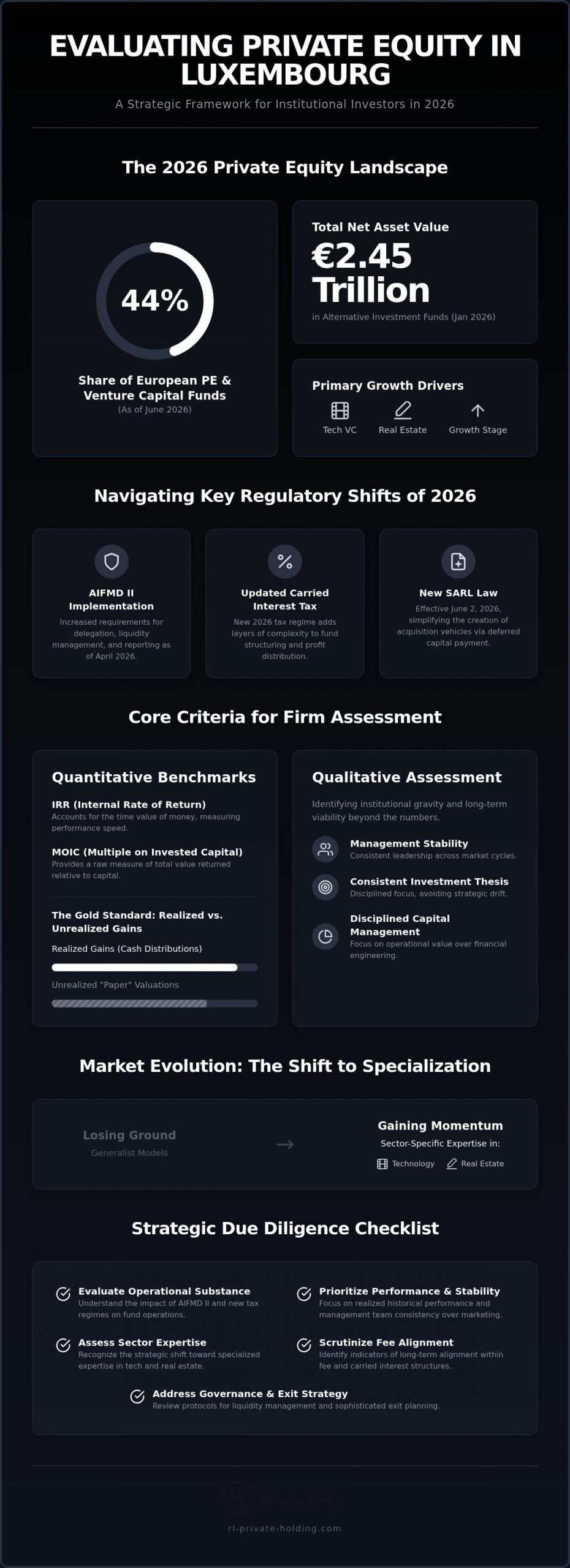
Luxembourg has solidified its position as a primary global hub for private equity. As of June 2026, the jurisdiction commands a 44% share of all European private equity and venture capital funds. This dominance isn’t merely a matter of volume; it’s a reflection of the jurisdiction’s evolution toward sophisticated alternative investment structures. The total Net Asset Value of alternative funds domiciled here reached €2.45 trillion in January 2026. For institutional investors, evaluating private equity firms in Luxembourg involves understanding how these firms leverage the local infrastructure to facilitate complex cross-border transactions. Growth in 2026 is largely driven by technology venture capital, real estate, and growth-stage funding, supported by a framework that prioritizes substance over mere presence.
Luxembourg as a Global Tier-1 Financial Center
The jurisdiction’s stability is anchored by its consistent AAA credit rating and a predictable political environment. These factors are foundational to Luxembourg’s economic landscape, which has long prioritized the financial services sector as a pillar of national growth. The Commission de Surveillance du Secteur Financier (CSSF) maintains a robust regulatory environment that ensures institutional gravity without stifling innovation. This ecosystem is further supported by a high concentration of expert service providers, including specialized legal, tax, and audit professionals. Their collective expertise allows firms to manage the high-stakes nature of global asset management with precision and transparency.
The Shift Toward Alternative Investment Fund Structures
The market has seen a significant transition toward more flexible and transparent vehicles. The Luxembourg special limited partnership (SCSp) remains a preferred choice for many sponsors due to its tax-transparent nature and contractual flexibility. In 2026, evaluating private equity firms in Luxembourg requires a close look at how they adapt to the April 2026 application of the AIFMD II Directive. This directive introduced more stringent requirements for delegation, liquidity management, and reporting. A new law effective June 2, 2026, also allows for the deferred payment of the €12,000 minimum share capital for SARLs, simplifying the creation of acquisition vehicles. These changes reflect an EU-wide trend toward greater governance and risk management, reinforcing Luxembourg’s role as a strategic hub for specialized investment strategies.
Core Criteria for Assessing Private Equity Firm Performance
Evaluating private equity firms in Luxembourg requires a balance between quantitative rigor and qualitative judgment. While historical performance provides a baseline, the current market demands an analysis of how firms adapt their strategies to evolving regulatory standards set by Luxembourg’s financial regulator. Investors must look beyond top-line figures to understand the stability of the management team and the robustness of internal risk frameworks. A firm’s ability to maintain a consistent investment thesis across different market cycles is often more indicative of future success than a single high-performing vintage year.
Quantitative Benchmarks: IRR and MOIC
Internal Rate of Return (IRR) and Multiple on Invested Capital (MOIC) serve as the primary metrics for performance. IRR accounts for the time value of money, while MOIC provides a raw measure of capital returned relative to the initial investment. In 2026, realized gains have become the gold standard for evaluation. Paper valuations, often referred to as “unrealized carry,” are increasingly scrutinized due to global market volatility. Normalizing this data across different cycles is essential to distinguish between genuine operational value creation and favorable macroeconomic tailwinds. High-quality firms provide granular data that allows limited partners to see exactly how much value was driven by revenue growth versus financial engineering.
Qualitative Assessment: Institutional Gravity and Discipline
Beyond the balance sheet, the “quiet authority” of a firm often signals its long-term viability. Institutional permanence isn’t built on marketing hyperbole but on disciplined decision-making processes and clear governance structures. Assessing the firm’s internal governance involves reviewing their investment committee protocols and how they manage conflicts of interest. A firm’s ability to maintain professional distance while ensuring transparency in reporting is a hallmark of a Tier-1 partner. This discipline is particularly critical when managing long-term private equity cycles that can span a decade or more. Professional investors often look for disciplined investment management that prioritizes long-term stability over short-term gains.
Risk management and portfolio diversification also play central roles in the vetting process. A firm’s approach to concentration risk, especially within specific sectors or geographies, should be clearly articulated. In 2026, sophisticated investors prioritize firms that demonstrate a methodical approach to mitigating downside risk through diversified portfolios and rigorous stress testing. Effective communication remains the final pillar; firms that provide timely, detailed, and sober reporting foster a level of trust that is indispensable for institutional partnerships. When evaluating private equity firms in Luxembourg, these qualitative factors often provide the most reliable indicators of a firm’s internal health and operational resilience.
Analyzing Investment Specialization and Sector Expertise
The 2026 investment environment has shifted the advantage toward firms with deep domain expertise. Generalist models often lack the technical precision required to navigate increasingly complex global markets. Evaluating private equity firms in Luxembourg necessitates a review of their specific industry knowledge and their ability to provide operational value beyond capital. This sector-specific focus allows for more accurate benchmarking and a clearer understanding of a firm’s competitive edge. It’s no longer enough to offer broad exposure; firms must demonstrate how their expertise translates into superior risk-adjusted returns.
Venture Capital and Technology Growth
Technology and growth-stage funding are primary areas of interest for institutional capital. When reviewing a firm’s technology portfolio, its exit history and operational support mechanisms are the most reliable indicators of quality. A venture capital Luxembourg framework provides the necessary tools to vet these specialized managers. You should look for firms that don’t just provide funding but also offer strategic guidance to help growth-stage companies scale effectively. This level of involvement is a hallmark of firms that prioritize long-term value creation over rapid, speculative exits.
Real Estate and Tangible Asset Management
Real estate continues to serve as a stabilizer within balanced portfolios, providing a hedge against market volatility. Integrating real estate asset management Luxembourg into your strategy requires assessing a manager’s ability to handle both direct acquisitions and indirect structures. While the 2026 interest rate environment has reached a new equilibrium, valuations are still highly dependent on a firm’s management discipline. Assessing their capability to optimize yields while mitigating physical and transition risks is paramount for maintaining the integrity of the portfolio.
ESG integration is no longer a peripheral concern but a core component of the investment thesis. Sophisticated investors look for firms that treat sustainability as a financial driver rather than a marketing exercise. Evaluating private equity firms in Luxembourg includes examining their reporting standards and their ability to quantify the impact of ESG initiatives on the bottom line. Firms that exhibit this level of discipline are better equipped to navigate the long-term shifts in the global economy. This commitment to transparency and objective performance metrics is essential for building trust with institutional partners and family offices.
The Due Diligence Checklist: Fees, Governance, and Exits
The final stage of vetting requires a granular audit of a firm’s operational and financial mechanics. While previous sections focused on market landscape and sector expertise, the due diligence phase demands a technical review of the underlying fund documents. Evaluating private equity firms in Luxembourg involves scrutinizing how a manager balances their internal incentives with the long-term interests of their limited partners. This alignment isn’t merely a matter of intent; it’s a structural requirement that must be codified within the partnership agreement to ensure institutional gravity and professional distance.
Understanding Investment Management Fees
Management fees typically follow the AUM-based model; however, 2026 has introduced more nuanced variations to accommodate increased regulatory reporting. The traditional 2/20 model remains a common starting point, but sophisticated investors now look for tiered structures that reflect the actual cost of administration. It’s essential to identify hidden costs in fund administration, audit, and tax compliance that can quietly erode net returns. Benchmarking these expenses against institutional standards for private equity investment management ensures that the GP’s overhead doesn’t become a drag on the portfolio’s performance.
GP/LP alignment is further defined by the mechanics of carried interest. The 2026 tax reform in Luxembourg distinguishes between contractual and participation-linked carry, which directly impacts how managers structure their personal stakes. A transparent firm will clearly outline these structures to demonstrate a commitment to performance-based rewards. If a firm’s fee structure seems overly complex or lacks clear benchmarks, it often serves as a primary indicator of misaligned incentives.
Exit Strategy Frameworks and Liquidity
A firm’s ability to return capital is the ultimate measure of its operational success. Evaluating private equity firms in Luxembourg involves a rigorous assessment of their historical exit strategies, whether through IPOs, trade sales, or secondary buyouts. In a high-stakes environment, a disciplined exit timeline is non-negotiable. You should analyze the firm’s track record of returning capital relative to their initial projections, as this reveals their ability to read market cycles and execute under pressure.
Governance remains the bedrock of any institutional partnership. Red flags often appear in the form of vague conflict-of-interest policies or opaque decision-making hierarchies within the investment committee. Investors should verify that the firm maintains a methodical approach to governance that prioritizes stability over short-term opportunism. For those seeking a partner with a proven record of structural discipline and global scale, exploring the professional frameworks of RL Private Holding provides a clear benchmark for institutional-grade management.
RL Private Holding: A Disciplined Approach to Investment
RL Private Holding represents a standard of institutional-grade management within the jurisdiction. The firm’s operations are characterized by a high degree of professionalism and a commitment to maintaining professional distance. This “quiet authority” is reflected in a diversified global portfolio that spans technology venture capital, real estate, and traditional asset management. For those evaluating private equity firms in Luxembourg, RL Private Holding serves as a reference point for stability and strategic focus. The firm prioritizes long-term value creation over short-term volatility, ensuring that all investment activities align with the underlying principles of institutional gravity and transparency.
Strategic Wealth and Asset Management
The firm provides specialized services to private wealth management firms Luxembourg and global institutional clients. This integration of venture capital and real estate asset management creates a robust framework for risk mitigation. By maintaining a steady hand in the background of major investments, RL Private Holding projects a sense of institutional permanence. The firm’s philosophy centers on the belief that disciplined capital allocation requires a methodical, hierarchical approach to decision-making. This ensures that every asset within the portfolio is managed with the same level of internal discipline and worldly sophistication.
Partnering for Long-Term Growth
Operating as a Luxembourg-based global holding company offers distinct advantages for sophisticated investors. The jurisdiction’s robust regulatory framework, combined with the firm’s focus on performance-based incentives, creates a clear alignment of interests. When evaluating private equity firms in Luxembourg, the clarity of a firm’s carried interest mechanics often reveals its commitment to limited partners. RL Private Holding utilizes precise, technical structures to ensure that rewards are directly linked to realized gains. This methodical approach allows investors to digest the scope of the business at a controlled pace, fostering a relationship built on trust and professional distance.
Initiating a professional engagement for capital allocation involves a structured review of the firm’s diversified holdings and governance protocols. RL Private Holding remains a steady partner for those who value stability and a clear plan in a high-stakes environment. Sophisticated investors seeking disciplined management are invited to review the firm’s organizational framework to understand how its strategic focus can mitigate long-term investment risk. This commitment to professional excellence ensures that RL Private Holding remains a reliable fixture in the global financial landscape.
Securing Long-Term Value in a Sophisticated Market
Success in the current alternative investment landscape depends on a firm’s ability to maintain structural discipline while adapting to stringent regulatory shifts like AIFMD II. We’ve explored why moving beyond top-line assets under management to scrutinize realized performance and sector-specific expertise is essential for institutional growth. Evaluating private equity firms in Luxembourg now requires a technical understanding of fee alignment and governance frameworks that prioritize transparency over promotional rhetoric. It’s a process that rewards patience and institutional rigor within the jurisdiction’s €2.45 trillion market.
RL Private Holding operates as a global investment holding company with its headquarters in Luxembourg. The firm manages a diversified portfolio across technology, real estate, and asset management, all underpinned by institutional-grade governance and reporting. This approach ensures that every allocation is handled with the quiet authority and professional distance required for long-term permanence. We invite you to explore strategic investment management with RL Private Holding to align your portfolio with a partner dedicated to disciplined global growth. Selecting a partner that values stability as much as performance is the first step toward a resilient investment future.
Frequently Asked Questions
How do I verify the track record of a Luxembourg private equity firm?
Verifying a firm’s track record involves a technical review of audited financial statements and gross versus net Internal Rate of Return (IRR). Investors should request granular data on realized exits to distinguish between operational value creation and market-driven multiples. Evaluating private equity firms in Luxembourg also requires confirming that the current senior management team was responsible for the performance of previous fund vintages to ensure continuity of expertise.
What are the most common fund structures used by private equity firms in Luxembourg?
The Special Limited Partnership (SCSp) and the Reserved Alternative Investment Fund (RAIF) are the standard structures in 2026. The SCSp is favored for its contractual flexibility and tax transparency, making it suitable for international co-investments. The RAIF allows for rapid deployment as it isn’t subject to direct CSSF product approval, provided it’s managed by an authorized Alternative Investment Fund Manager (AIFM) under the AIFMD II framework.
What is the typical management fee for a Luxembourg-based private equity fund in 2026?
Management fees in the Luxembourg market typically range from 1.5% to 2.0% of committed capital. By 2026, sophisticated firms often apply these fees to invested capital rather than committed capital once the investment period concludes. These costs are intended to cover the firm’s operational substance, including the increased administrative expenses associated with compliance under the latest AIFMD II reporting standards and liquidity management requirements.
How does carried interest work in Luxembourg investment structures?
Carried interest serves as the primary alignment mechanism, rewarding managers with a share of profits, usually 20%, after returning initial capital and a preferred return to investors. The 2026 tax reforms distinguish between contractual carry, taxed at approximately 11.45%, and participation-linked carry. The latter may be fully tax-exempt if the stake is held for over six months and remains below 10% of the total fund capital, ensuring disciplined long-term holding patterns.
What role does the CSSF play in overseeing private equity firms?
The Commission de Surveillance du Secteur Financier (CSSF) supervises the financial sector to ensure stability and investor protection. Its role includes the authorization and ongoing monitoring of Alternative Investment Fund Managers (AIFMs). Through Circular 25/901 and other frameworks, the CSSF enforces strict limits on borrowing and investment concentration, ensuring that firms operate within the predefined legal and risk boundaries of the Luxembourg jurisdiction.
Can individual investors access private equity through Luxembourg holding companies?
Participation is generally reserved for institutional or well-informed investors who can commit a minimum of €125,000. While retail banking services aren’t the focus of these firms, individual investors may access private equity through a Société de Participations Financières (SOPARFI). This structure provides a tax-efficient holding vehicle for private equity assets, provided the investor meets the necessary professional qualifications and adheres to the regulatory requirements for alternative investments.
What is the difference between a regulated and an unregulated fund vehicle in Luxembourg?
Regulated vehicles like the SIF are subject to direct CSSF approval and product-level supervision, offering the highest level of investor protection. Conversely, unregulated vehicles such as the SCSp or RAIF prioritize speed and flexibility. While the vehicles themselves aren’t authorized, they must be managed by a regulated AIFM. This ensures that the firm still adheres to European standards for transparency, risk management, and reporting despite the vehicle’s unregulated status.
How do Luxembourg firms handle ESG and sustainability reporting?
Firms manage sustainability reporting through the Sustainable Finance Disclosure Regulation (SFDR) framework. They categorize funds under Article 8 for environmental characteristics or Article 9 for specific sustainable objectives. In 2026, the emphasis has shifted toward quantitative ESG metrics, requiring firms to provide documented evidence of their impact to avoid greenwashing risks and comply with the latest EU ESG Ratings Regulation and national transparency standards.