

The traditional reliance on the Internal Rate of Return (IRR) as a definitive measure of success is no longer a defensible strategy for sophisticated institutional fiduciaries. While IRR remains a standard industry metric, its susceptibility to market timing biases and cash flow manipulation often obscures the underlying risk profile of an investment. Most institutional investors recognize that the lack of standardized risk metrics across private asset classes creates significant hurdles when they attempt to compare performance against public benchmarks. This analysis provides an authoritative overview of advanced risk-adjusted return models for private equity, offering a disciplined framework to evaluate performance with technical precision.
By moving beyond basic cash flow metrics, a firm can better quantify the illiquidity premium and implement a robust benchmarking system that reflects true economic value. We’ll explore how to optimize capital allocation through synthetic benchmarking and tail-risk modeling; this ensures that fiduciary reporting is supported by sophisticated, objective data. This examination covers the transition from traditional IRR to more resilient models like Public Market Equivalent (PME) and incorporates the latest IPEV Valuation Guidelines effective for 2026 reporting periods. The following sections outline the structural components necessary to enhance transparency and maintain institutional stability in a complex global landscape.
Key Takeaways
- Identify the structural limitations of traditional IRR and MOIC to ensure performance evaluations reflect true economic risk.
- Master the application of Public Market Equivalent (PME) models to accurately benchmark private cash flows against public indices.
- Deploy sophisticated risk-adjusted return models for private equity to quantify the illiquidity premium and strengthen professional oversight.
- Adapt standard volatility measures like the Sharpe Ratio to better account for the non-normal return distributions inherent in private assets.
- Integrate these advanced frameworks into a disciplined wealth management strategy to enhance institutional stability and reporting accuracy.
The Evolution of Performance Measurement in Private Equity
The landscape of private capital has matured significantly. Institutional investors no longer accept absolute return figures as sufficient evidence of success. This shift toward sophisticated risk modeling reflects a broader transition in global finance, where the focus has moved from simple cash-on-cash results to a more nuanced understanding of how those results were achieved. It’s a move toward institutional gravity that prioritizes stability over volatility.
Implementing robust risk-adjusted return models for private equity is now a prerequisite for institutional-grade asset management. These frameworks allow fiduciaries to distinguish between true manager alpha and returns that are merely a byproduct of market beta or excessive leverage. Without these models, an investor cannot accurately assess whether the performance of a specific fund justifies its unique risk profile.
Deconstructing the Limitations of Traditional Metrics
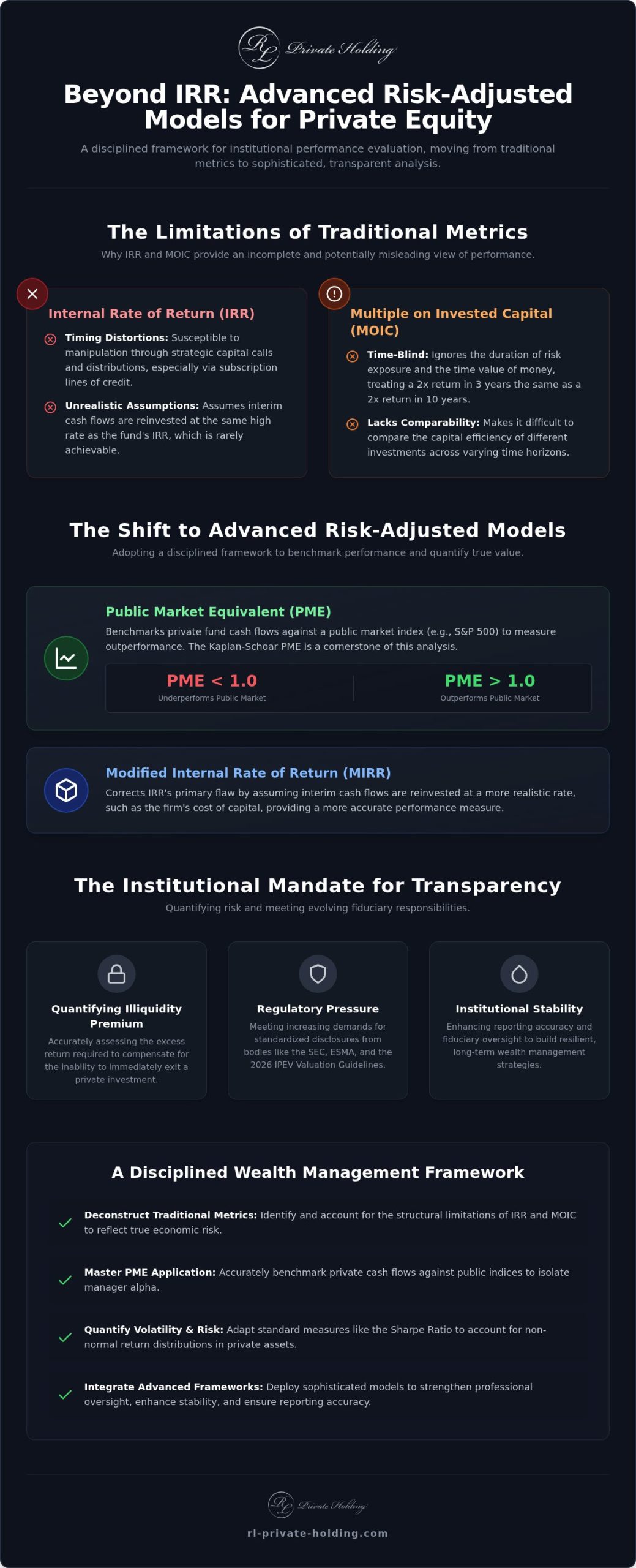
Traditional benchmarks like the Internal Rate of Return (IRR) and Multiple of Invested Capital (MOIC) offer a narrow view of performance. IRR is often distorted by the strategic timing of capital calls and distributions. For instance, the use of subscription lines of credit can artificially inflate IRR without increasing the actual wealth generated. This “GP-led” timing creates a gap between reported figures and actual risk exposure.
- Reinvestment Rate Assumptions: IRR assumes interim cash flows are reinvested at the fund’s internal rate, which is often unrealistic in fluctuating markets.
- Time-Value of Risk: MOIC provides a clear picture of total gains but ignores the duration of risk exposure, making it impossible to compare the efficiency of capital allocations over different periods.
The Institutional Mandate for Risk Transparency
Fiduciary responsibilities have evolved alongside market complexity. Regulators such as the SEC and ESMA are increasingly focused on standardized disclosures that reflect the true risk profile of private assets. This regulatory pressure, combined with the 2026 IPEV Valuation Guidelines, requires managers to provide deeper transparency into how valuations are derived. Within a wealth management Luxembourg context, this transparency is vital for maintaining institutional stability.
The illiquidity premium is the excess return required to compensate for the inability to exit a position immediately. Accounting for this premium is essential when evaluating whether a private equity allocation justifies the capital lock-up. These risk-adjusted return models for private equity ensure that investors are compensated for the lack of liquidity and the structural complexity of their holdings.
Advanced Risk-Adjusted Return Models: PME and Direct Alpha
While traditional metrics provide a snapshot of nominal growth, institutional stability requires a deeper analysis of relative performance. The adoption of risk-adjusted return models for private equity allows for a disciplined comparison between illiquid private holdings and public market benchmarks. One such advancement is the Modified Internal Rate of Return (MIRR), which corrects the reinvestment rate fallacy by assuming interim cash flows are reinvested at a more realistic cost of capital rather than the fund’s own IRR.
The Public Market Equivalent (PME) serves as a primary tool for bridging the gap between private cash flows and public indices. Unlike IRR, which exists in a vacuum, PME measures the wealth effect of a private equity investment relative to an alternative investment in a public index, such as the S&P 500. This methodology ensures that capital allocation decisions are based on a manager’s ability to exceed the returns available in more liquid markets.
The Kaplan-Schoar PME Framework
The Kaplan-Schoar PME remains a cornerstone of institutional benchmarking. It is calculated as the ratio of the present value of distributions to the present value of contributions, with both discounted using the realized return of a public market index. A value greater than 1.0 indicates that the private equity fund has outperformed the public market after accounting for the timing of cash flows. Selecting an appropriate benchmark is vital; using a broad index for a sector-specific fund may lead to skewed results that fail to reflect the true risk-adjusted performance.
Isolating Alpha with the Direct Alpha Model
Modern portfolio analysis has evolved toward the Direct Alpha model. This approach moves beyond simple ratios by mathematically “de-levering” private equity returns from public market movements. It provides a precise measure of idiosyncratic manager performance, isolating the value added through operational improvements rather than market beta. Research such as A New Approach to Risk-Adjusted Returns highlights how this metric offers a superior perspective for long-term portfolio evaluation.
Integrating Direct Alpha into private equity investment management workflows allows fiduciaries to identify managers who consistently generate non-market-correlated returns. This level of technical rigor is essential for maintaining institutional gravity in a diversified global portfolio. For organizations seeking to refine their reporting, utilizing a disciplined partner to oversee these complex calculations ensures long-term strategic alignment. To learn more about our approach to structural oversight, you may review our specialized wealth management services.
Quantifying Volatility and Tail Risk in Private Portfolios
Measuring risk in private markets requires a fundamental departure from the assumptions used in public equities. Because private assets don’t trade on daily exchanges, standard deviation often understates actual volatility. Sophisticated risk-adjusted return models for private equity must account for the non-normal distribution of returns, where “fat tails” and skewness are the norm rather than the exception. Adapting the Sharpe Ratio for these assets involves adjusting for the lack of liquidity, while the Sortino Ratio is often preferred for its specific focus on downside deviation and capital preservation.
Value at Risk (VaR) provides a statistical estimate of potential losses during extreme market conditions. In venture capital and early-stage private equity, the “L-Curve” represents the reality that a high percentage of investments may result in a total loss of capital. This requires a portfolio-level view of risk where a few successful exits must compensate for the high probability of failure across individual holdings. Bayesian inference provides a structured method for refining risk estimates by incorporating prior industry knowledge when specific historical data for a new asset is sparse.
Volatility Estimation in the Absence of Daily Pricing
The quarterly reporting cycle inherent in private equity creates a “smoothing effect” that masks true market volatility. This lag can lead to an understated correlation with public markets, potentially misleading fiduciaries about the actual risk profile of their allocations. Synthetic volatility models address this by using public proxies or fundamental drivers, such as EBITDA multiples, to estimate what the volatility would look like if the asset were liquid. The 2026 IPEV Valuation Guidelines emphasize the need for this transparency, requiring managers to use consistent and objective data to avoid artificial smoothing in performance reporting.
Tail Risk and Downside Protection Strategies
Institutional safety relies on understanding the “worst-case” scenario beyond standard VaR thresholds. Conditional Value at Risk (CVaR) measures the expected loss in the tail of the distribution, providing a more comprehensive view of systemic vulnerability. Stress testing portfolios against economic shocks, such as the interest rate fluctuations observed in early 2026, ensures that the structure can withstand periods of restricted credit. Diversification remains the primary defense against idiosyncratic risk. By spreading capital across different vintage years, sectors, and geographic regions, an institutional partner can mitigate the impact of localized downturns and maintain long-term stability.
Strategic Implementation within Institutional Frameworks
Strategic implementation requires moving beyond the theoretical application of risk-adjusted return models for private equity to integrate these findings into the broader institutional balance sheet. For fiduciaries, this means aligning private capital allocations with the overall risk appetite of the organization. Within a wealth management Luxembourg context, the ability to standardize reporting across multiple General Partners (GPs) is essential. A unified model allows for a transparent comparison of performance; it ensures that the illiquidity premium is sufficiently captured without compromising the need for tactical flexibility in other asset classes.
The interaction between private equity risk and real estate asset management is particularly relevant for diversified holders. Both asset classes share structural similarities, such as long-term lock-ups and valuation lags. By applying consistent risk-adjusted frameworks across these sectors, institutional partners can better predict how systemic shocks might impact the total portfolio. It’s a method that prioritizes institutional gravity over short-term fluctuations.
Benchmarking and Manager Selection
Selecting the right manager is an exercise in differentiating between operational skill and mere market luck. Risk-adjusted data provides the necessary granularity to identify managers who consistently outperform their peer groups across different market cycles. Vintage year diversification serves as a critical component of this strategy; it mitigates the risk of deploying capital into a single, potentially unfavorable economic environment. Establishing internal hurdles based on synthetic risk-free rates, such as the September 2026 SOFR rates of approximately 3.62% to 3.64%, provides a more accurate baseline for performance than static historical benchmarks.
Multi-Asset Portfolio Synergy
Private equity’s role as a diversifier is most effective when its correlation with public markets is clearly understood. This analysis is central to family office investment strategies Luxembourg for 2026, where the focus has shifted toward total balance sheet stability. Managing the “Capital Call” risk is a vital part of this synergy. It requires a disciplined approach to cash management to ensure that liquidity is available when GPs draw down committed capital, even during periods of public market volatility. This structural oversight prevents the need for forced liquidations in other parts of the portfolio.
To optimize your portfolio’s structural integrity and reporting accuracy, explore our comprehensive private equity investment management services.
Disciplined Management: The RL Private Holding Perspective
Institutional stability is not a static achievement but a result of continuous, professional oversight. At RL Private Holding, the foundation of our investment philosophy rests on a commitment to objective analysis and structural integrity. We recognize that the sophisticated risk-adjusted return models for private equity discussed throughout this analysis are only as effective as the discipline with which they are applied. By integrating these frameworks into our core operational processes, we ensure that every allocation is evaluated through a lens of institutional gravity rather than short-term market sentiment.
Operating from a global base in Luxembourg, we leverage a robust regulatory environment that is recognized for its rigorous standards of investor protection and transparency. This framework provides a secure infrastructure for managing complex asset structures across technology, real estate, and private equity. As the 2026 IPEV Valuation Guidelines and updated SEC qualified client thresholds take effect, our firm remains committed to maintaining a sophisticated risk modeling approach that exceeds basic compliance requirements. This commitment to transparency ensures that our global partners receive reporting that is both technical and factual.
Institutional Gravity and Long-Term Stability
A permanent capital mindset is central to our approach to risk-adjusted performance. Unlike traditional fund structures that are often constrained by fixed investment horizons, our model allows for a more patient deployment of capital. This flexibility is essential for capturing the true illiquidity premium of private assets. We apply rigorous due diligence to global venture capital Luxembourg opportunities, ensuring that each potential investment aligns with our standards for long-term value creation. Our reporting remains sober and factual; we prioritize the clear communication of underlying risk factors over the embellishment of nominal returns.
A Strategic Partner in Global Finance
RL Private Holding functions as a discreet and authoritative expert in the global financial landscape. We navigate complex sectors with a disciplined risk framework that prioritizes the preservation of capital and the generation of sustainable alpha. Our role is that of a steady hand in the background of major investments, providing the professional oversight necessary to manage diversified portfolios with precision. For institutional investors, the next step in optimizing a private equity allocation involves a partnership built on trust, worldly experience, and a shared commitment to structural excellence. We invite partners to engage with our disciplined framework to ensure their portfolios are positioned for institutional permanence.
Advancing Institutional Stability Through Structural Precision
The transition toward sophisticated risk analytics is no longer optional for institutional fiduciaries. Implementing risk-adjusted return models for private equity provides the transparency needed to differentiate between market beta and genuine manager alpha. This disciplined approach, supported by models like PME and Direct Alpha, ensures that capital allocation remains aligned with long-term stability rather than short-term volatility. As the global financial landscape becomes more complex, professional oversight and technical rigor remain the primary safeguards for diversified portfolios.
RL Private Holding maintains a dedicated focus on these principles; we manage a global portfolio across technology, real estate, and private equity from a secure Luxembourg base. Our expertise in institutional-grade risk management and multi-sector oversight provides global partners with the clarity required for high-stakes decision-making. Explore the RL Private Holding approach to institutional asset management to strengthen your portfolio’s structural integrity. By prioritizing objective data and methodical oversight, investors can navigate the private markets with confidence and ensure institutional permanence.
Frequently Asked Questions
What is the primary advantage of using Direct Alpha over Public Market Equivalent (PME) models?
Direct Alpha provides a precise measure of idiosyncratic manager performance by mathematically de-levering private equity returns from public market movements. Unlike Public Market Equivalent (PME) models, which function as a ratio of wealth generated, Direct Alpha isolates the specific value added through operational improvements. This allows institutional investors to distinguish between true skill and returns driven by market beta. It’s a critical tool for those utilizing advanced risk-adjusted return models for private equity to evaluate long-term manager efficacy.
How do institutional investors account for the illiquidity premium in risk-adjusted return models?
Institutional investors account for the illiquidity premium by adding a required spread over public market benchmarks, typically ranging from 2% to 5% depending on the asset class and holding period. This adjustment reflects the compensation required for the inability to exit a position immediately. By incorporating this spread into their risk-adjusted return models for private equity, fiduciaries ensure that the capital lock-up is justified by a return profile that exceeds liquid alternatives.
Can the Sharpe Ratio be accurately applied to private equity portfolios?
The Sharpe Ratio cannot be accurately applied to private equity without significant adjustments because it assumes a normal distribution of returns. Private assets often exhibit skewness and “fat tails” that standard deviation fails to capture. Sophisticated investors often prefer the Sortino Ratio, which focuses exclusively on downside deviation. This provides a more realistic assessment of risk for illiquid portfolios where capital preservation and the mitigation of tail risk are the primary institutional priorities.
What role does vintage year diversification play in reducing private equity risk?
Vintage year diversification reduces risk by spreading capital across different economic cycles and interest rate environments. This strategy prevents an institutional portfolio from being overly exposed to the specific market conditions of a single year. It also helps smooth the “J-curve” effect, ensuring that capital calls and distributions are balanced over time. This methodical approach to allocation is a cornerstone of maintaining institutional stability and achieving consistent performance across a global portfolio.
How does the Luxembourg regulatory environment support sophisticated risk-adjusted reporting?
The Luxembourg regulatory framework provides a secure and transparent infrastructure for sophisticated performance reporting through strict adherence to AIFMD and IPEV guidelines. This environment ensures that valuations are conducted with professional oversight and objective data. For global partners, this robust oversight facilitates the use of complex risk models; it provides the regulatory certainty required for institutional-grade asset management. This stability is a key reason why Luxembourg remains a primary hub for global private capital.
What is the impact of valuation smoothing on risk-adjusted performance metrics?
Valuation smoothing occurs due to the quarterly nature of private asset reporting, which often masks true market volatility. This effect can lead to an understated correlation between private equity and public markets, creating an illusion of stability. Sophisticated risk models address this by using synthetic volatility proxies or de-smoothing techniques. Without these adjustments, an investor might miscalculate the actual risk profile of their portfolio and overlook potential systemic vulnerabilities during market shocks.
How often should institutional investors update their risk-adjusted return models?
Institutional investors should update their models at least quarterly to align with Net Asset Value (NAV) reporting cycles and the latest valuation data. However, during periods of significant market volatility or geopolitical shifts, more frequent stress testing is required. Regular updates ensure that the risk profile remains current and that fiduciary reporting reflects the most accurate economic reality. This disciplined rhythm of assessment supports long-term strategic planning and maintains the integrity of the institutional framework.
Why is the Kaplan-Schoar PME considered a wealth-based measure rather than a rate-of-return measure?
The Kaplan-Schoar PME is a wealth-based measure because it calculates the ratio of discounted distributions to contributions relative to a public index. It answers whether an investor is wealthier for having chosen private equity over a public market alternative. Unlike a rate-of-return measure, which focuses on annualized percentage growth, the PME ratio provides a direct comparison of terminal wealth. A value above 1.0 indicates that the private investment outperformed the benchmark in absolute wealth terms.