

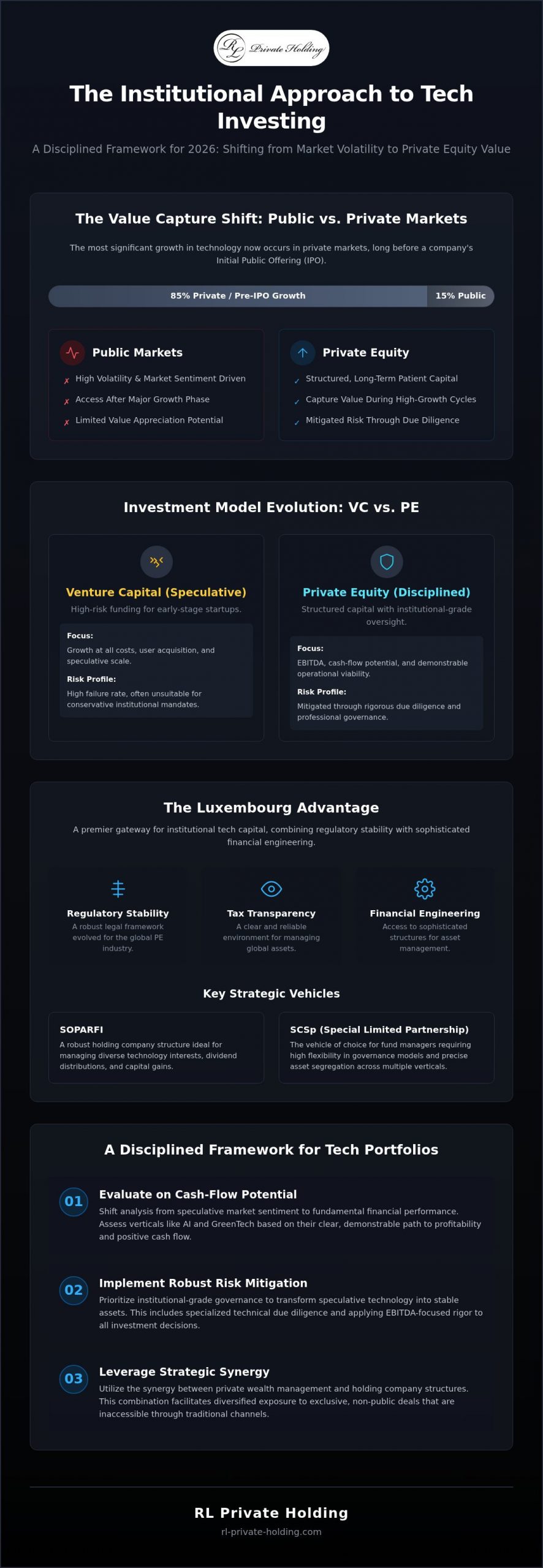
The era of capturing transformative technological value through public equity markets has largely concluded; the most significant growth now occurs within private cycles long before an initial public offering. For institutional investors, the persistent challenge remains the inherent volatility of public tech stocks and the opacity often found in direct technology investments. Accessing emerging tech through private equity offers a necessary alternative, providing a structured environment where technical due diligence and long-term capital alignment take precedence over market sentiment.
You likely recognize that traditional entry points into sectors like artificial intelligence or quantum computing often lack the transparency and rigor required for institutional mandates. This article provides a disciplined framework for 2026, demonstrating how private equity structures can transform speculative technology into stable, institutional-grade assets. We will examine the methodologies used to mitigate technical risk and the strategic advantages of the Luxembourg regulatory environment for managing high-growth portfolios. By the conclusion, you’ll understand the methodical approach required to secure exclusive, non-public deals while maintaining the professional standards of global asset management.
Key Takeaways
- Analyze the fundamental shift from speculative venture capital to a disciplined private equity approach for capturing long-term value in the technology sector.
- Discover the regulatory and structural benefits of accessing emerging tech through private equity via Luxembourg’s sophisticated SOPARFI framework.
- Identify specific methodologies for evaluating artificial intelligence and GreenTech verticals based on cash-flow potential rather than market sentiment.
- Implement a robust risk-mitigation strategy that prioritizes specialized technical due diligence and institutional-grade governance.
- Understand how the synergy between private wealth management and holding company structures facilitates diversified exposure to exclusive, non-public deals.
The Convergence of Private Equity and Emerging Technology
The traditional boundary between speculative technology funding and institutional asset management has dissolved. As we approach 2026, the global market landscape demands a departure from the “growth at all costs” model that defined previous decades. Accessing emerging tech through private equity has emerged as the preferred method for institutional investors seeking to capture value without the inherent instability of earlier-stage funding rounds. This shift represents a move toward structural discipline, where technological potential is measured against rigorous financial performance and operational viability.
Traditional public market exposure is no longer a reliable source of alpha in the technology sector. Companies are choosing to remain private for longer periods, often reaching multi-billion euro valuations before considering an initial public offering. Consequently, by the time a technology firm reaches the public exchange, the most significant portion of its value appreciation has already been captured by private stakeholders. Private equity provides the “patient capital” required to support long-term technological cycles, such as the development of specialized hardware or large-scale infrastructure, which are often incompatible with the short-term pressures of quarterly public reporting.
The Evolution of Tech as a Private Equity Vertical
Private equity’s focus has expanded beyond established Software-as-a-Service (SaaS) models into deep tech, quantum computing, and artificial intelligence. This maturation reflects a broader trend where technology is no longer viewed as a separate sector but as a foundational component of every industrial vertical. Institutional investors are increasingly shifting allocations toward private tech to avoid the valuation gap often seen at the point of public listing. The 2026 landscape favors this transition, as the market increasingly rewards firms that can demonstrate a clear path to profitability rather than just user acquisition or speculative scale.
Institutional Gravity vs. Venture Volatility
The risk profile of Venture capital financing for emerging tech often remains too high for conservative institutional mandates due to the high failure rate of early-stage startups. Private equity introduces a layer of EBITDA-focused rigor and institutional governance that speculative venture rounds often lack. By leveraging the expertise of private wealth management firms Luxembourg, investors can utilize sophisticated holding structures to manage these assets with the same precision applied to traditional industrials or real estate. The convergence of institutional-grade discipline and emerging technology represents a mandatory pillar for any resilient 2026 portfolio.
Strategic Vehicles for Tech Allocation: The Luxembourg Advantage
Luxembourg has solidified its position as the premier gateway for institutional tech capital. Unlike fragmented markets, the Grand Duchy offers a centralized environment where regulatory stability meets sophisticated financial engineering. Institutional investors realize that accessing emerging tech through private equity is not just about the underlying asset, but the vehicle that houses it. Confidence in this jurisdiction is driven by a combination of tax transparency and a legal framework that has evolved alongside the global private equity industry. This environment provides the necessary “quiet authority” required for high-stakes technology mandates.
The SOPARFI remains a staple for holding diverse technology interests, providing a robust environment for managing dividend distributions and capital gains. Meanwhile, the Special Limited Partnership (SCSp) has become the vehicle of choice for fund managers who require a high degree of flexibility in their governance models. These structures allow for the precise segregation of assets, which is critical when managing a portfolio that spans multiple technological verticals and jurisdictions.
Optimizing Investment Structures for Global Reach
Luxembourg investment structures, specifically the SCSp, provide the necessary framework for managing diverse technology assets without the rigid constraints of traditional corporate forms. This structure allows for contractual freedom between limited and general partners, which is essential when navigating the rapid development cycles of emerging tech. These vehicles operate under the rigorous oversight of the CSSF, ensuring that tech funds maintain the highest levels of compliance and institutional integrity. For those managing global portfolios, the SOPARFI serves as a reliable holding company that facilitates cross-border operations while maintaining a stable tax footprint.
The Mechanics of Asset Allocation in Tech-PE
Integrating technology assets into a private equity investment management framework allows for a more controlled approach to sector exposure. While public markets often react to short-term sentiment, a PE-led strategy focuses on the underlying infrastructure and long-term value creation. For instance, recent trends in private equity investment in AI demonstrate a shift toward funding data centers and semiconductor manufacturing rather than speculative consumer applications. This methodical approach helps balance the illiquid nature of private tech with the yield requirements of institutional portfolios. The local ecosystem in Luxembourg provides the necessary deal flow and technical expertise to facilitate these complex transactions. If you’re seeking to refine your portfolio strategy, exploring sophisticated asset management solutions can provide the structural clarity required for the 2026 market.
Evaluating Emerging Tech Verticals through a PE Lens
Evaluating specific sectors requires a departure from the speculative fervor often associated with early-stage funding. Accessing emerging tech through private equity allows institutional investors to apply a more sober analysis to high-growth verticals that have historically been the domain of venture capital. In the artificial intelligence and machine learning space, the focus has shifted from raw computational capability to sustainable, cash-flow positive business models that deliver measurable operational efficiency. This shift is necessary. Similarly, the global energy transition requires the capital-intensive discipline that private equity provides, moving GreenTech from experimental phases to industrial-scale implementation through structured infrastructure investment.
Fintech and blockchain continue to provide structural disruption within the global financial landscape, yet they now face increased scrutiny regarding their underlying economic utility and regulatory compliance. In BioTech and HealthTech, private capital serves as a stabilizing force, helping firms navigate complex clinical trials and regulatory hurdles while maintaining the long-term focus required for research and development. Each vertical is assessed not merely on its innovation potential but on its ability to integrate into an institutional framework that prioritizes risk mitigation and steady value appreciation over time.
Valuation Rigor in High-Growth Sectors
Applying traditional private equity valuation metrics to pre-profit technology firms is essential for maintaining portfolio integrity in the 2026 landscape. This process involves a rigorous assessment of revenue quality and sustainable unit economics rather than relying on top-line growth or user acquisition numbers. Identifying durable “moats”, such as proprietary intellectual property, high switching costs, or network effects, is critical in a rapidly evolving technological environment. This disciplined approach ensures that accessing emerging tech through private equity remains a pursuit of fundamental value rather than a reaction to market sentiment.
The Role of ESG in Tech Portfolios
Integrating environmental, social, and governance standards into technology investment due diligence is no longer optional; it’s a primary driver of exit value. Technology companies that demonstrate high ESG compliance often command a premium during divestment as they align with the mandates of global institutional buyers. The intersection of venture capital Luxembourg and sustainable tech illustrates how local structures support these long-term objectives. By embedding ESG criteria early in the investment lifecycle, firms can effectively mitigate regulatory risks and enhance the overall resilience of the technology portfolio.
Risk Mitigation and Value Creation in Tech Portfolios
Effective risk management in the technology sector requires a transition from the speculative “move fast and break things” philosophy toward a framework of institutional maturity. Accessing emerging tech through private equity allows for a multi-phased approach to value creation that venture capital often lacks. This process begins with specialized technical due diligence and a comprehensive assessment of intellectual property (IP). It’s not enough to evaluate current software performance; one must also analyze the defensibility of the underlying code and its adaptability to future market shifts. This rigorous initial phase ensures that the foundation of the investment is secure before capital is deployed.
Once the acquisition is complete, the focus shifts to operational improvement through institutional governance. Private equity firms utilize their position to implement professional management structures, refined financial reporting, and disciplined cost controls. This transition is essential for technology companies that may have prioritized rapid scale over sustainable unit economics. The PE “value creation” phase serves as the critical bridge that transforms raw technological innovation into sustainable institutional profitability. By the time the asset reaches the strategic buy-and-build phase, it’s positioned to serve as a platform for consolidating fragmented technology markets, thereby increasing its overall market share and valuation.
Active Ownership and Operational Excellence
Active ownership is characterized by the strategic use of board seats to steer technology startups toward institutional maturity. This involvement extends beyond financial oversight to include talent management and the restructuring of executive compensation. Aligning the interests of founders with those of institutional investors is paramount. By implementing performance-based incentives and long-term vesting schedules, PE managers ensure that the leadership team remains focused on durable value rather than short-term exits. This level of oversight provides the stability required to navigate the complexities of global technology cycles.
Mitigating Technical and Market Risks
Diversification within tech-focused portfolios remains a primary defense against sector-specific downturns. Hedging against rapid technological obsolescence requires a strategic holding approach where assets are integrated into broader industrial applications. This reduces the risk of a single technological breakthrough rendering an entire investment obsolete. Performance-based incentives play a vital role here, ensuring that technical teams are motivated to innovate within a framework of commercial reality. For those seeking to implement these sophisticated strategies, partnering with a disciplined private equity manager ensures that your technology exposure is managed with institutional-grade rigor.
Partnering for Institutional-Grade Tech Exposure
Accessing emerging tech through private equity is a strategic undertaking that relies heavily on the quality of one’s institutional partnerships. While individual deal sourcing is possible, the most resilient portfolios leverage the established networks of private wealth management firms Luxembourg. These entities provide the necessary bridge between private capital and exclusive, non-public technology deals that remain inaccessible to the broader market. The synergy between wealth management and private equity ensures that tech exposure isn’t just an isolated bet but a core component of a broader, long-term wealth preservation strategy. This alignment is vital for maintaining the professional distance required in high-stakes asset management.
A holding company structure remains the ideal vehicle for managing multi-sector technology exposure. It allows for the clean segregation of assets across artificial intelligence, GreenTech, and biotechnology while providing a unified governance framework. This structural clarity is essential for institutional investors who require transparency and risk isolation. Looking toward the remainder of the decade, the trend in tech-PE will move toward deeper integration of operational expertise within the investment team. This ensures that portfolio companies are guided by those who understand both the underlying technology and the institutional requirements of global markets.
Integrating Tech into the Global Portfolio
A balanced institutional portfolio requires the interplay of high-growth technology assets and stable, yielding investments. Integrating tech allocations with real estate asset management Luxembourg provides a necessary hedge against the inherent volatility of the technology sector. RL Private Holding plays a central role in this process, managing complex, diversified portfolios that span multiple asset classes and jurisdictions. By aligning venture capital funding with traditional private equity and real estate, investors can achieve long-term wealth preservation that withstands cyclical market shifts. This holistic approach ensures that the pursuit of technological alpha doesn’t compromise the overall stability of the institutional mandate.
Next Steps for Institutional Investors
Securing a position within the Luxembourg financial ecosystem is the first step toward institutional-grade technology exposure. Investors should conduct initial portfolio reviews to determine their readiness for the illiquid and complex nature of private tech assets. Partnering with a discreet, authoritative holding company like RL Private Holding provides the necessary access to global networks and technical expertise. The process of accessing emerging tech through private equity is methodical and requires a partner who values professional distance and disciplined execution. Establishing these connections now ensures that your portfolio is positioned to capture the value of the next technological cycle with the required structural integrity.
Strategic Alignment for the Future of Technology Allocation
The transition toward a disciplined investment model marks a significant evolution in how global capital interacts with innovation. Accessing emerging tech through private equity provides the structural integrity necessary to mitigate the volatility of public markets while capturing long-term value. By utilizing Luxembourg’s sophisticated legal frameworks and prioritizing rigorous technical due diligence, institutional investors can secure exposure to transformative sectors with sustained confidence. This methodical approach ensures that technological potential is always balanced against operational reality.
Success in this environment requires more than capital; it demands a partner with expertise in diversified portfolio management and a clear commitment to professional institutional governance. RL Private Holding, headquartered in Luxembourg with global scale operations, offers the stability and strategic focus required to navigate these complex cycles. As the market continues to reward operational excellence over speculative growth, the importance of a methodical, risk-mitigated approach shouldn’t be overlooked.
Contact RL Private Holding to discuss strategic tech allocation and refine your approach to the 2026 technology landscape. The current market environment offers a unique window for those prepared to apply institutional-grade rigor to the next generation of global growth.
Frequently Asked Questions
How does private equity differ from venture capital when investing in emerging tech?
Private equity typically focuses on companies with proven business models and established revenue streams, whereas venture capital targets earlier, more speculative stages. In the technology sector, private equity investors prioritize operational efficiency and EBITDA growth. This approach introduces institutional-grade governance and professional management structures that are often absent in the high-growth venture capital environment. It ensures that technological innovation is supported by a stable financial foundation.
What are the primary benefits of using a Luxembourg SOPARFI for technology investments?
The SOPARFI is a fully taxable holding company that benefits from Luxembourg’s extensive network of double tax treaties. It’s particularly effective for technology investments due to the participation exemption regime, which may exempt dividends and capital gains from tax under specific criteria. This provides a stable, transparent framework for managing global IP portfolios and cross-border tech assets. Its structural reliability makes it a preferred choice for institutional-grade holding strategies.
Is emerging tech suitable for a conservative institutional portfolio?
Emerging technology is increasingly suitable for conservative portfolios when accessed through a disciplined framework. Accessing emerging tech through private equity allows institutions to bypass the extreme volatility of public tech stocks while maintaining exposure to high-growth sectors. The inclusion of technical due diligence and active ownership transforms these assets into stable, long-term holdings. This methodical approach aligns tech exposure with the risk-mitigation requirements of institutional mandates.
How do private equity firms conduct due diligence on complex technology assets?
Due diligence for technology assets involves a comprehensive evaluation of intellectual property, source code integrity, and cybersecurity protocols. PE firms often engage specialized technical consultants to assess the scalability of the software architecture and the defensibility of the product’s market position. This process ensures that the underlying technology is not only functional but also capable of supporting industrial-scale operations. It bridges the gap between financial analysis and technical reality.
What role does ESG play in private equity tech investments in 2026?
By 2026, ESG has become a fundamental component of technology valuation and risk assessment. Investors prioritize firms that demonstrate high standards in data privacy, ethical AI development, and energy-efficient infrastructure. These factors directly influence the eventual exit value, as institutional buyers increasingly avoid assets with governance or environmental liabilities. Integrating ESG criteria into the investment lifecycle ensures that technology portfolios remain resilient against evolving global regulatory requirements.
Can I access emerging tech through a Luxembourg Special Limited Partnership (SCSp)?
The Special Limited Partnership (SCSp) is an ideal vehicle for technology allocations due to its high degree of contractual flexibility. It allows fund managers to tailor governance and distribution rules to the specific needs of a technology-focused portfolio. Because the SCSp lacks legal personality and is tax transparent, it’s frequently utilized for cross-border investments where institutional investors require a sophisticated, internationally recognized structure. It remains a cornerstone of the Luxembourg financial ecosystem.
What are the typical fee structures for tech-focused private equity funds?
Tech-focused private equity funds generally follow the traditional model consisting of a 2% management fee and 20% carried interest. However, these structures often incorporate specific performance hurdles related to technical milestones or long-term profitability targets. These incentives ensure that the interests of the fund manager remain closely aligned with those of the institutional investors. Fee structures are designed to reward sustainable value creation rather than short-term speculative gains.
How does RL Private Holding facilitate access to exclusive technology deals?
RL Private Holding utilizes its established institutional networks and localized expertise in Luxembourg to identify exclusive investment opportunities. The firm’s position as a quiet authority in the global landscape allows it to source non-public technology deals that aren’t available through traditional channels. By integrating wealth management with private equity expertise, the firm provides a comprehensive framework for accessing emerging tech through private equity. This ensures that clients benefit from both high-growth potential and institutional-grade oversight.