

A prestigious address and regulatory registration alone do not establish the quality of an investment partner. Choosing a trusted investment advisor in Luxembourg means looking closely at institutional alignment, sector expertise and how clearly a firm explains its responsibilities to clients.
In a sophisticated cross-border market, investors can still find it difficult to distinguish retail-level advice from institutional portfolio management. The difference matters when a portfolio includes private assets and fees combine assets-under-management charges with performance-based compensation.
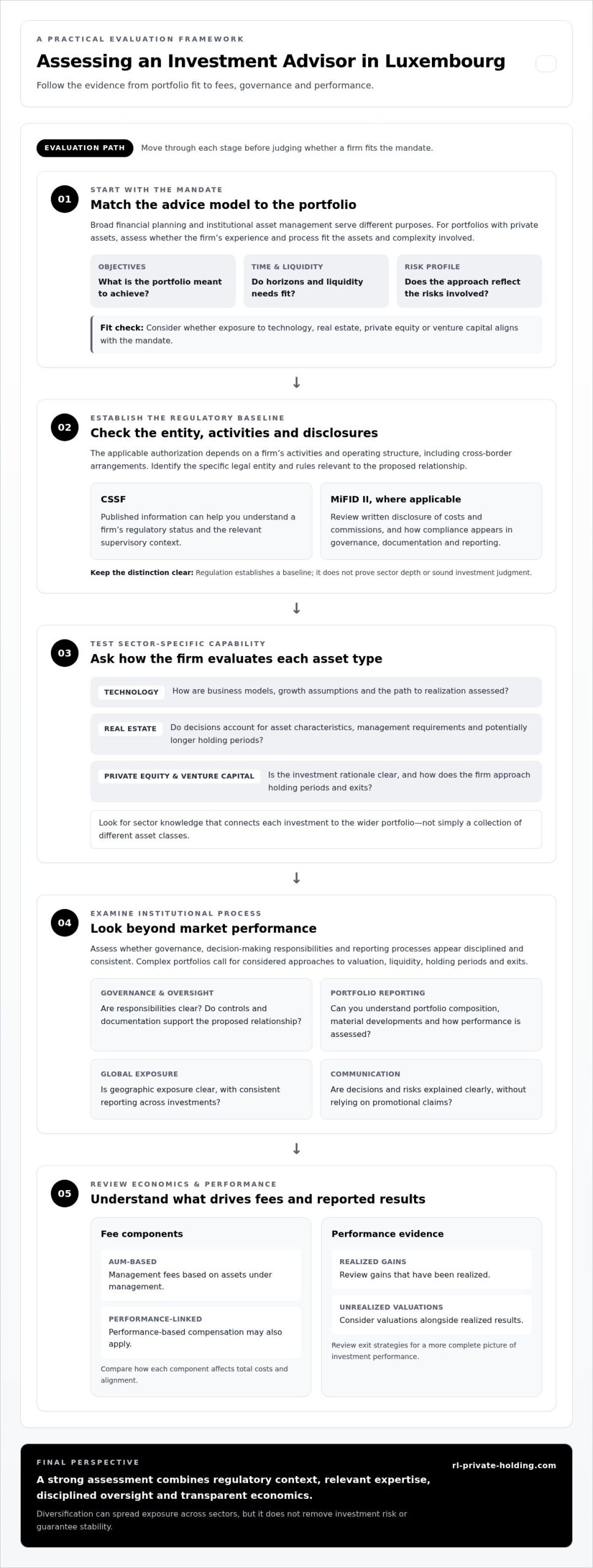
This article offers a practical framework for assessing an advisor’s regulatory position, governance, investment capabilities and long-term stability. It also explains how to review fee disclosures and judge whether a firm’s investment focus fits a portfolio that includes venture capital, private equity or real estate. RL Private Holding is headquartered in Luxembourg and manages a global portfolio spanning these sectors. Use the criteria below to compare potential partners and clarify what you need from an investment relationship.
Key Takeaways
- Assess institutional alignment and sector-specific experience, not credentials or reputation alone, when choosing a trusted investment advisor in Luxembourg.
- Consider how exposure to technology, real estate, private equity and venture capital fits your objectives, time horizon and risk profile.
- Compare AUM-based management fees with performance-linked incentives, and understand how each component affects costs and alignment.
- Review realized gains, unrealized valuations and exit strategies to build a more complete picture of investment performance.
- Assess how a Luxembourg-based firm with a global portfolio approaches wealth management and alternative investments.
The Evolution of the Luxembourg Investment Advisory Landscape
Luxembourg’s investment market extends beyond traditional banking and broad financial planning. Retail-oriented advice may focus on household finances and conventional investments, while institutional asset management deals with more complex portfolios, structures and time horizons. If you are considering private equity, venture capital or real estate alongside other assets, look for experience that matches the decisions and risks involved. The Investment Management Overview provides background on the discipline’s scope and objectives.
Luxembourg’s role as a global financial centre reflects its capacity to support cross-border investment structures and international portfolios. A local base can provide a framework for managing global exposure, but location alone does not demonstrate investment capability. When choosing a trusted investment advisor in Luxembourg, assess whether the firm’s mandate, sector knowledge and oversight fit the portfolio it is expected to manage.
Institutional vs. Retail Advisory Models
Institutional-grade management is distinguished by investment scope and process, not just presentation. Complex portfolios call for considered approaches to valuation, liquidity, holding periods and exits, particularly in private equity and venture capital. Assess how sector expertise connects to your wider objectives and how the firm explains the role of each investment in the portfolio.
Broad financial planning and institutional asset management serve different purposes. Planning can help define financial objectives; managing alternative investments also requires portfolio construction and an understanding of how private assets behave over time. Compare a firm’s experience and investment approach with the assets, time horizon and level of complexity involved in your mandate.
The Regulatory Environment and CSSF Oversight
The European Securities and Markets Authority (ESMA) contributes to common supervisory standards and guidance across the European Union. In Luxembourg, the Commission de Surveillance du Secteur Financier (CSSF) supervises relevant financial professionals and products within its remit, supporting investor protection and financial-system stability. The applicable authorization depends on a firm’s activities and operating structure, including cross-border arrangements.
European regulatory requirements evolve, making clear disclosure and sound governance important parts of an investment relationship. MiFID II provides a framework for written disclosure of costs and commissions where it applies. Ask which rules apply to the specific legal entity and activities involved, then review how compliance is reflected in governance, documentation and reporting. The CSSF’s published information can help you understand a firm’s regulatory status, but you should also assess whether its controls and disclosures support the proposed relationship.
Regulation establishes an important baseline, but it does not prove sector depth or sound investment judgment. Assess those qualities separately by examining the firm’s experience and process in the asset classes relevant to your portfolio.
Essential Criteria for Evaluating Institutional Advisors
Institutional capability depends on how a firm connects sector knowledge, portfolio construction and governance, not on individual credentials alone. When choosing a trusted investment advisor in Luxembourg, examine whether the firm’s experience fits the assets under consideration and whether its approach accounts for different investment horizons, liquidity needs and risk profiles. Diversification can spread exposure across sectors, but it does not remove investment risk or guarantee stability.
Technology and real estate require distinct forms of analysis. For technology investments, assess how the manager evaluates business models, growth assumptions and the path to realization. For real estate, consider how decisions account for asset characteristics, management requirements and potentially longer holding periods. A global portfolio managed from a Luxembourg base also calls for clear information about geographic exposure and consistent reporting across investments.
Multi-Sector Expertise and Portfolio Diversification
Review how private equity investment management fits into the wider portfolio, including the investment rationale and approach to exits. Venture capital funding can provide exposure to growth-stage opportunities, while real estate has different asset characteristics and time horizons. Consider how real estate asset management Luxembourg fits with other holdings rather than assessing it in isolation. The aim is a coherent allocation aligned with the investor’s mandate, not simply a collection of different asset classes.
Institutional Gravity and Firm Infrastructure
Market performance is only one part of institutional strength. Assess whether governance, decision-making responsibilities and reporting processes appear disciplined and consistent. For regulatory context, the Luxembourg’s Financial Regulator (CSSF) publishes information relevant to supervised financial firms. Its resources can support a review of regulatory status; governance and infrastructure relevant to the proposed relationship require separate assessment.
Professional distance also has practical value. Look for communication that explains decisions and risks clearly, without relying on promotional claims. Useful reporting should help you understand portfolio composition, material developments and how performance is assessed. For global assets managed from a Luxembourg base, examine whether the firm’s approach gives a coherent view across sectors and markets.
RL Private Holding is headquartered in Luxembourg and manages a global portfolio spanning technology, real estate, private equity and venture capital. Its investment focus provides a relevant example of multi-sector exposure managed from a Luxembourg base. Review RL Private Holding’s investment focus as part of your assessment of institutional alignment.
Analyzing Fee Structures and Operational Transparency
Fee terms affect both the cost of investment management and the incentives compensation may create. A clear proposal should explain the calculation basis, payment timing, included responsibilities and any additional expenses. When choosing a trusted investment advisor in Luxembourg, do not focus only on the lowest headline charge. Understand what each fee rewards and how it relates to the mandate.
The Impact of AUM-Based Management Fees
An assets-under-management fee is generally calculated by applying an agreed rate to a defined asset value. The agreement should specify which assets are included, how often they are valued, and whether the basis is invested capital, committed capital or another measure. These distinctions can affect fees, particularly when private assets are valued less frequently.
Compare proposals on a like-for-like basis rather than assuming one fee level is an institutional standard. Check what the recurring charge covers, such as portfolio oversight, investment analysis, reporting and administration, and identify expenses charged separately. The Luxembourg Fund Industry Association (ALFI) provides broader industry context, but the actual mandate and contractual fee schedule are what determine your costs. AUM-based revenue can support the resources required to manage a portfolio, while also creating an incentive to retain or grow assets. Consider that incentive alongside the services delivered.
Performance Fees and Carried Interest Dynamics
Performance-based compensation links some remuneration to investment results, but the terms determine how that link works. A hurdle rate is a return threshold that may need to be achieved before an incentive becomes payable. Review how it is calculated, whether it is cumulative and whether a catch-up provision applies. Establish whether incentives are assessed investment by investment or across the portfolio.
Carried interest is commonly associated with private equity and venture capital, where value may be realized over extended holding periods. It can connect a manager’s potential reward to investment outcomes, but it does not by itself prove confidence, skill or alignment. Examine the contractual mechanics: allocation of proceeds, timing of distributions, loss-recovery provisions and any clawback if early gains are later offset by losses.
Transparency matters when investments are realized. Reporting should distinguish realized proceeds from unrealized valuations and show how fees or carried interest were calculated under the agreed terms. Review how the firm accounts for partial exits, write-downs and portfolio-level gains or losses. RL Private Holding’s revenue model includes AUM management fees and performance-driven carried interest. Review its investment approach as part of understanding how compensation relates to long-term portfolio management.
Executing Institutional-Grade Due Diligence
Due diligence should test how an investment firm makes decisions, manages setbacks and turns opportunities into realized outcomes. Headline returns are only a starting point. For investors choosing a trusted investment advisor in Luxembourg, a disciplined review separates realized gains from unrealized valuations and examines the process behind both.
Verification of Track Records and Exit Strategies
Review performance across different investment periods and market conditions rather than relying on a single successful fund or recent result. Where information is available, examine investments individually and in aggregate. Compare the original investment thesis with later decisions, including changes in strategy, follow-on funding or asset disposition. For venture capital, look at completed exits alongside write-offs and investments still held. This helps show whether reported performance reflects cash returned to investors or mainly estimated values.
Exit analysis should cover timing and rationale, not just the final outcome. Assess whether the firm can explain how it approached a sale, refinancing or another exit route and how proceeds were allocated. Consistent documentation helps you understand both successful and underperforming investments.
Evaluating Risk Management and Governance
Private equity and real estate can involve limited liquidity, so assess how the firm monitors commitments, cash needs and the timing of expected realizations. Review its approach to valuation updates, concentration and downside scenarios. Understand how internal controls and independent oversight operate, and whether reporting records material decisions and changes in risk assessments.
Governance also depends on people and continuity. Identify who has decision-making authority, how an investment committee reaches and records decisions, and what arrangements support continuity if senior leadership changes. A firm’s response to prior volatility can reveal whether its process holds under pressure. Look for a clear account of decisions, identified risks and lessons applied, rather than retrospective claims of foresight.
Practical due diligence checklist:
- Separate realized proceeds from unrealized valuations in performance reporting.
- Review exits, write-offs and continuing investments against the original thesis.
- Understand how liquidity, valuation and concentration risks are monitored.
- Examine decision-making responsibilities, oversight and leadership continuity.
- Assess whether reporting clearly explains results and material changes.
This process places evidence and governance alongside performance when assessing a long-term investment relationship. Learn more about RL Private Holding’s global investment approach by exploring the firm’s investment focus.
RL Private Holding: A Disciplined Partner for Global Portfolios
For investors assessing institutional alignment, RL Private Holding brings a Luxembourg-based perspective to global investment management. The firm manages a portfolio spanning technology, real estate, private equity and venture capital. This breadth provides context for considering how different sectors can fit within a broader investment strategy, while recognizing that each has distinct risks, liquidity characteristics and time horizons.
Choosing a trusted investment advisor in Luxembourg involves more than comparing investment categories. It also means understanding how a firm’s capabilities relate to your objectives, how decisions are made and how compensation is structured. RL Private Holding’s revenue model includes assets-under-management fees and performance-driven carried interest. Reviewing the terms and mechanics of an arrangement helps clarify how ongoing management and investment outcomes relate to remuneration.
A Legacy of Strategic Asset Management
As an investment holding company headquartered in Luxembourg, RL Private Holding manages a global portfolio across its areas of focus. Its activities include private equity investment management, venture capital funding, real estate asset management and wealth management services. For investors, the practical question is how this range aligns with their goals, risk tolerance and intended investment horizon.
A measured institutional approach favors clear analysis over promotional claims. Professional distance can support deliberative decision-making, while a global perspective from a Luxembourg base provides a framework for considering international assets. Neither geography nor sector breadth alone establishes suitability, so assess the firm’s approach against your investment requirements.
Next Steps in Portfolio Optimization
Start by defining the outcomes you want your portfolio to support. Then consider how private equity, venture capital and real estate may fit alongside your wider wealth strategy. A Luxembourg-based holding company can provide an organizational context for global investments, but the structure should be evaluated in light of your objectives, governance needs and circumstances. Clear discussion of mandates, reporting and fees helps establish a sound basis for an investment relationship.
RL Private Holding’s compensation model combines AUM management fees with performance-driven carried interest. Understanding how these components apply to an arrangement is an important part of evaluating alignment. The firm’s focus on multiple sectors also offers a starting point for assessing whether its investment scope matches your portfolio priorities.
To make a formal inquiry about wealth management and strategic investment management, engage with RL Private Holding for strategic investment management.
Build a Partnership Around Long-Term Alignment
Choosing a trusted investment advisor in Luxembourg means assessing more than credentials or headline performance. Sector-specific expertise, disciplined due diligence and clear reporting help reveal whether a firm can manage the complexity of a global portfolio. Fee and incentive arrangements also deserve close attention because their terms shape how management responsibilities and investment outcomes are reflected in compensation.
RL Private Holding manages a global portfolio from its Luxembourg headquarters, with a focus on private equity, venture capital, real estate and technology. Its revenue model combines AUM management fees with performance-driven carried interest, providing a basis for examining how compensation relates to portfolio management and realized outcomes.
A considered investment partnership rests on clear objectives, transparent terms and a shared understanding of risk and time horizon. Contact RL Private Holding about institutional investment management to discuss how its investment focus may align with your priorities.
Frequently Asked Questions
How do I verify if an investment advisor is regulated in Luxembourg?
Search the firm’s legal name on the Commission de Surveillance du Secteur Financier (CSSF) website and review its stated status and permitted activities. Confirm that the entity you are assessing is the same one named in the proposed agreement, since related companies may have different roles. Regulatory status is an important due diligence step when choosing a trusted investment advisor in Luxembourg, but it does not by itself establish investment expertise or suitability.
What is the typical management fee for institutional asset management in Luxembourg?
There is no single management fee that applies to every institutional mandate. The amount and calculation basis can depend on the assets managed, portfolio complexity, responsibilities and agreed service scope. Review whether the fee is based on assets under management, committed capital or another measure, and identify separate expenses or performance incentives. Request a written breakdown showing how fees are calculated, valued and charged over the life of the relationship.
How does carried interest work in a private equity partnership?
Carried interest is a performance-based share of investment profits allocated to a manager or investment sponsor under the partnership agreement. It is generally connected to realized gains, but the exact calculation and payment timing depend on the contractual terms. Review the distribution waterfall, any hurdle rate, loss-recovery provisions and potential clawback. These details explain when an incentive is earned and whether later losses can affect amounts already distributed.
Can a Luxembourg holding company manage global real estate assets?
Yes. A Luxembourg-based holding company can manage a portfolio that includes real estate assets in multiple countries, subject to the relevant ownership structures and rules in each jurisdiction. Management may involve investment oversight, portfolio coordination and local operational arrangements. RL Private Holding is headquartered in Luxembourg and manages a global portfolio that includes real estate. The suitability of any structure depends on the investor’s objectives, governance needs and circumstances.
What is the difference between a family office and a private equity firm?
A family office generally coordinates wealth-related matters for an individual or family, which may include investment oversight and broader financial administration. A private equity firm primarily invests in private companies or manages private equity investments, often with a defined investment strategy and realization horizon. Their roles can overlap, but they are not interchangeable. Assess the organization’s mandate, decision-making authority and services to determine how its function matches your needs.
How often should an institutional advisor provide performance reports?
Reporting frequency should be agreed in the mandate because there is no single cadence suitable for every portfolio. Private assets may be valued less frequently than liquid investments, so reports should state valuation dates and distinguish realized results from estimates. Agree on how often you will receive performance, risk and portfolio updates, and what material events prompt additional communication. Consistent reporting makes it easier to track decisions and compare results over time.
What role does venture capital play in an institutional portfolio?
Venture capital provides exposure to early-stage or growth-oriented businesses and may complement investments in other asset classes. It also carries distinct risks, including uncertainty around business development, valuation and the timing of exits. Institutional investors should consider how venture capital fits the portfolio’s objectives, liquidity needs and time horizon, rather than treating it as a standalone source of growth. Diversification can spread exposure, but it cannot eliminate investment risk.
Is a SOPARFI structure relevant for my investment advisory needs?
A SOPARFI may be relevant when considering a Luxembourg corporate structure for holding investments, but it is not itself an investment advisor or an investment strategy. Its suitability depends on factors such as ownership, governance, cross-border objectives and tax circumstances. Separate the choice of corporate vehicle from the choice of portfolio manager, and obtain qualified legal and tax advice before establishing or using a structure for investment purposes.