

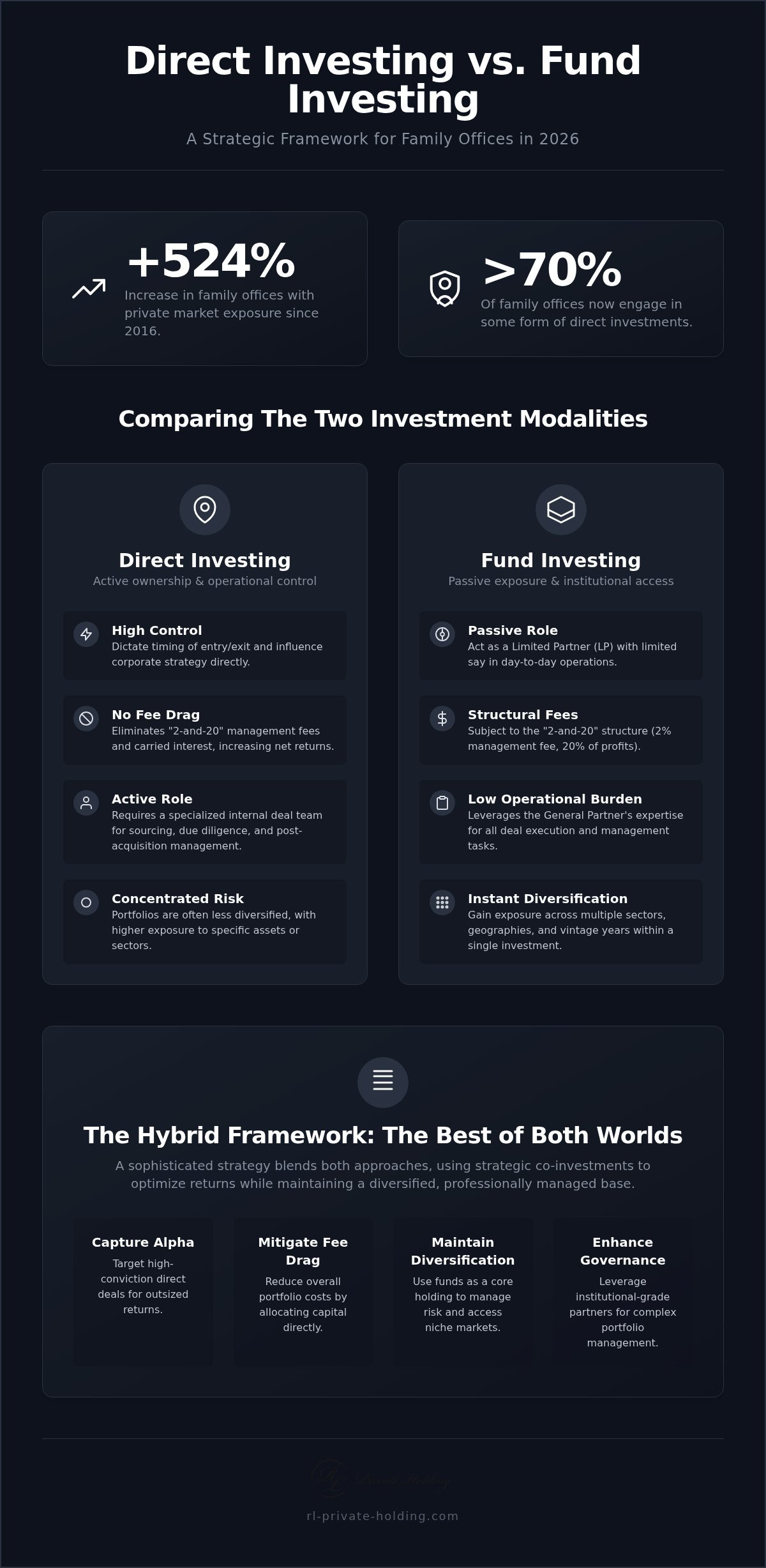
Since 2016, the number of family offices with exposure to private markets has increased by 524 percent, signaling a fundamental shift in the management of generational wealth. Many principals now find themselves at a crossroads when evaluating direct investing vs fund investing for family offices, particularly as the traditional “2-and-20” fee structure and blind-pool opacity become increasingly difficult to justify. You likely recognize the inherent trade-off; the simplicity of fund allocations often comes at the expense of control and net returns, while the pursuit of direct deals introduces significant operational complexity and management requirements.
This article provides a 2026 strategic framework designed to optimize your portfolio by balancing these two modalities to enhance alpha and align interests with investment partners. We’ll analyze the structural trade-offs of each approach and examine how a hybrid model can utilize strategic co-investment to mitigate fee drag while maintaining institutional-grade governance. This analysis offers a clear roadmap for navigating the private equity landscape with the precision and discipline required of a global firm.
Key Takeaways
- Establish a clear baseline for allocation by defining the structural differences between direct equity acquisition and managed fund commitments.
- Evaluate the internal operational requirements, including the necessity of a specialized deal team, when transitioning to direct investment strategies.
- Identify the strategic advantages of fund investing, such as institutional access to niche asset classes and professional manager selection.
- Develop a hybrid framework for direct investing vs fund investing for family offices to capture alpha through co-investment while maintaining portfolio diversification.
- Optimize global portfolio governance by leveraging institutional-grade management to navigate complex carried interest and performance-based structures.
The Evolution of Allocation: Direct Investing vs. Fund Investing for Family Offices
The landscape of private capital has undergone a significant transformation since the mid-2010s. Direct investing is defined as the acquisition of equity stakes in private enterprises without the intervention of an intermediary manager; it places the responsibility of due diligence and oversight entirely on the investor. Conversely, fund investing involves the commitment of capital to a Private Equity or Venture Capital fund managed by a General Partner (GP). In 2026, the strategic choice between direct investing vs fund investing for family offices is no longer a simple binary preference. It’s a fundamental decision regarding the firm’s operational identity and long-term governance.
A Family office must now decide whether to act as a passive provider of capital or an active strategic partner. Data indicates that over 70 percent of family offices now engage in direct investments. This trend isn’t merely a pursuit of higher returns. It represents a shift toward ownership over mere exposure. Since 2016, the number of family offices with exposure to private markets has increased by 524 percent. This surge has pushed many organizations to move beyond passive Limited Partner (LP) roles. They’re becoming active participants that influence corporate strategy and operational outcomes.
The Drivers of the Direct Investing Trend
The move toward direct allocations is primarily fueled by a desire for structural efficiency and control. Many principals find the traditional 2-and-20 fee structure creates a significant “fee drag” that erodes net performance over a ten-year horizon. By investing directly, an office eliminates management fees and carried interest payments to external GPs. Control is another critical factor. Direct investors dictate the timing of entry and exit, rather than being bound by the rigid lifecycle of a closed-end fund. This autonomy allows for better alignment with the family’s entrepreneurial heritage and specific industry expertise. It’s about leveraging what the family already knows to create alpha.
The Enduring Relevance of Fund Structures
Despite the growth of direct deals, fund structures remain a vital component of a sophisticated portfolio. They provide instant diversification across sectors, geographies, and vintage years that an individual office rarely achieves alone. GPs offer access to proprietary deal flow and niche strategies, such as distressed debt or specialized secondary markets, which require deep, localized networks. Furthermore, the institutional due diligence capabilities of a dedicated fund manager are difficult to replicate internally. Funds act as a critical layer of risk management; they provide a diversified base that allows the office to take more concentrated risks in its direct portfolio.
The Mechanics of Direct Private Equity and Venture Capital
Executing a direct investment strategy requires a transition from capital allocation to active operational management. While the debate over direct investing vs fund investing for family offices often centers on fee structures, the practical mechanics of deal execution represent the true barrier to entry. A successful office must develop a robust pipeline through proprietary networks or participate in competitive auctions. The latter often requires a level of speed and scale that smaller, less specialized teams struggle to maintain effectively.
Once a lead is identified, the due diligence protocol must replicate institutional-grade analysis to protect generational wealth. This involves rigorous assessments of financial health, market positioning, and management quality. The challenges of direct investments often manifest most acutely after the transaction closes. Post-acquisition management requires the office to actively drive value within the portfolio company. This is a significant departure from the passive monitoring associated with fund participation. It demands a hands-on approach to corporate governance and strategic oversight.
Sourcing and Executing Direct Deals
A clear investment mandate is the foundation of any direct strategy. It should be rooted in the family’s core competencies, allowing the office to add strategic value beyond simple capital provision. Many offices utilize “club deals” or peer-to-peer networking to share the diligence burden and spread financial risk. Implementing formal private equity investment management frameworks ensures that each transaction is evaluated against a consistent set of institutional benchmarks. This discipline prevents the emotional biases that can occasionally influence family-led deal sourcing.
Operational Risk and Resource Allocation
Internalizing the General Partner (GP) function carries substantial overhead. An office must weigh the cost of hiring specialized deal teams and establishing an investment committee against the potential fee savings. Liquidity management also becomes more complex. Direct positions are highly illiquid and lack the scheduled distributions of a diversified fund. Small teams also face “key person risk,” where the departure of a single professional can stall the entire direct program. Balancing these factors requires a methodical approach to organizational design. For families seeking to institutionalize their private market exposure, partnering with a disciplined global firm can provide the necessary operational scale and stability.
Fund Investing: Strategic Diversification and Institutional Access
While the operational autonomy of direct deals is attractive, fund investing remains the primary mechanism for achieving broad-based risk mitigation. The central tension in direct investing vs fund investing for family offices often revolves around the “blind pool” risk. Investors commit capital to a mandate without knowing the specific underlying assets. However, this risk is balanced by the opportunity to leverage the institutional manager selection process. Elite General Partners (GPs) possess the infrastructure to evaluate thousands of opportunities to select the few that meet a rigorous institutional threshold. This systematic approach provides a level of diversification that is difficult to replicate through idiosyncratic direct acquisitions.
Fund structures also grant access to niche strategies that require specialized operational capabilities. This includes distressed debt, secondary market transactions, and early-stage specialized venture capital. These sectors often demand localized networks and high-frequency monitoring that a typical single-family office isn’t equipped to handle. Integrating these specialized vehicles into family office investment strategies in Luxembourg allows for a more resilient portfolio. Benchmarking these allocations requires a disciplined comparison of net-of-fee returns against the internal rate of return (IRR) of direct deals. It’s vital to account for the “total cost of ownership” in direct investing, including the hidden expenses of internal deal teams and due diligence.
Selecting Tier-1 Fund Managers
Successful fund allocation depends on the ability to identify managers who’ve demonstrated resilience across multiple economic cycles. Evaluations should focus on the GP’s value creation thesis and the stability of the senior investment team. High turnover among partners often signals future volatility in performance. Many global GPs utilize venture capital Luxembourg hubs to centralize their European and international operations. This provides family offices with a transparent gateway to institutional-grade deal flow and standardized reporting.
Structural Efficiency in Fund Allocation
The choice of vehicle is as critical as the choice of manager. Utilizing the Luxembourg special limited partnership (SCSp) offers a flexible, tax-transparent framework for making large-scale fund commitments. This structure is particularly effective for managing the complexities of capital calls and distribution waterfalls across a multi-fund portfolio. For offices that don’t meet the minimum commitment levels of elite funds, feeder funds can provide a strategic path to access restricted institutional tranches. This ensures the office maintains exposure to top-quartile performance without the necessity of a massive, single-asset commitment.
A Hybrid Decision Framework: Co-Investment and Structural Governance
The choice between direct investing vs fund investing for family offices shouldn’t be viewed as a binary conflict. Most sophisticated organizations now utilize a hybrid framework that captures the benefits of both strategies simultaneously. This approach allows a family to maintain high-conviction direct stakes while relying on fund managers for diversification and specialized market intelligence. The “Direct-Led, Fund-Supported” model for 2026 prioritizes concentrated direct ownership in core-competency sectors while utilizing diversified fund allocations for broader market exposure and risk management.
Decision criteria for this framework depend heavily on the family’s internal bandwidth and technical expertise. You should lead when the transaction falls within a primary industry of family expertise where you possess a competitive advantage. You’ll want to follow or co-invest when the deal is attractive but requires the specialized due diligence or operational support of a General Partner. Delegation to a fund remains the most prudent choice for non-core sectors or distant geographies where the office lacks a proprietary network.
The Co-Investment Advantage
Co-investing serves as a bridge between passive and active involvement. It allows an office to reduce its blended fee profile, as many GPs offer co-investment rights on a “no fee, no carry” basis to their largest Limited Partners. This structure also facilitates “over-the-shoulder” learning. Your internal team gains exposure to the GP’s operational playbooks and exit strategies without bearing the full burden of deal sourcing. It’s a strategic way to build internal expertise while gaining outsized exposure to high-conviction assets already vetted by institutional professionals.
Luxembourg Structures for Hybrid Portfolios
Managing a hybrid portfolio requires a robust legal and tax infrastructure. Many private wealth management firms Luxembourg recommend integrating these holdings within a SOPARFI (Société de Participations Financières). This vehicle is exceptionally flexible for holding both global direct equity stakes and interests in various fund structures. It simplifies regulatory compliance and reporting by consolidating diverse assets under a single institutional-grade holding company. For families seeking to institutionalize these complex structures, we invite you to explore our institutional-grade asset management services to ensure long-term portfolio stability.
Governance for these hybrid models must be rigorous. Reporting standards should provide a unified view of risk, accounting for both the transparency of direct deals and the periodic reporting cycles of private funds. Monitoring must track total exposure to specific industries or geographies across both allocation types to prevent unintended concentration. This methodical oversight ensures that the portfolio remains aligned with the family’s long-term wealth preservation goals while aggressively pursuing alpha in core markets.
Partnering for Scale: How RL Private Holding Optimizes Global Portfolios
The strategic tension between direct investing vs fund investing for family offices is resolved through the implementation of institutional-grade infrastructure. RL Private Holding operates at the intersection of these two modalities; we provide the global scale and methodical discipline required to manage complex, multi-sector portfolios. By bridging the gap between the flexibility of a family office and the rigor of an institutional asset manager, we enable our partners to execute on high-conviction opportunities without the overhead of an internal multi-disciplinary team. Our approach focuses on the preservation and growth of generational wealth through a diversified exposure to tech, real estate, and private equity.
Building a resilient, multi-generational investment infrastructure requires a shift from reactive deal-making to proactive portfolio governance. This transition ensures that the family’s legacy isn’t dependent on the success of a single asset or the expertise of a single individual. By utilizing a partner with established operational scale, family offices can access sophisticated Private Equity Investment Management and Venture Capital Funding without sacrificing the discretion or agility that defines their organization. This partnership model provides the stability needed to navigate volatile market cycles while maintaining a clear focus on long-term wealth preservation.
Institutional Support for Family Office Mandates
Successful direct investment execution requires a robust operational backbone that many family offices find difficult to maintain internally. We provide the technical expertise and administrative framework necessary to manage performance-based incentives and carried interest structures. Our partners benefit from strategic advisory on real estate asset management Luxembourg and global private equity markets. This support extends to the development of customized reporting and governance frameworks; these systems ensure that complex family holdings remain transparent and compliant across multiple jurisdictions. This level of institutional discipline is essential for maintaining portfolio integrity over several generations.
Next Steps: Evaluating Your Current Allocation
Optimizing a portfolio for 2026 begins with a rigorous audit to identify areas of fee leakage and unintended concentration risk. You should evaluate whether your current team possesses the technical depth to manage direct assets or if your capital is better served through a hybrid model. Defining the long-term role of the office is a critical governance decision; you must determine if the entity functions primarily as a capital allocator or a strategic business builder. Engaging with global investment partners allows you to enhance your proprietary deal flow and access institutional-grade due diligence. This methodical evaluation ensures that your investment infrastructure is resilient enough to navigate the evolving global financial landscape.
Future-Proofing Generational Capital through Institutional Discipline
The decision regarding direct investing vs fund investing for family offices is ultimately a question of how a family chooses to define its operational identity. A successful 2026 strategy requires a transition from passive capital allocation toward a hybrid framework. This model utilizes the diversification of funds alongside the alpha-generating potential of direct ownership. It’s an evolution that demands more than just capital. It requires a robust governance structure and a sophisticated operational backbone to manage the complexities of global private markets.
By leveraging professional expertise in Private Equity and Venture Capital, your office can bridge the gap between its unique flexibility and the institutional discipline necessary for long-term success. Maintaining discreet, institutional-grade wealth preservation remains the priority as you navigate these structural trade-offs. We invite you to consult with RL Private Holding on optimizing your global investment structure. Our Luxembourg-based asset management provides the global scale and stability required to secure your legacy across multiple generations. Establishing this disciplined infrastructure today ensures your portfolio remains resilient in an increasingly complex financial landscape.
Frequently Asked Questions
What are the main differences between direct investing and fund investing for family offices?
Direct investing involves acquiring equity stakes in private companies without an intermediary manager, placing the full responsibility of due diligence on the investor. Fund investing entails committing capital to a fund managed by a General Partner. The primary distinction in direct investing vs fund investing for family offices lies in the level of control and operational burden; direct deals offer autonomy, while funds provide instant diversification across sectors, geographies, and vintage years.
Why are many family offices shifting toward direct private equity investments in 2026?
The shift toward direct private equity in 2026 is driven by a desire to eliminate the fee drag associated with traditional 2-and-20 structures. Many organizations now seek greater transparency than blind-pool funds allow. Additionally, direct ownership provides better alignment with a family’s entrepreneurial heritage, allowing principals to leverage specific industry expertise to drive value rather than remaining passive participants in a broader portfolio managed by external professionals.
How does co-investment serve as a middle ground between direct and fund strategies?
Co-investment allows family offices to participate in specific deals alongside a General Partner, often with reduced or eliminated management fees. This serves as a strategic middle ground in the debate of direct investing vs fund investing for family offices. It provides the benefit of professional GP due diligence while allowing the office to increase its concentration in high-conviction assets and build internal expertise through over-the-shoulder learning from institutional professionals.
What kind of internal team is required for a family office to succeed in direct investing?
Success in direct investing requires a specialized deal team capable of institutional-grade due diligence and post-acquisition management. A formal investment committee is essential to ensure objective decision-making and mitigate emotional biases. Most offices need professionals with expertise in financial modeling, legal structuring, and operational oversight. Without these internal resources, the operational risk of managing concentrated private equity positions becomes significantly higher, potentially compromising the stability of the generational portfolio.
How can a Luxembourg SOPARFI structure benefit a family office’s investment strategy?
A Luxembourg SOPARFI serves as a flexible vehicle for holding global direct stakes and fund interests within a single institutional framework. It offers significant tax transparency and is widely recognized by global investment partners. This structure simplifies regulatory compliance and reporting for sophisticated family holding companies. It allows for the efficient management of diverse assets, including tech, real estate, and private equity, under a unified corporate umbrella while maintaining a high formality register.
What are the primary risks associated with direct investing for smaller family offices?
Smaller offices face heightened concentration risk and liquidity challenges when pursuing direct deals. Unlike a diversified fund, a single direct investment can represent a disproportionate share of the total portfolio. Additionally, these offices often suffer from key person risk, where the departure of one investment professional can stall the entire program. Managing the operational complexity of a portfolio company without adequate scale frequently leads to underperformance compared to the diversified fund benchmarks managed by larger firms.
How should a family office evaluate the performance of its fund managers vs. direct deals?
Performance evaluation should focus on net-of-fee returns for funds compared to the internal rate of return for direct deals, adjusted for the total cost of ownership. This includes accounting for the hidden expenses of internal deal teams, legal fees, and the time spent on operational oversight. A disciplined framework should also consider risk-adjusted returns, as direct deals often carry higher idiosyncratic risk than the diversified exposure provided by institutional fund managers across multiple cycles.
Can fund investing still provide outsized returns compared to direct investments?
Fund investing continues to provide outsized returns, particularly through access to top-quartile managers and niche strategies. These include distressed debt, specialized venture capital, and secondary markets that require localized networks and high-frequency monitoring. While direct deals offer fee savings, elite fund managers often deliver superior gross performance through proprietary deal flow and institutional-grade value creation playbooks that individual family offices cannot easily replicate without the benefit of institutional scale and global reach.