

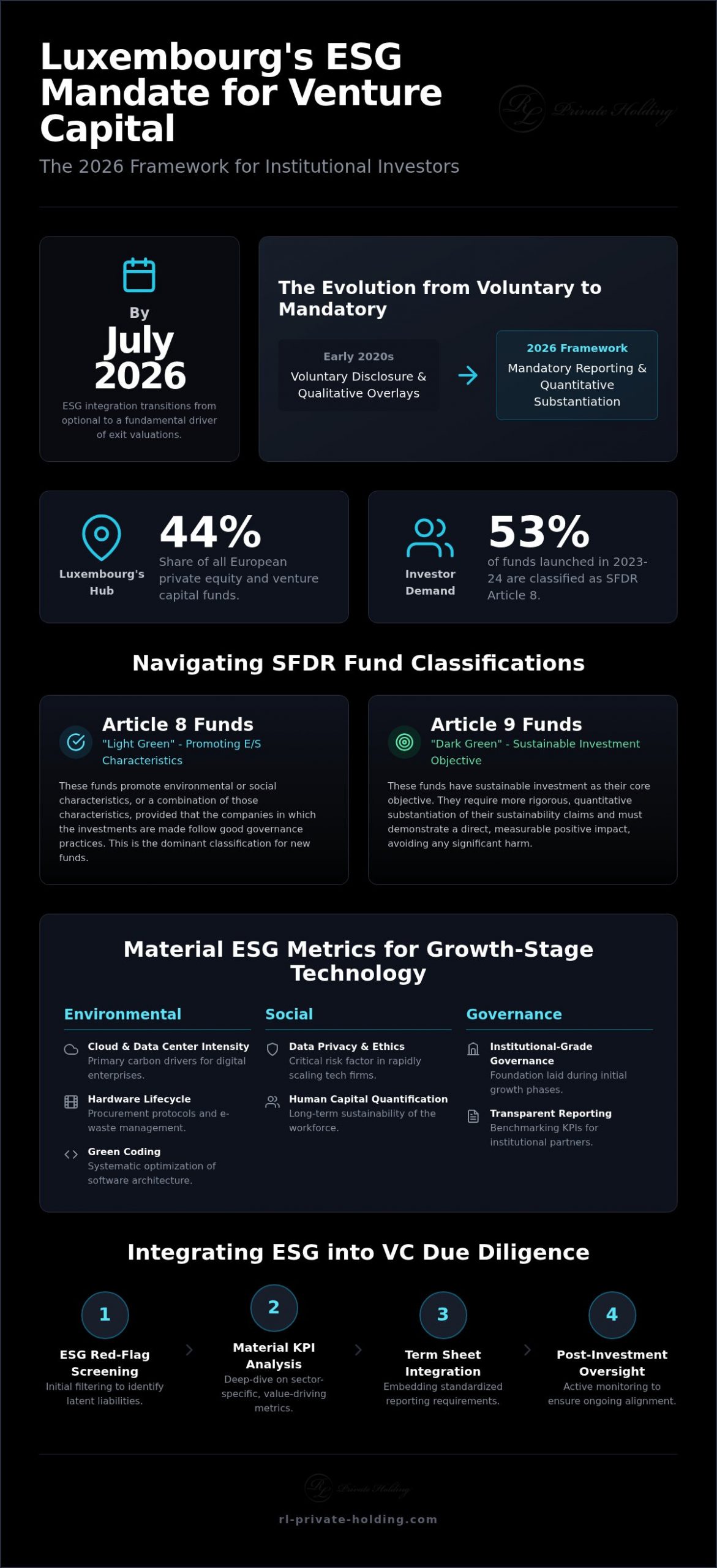
By July 2026, ESG integration in the Grand Duchy has transitioned from a secondary compliance exercise into a fundamental driver of exit valuations for alternative assets. With Luxembourg commanding a 44% share of all European venture capital funds, the implementation of standardized ESG metrics for venture capital in Luxembourg is now a critical requirement for institutional managers. You likely recognize that the inherent data fragmentation within early-stage companies often complicates the rigorous reporting mandates established by SFDR Article 8 and 9. This operational complexity requires a disciplined approach to portfolio oversight that balances regulatory obligations with the pursuit of material, growth-oriented data.
This strategic framework provides a sophisticated analysis of the essential key performance indicators and disclosure requirements currently defining the Luxembourg financial ecosystem. It’s designed to clarify your obligations under the EU ESG Ratings Regulation that became applicable on July 2, 2026. We offer a methodical overview of the transition from basic transparency to active value creation, ensuring that your investment structures maintain their alignment with Luxembourg’s leadership in sustainable finance while meeting the heightened expectations of global institutional partners.
Key Takeaways
- Comprehend the shift from voluntary ESG disclosure to the mandatory 2026 regulatory framework governing alternative investment funds in Luxembourg.
- Identify material ESG metrics for venture capital in Luxembourg specifically tailored for growth-stage technology, including hardware lifecycles and human capital quantification.
- Differentiate between the reporting obligations of SFDR Article 8 and Article 9 funds to ensure accurate disclosure of sustainable objectives.
- Establish robust due diligence protocols that integrate ESG red-flag screening and standardized reporting requirements into investment term sheets.
- Gain insights into how disciplined institutional frameworks can be applied to maintain transparency and stability within a volatile venture capital landscape.
The Evolution of ESG Frameworks in the Luxembourg Venture Capital Ecosystem
The regulatory landscape for alternative investments has undergone a fundamental shift. Voluntary adoption of Environmental, Social, and Governance (ESG) principles has been replaced by a rigorous, mandatory framework. As of April 16, 2026, the transposition of AIFMD II into national law has formalized reporting, delegation, and liquidity management requirements. Luxembourg remains the primary jurisdiction for these structures, currently commanding a 44% share of all European private equity and venture capital funds. This dominance is sustained by a sophisticated legal ecosystem that prioritizes transparency and investor protection above all else.
Defining materiality in growth-stage technology requires a departure from traditional industrial metrics. For a venture capital portfolio, ESG metrics for venture capital in Luxembourg must focus on the specific risks inherent in rapid scaling. This includes data privacy ethics, compute-efficiency, and the long-term sustainability of human capital. The Sustainable Finance Disclosure Regulation (SFDR) has fundamentally altered fund marketing by requiring clear classification under Article 8 or Article 9. It isn’t just about labels. It’s about the quantitative substantiation of sustainability claims to avoid the reputational risks associated with greenwashing.
Luxembourg as a Global Hub for Sustainable Private Markets
The Luxembourg Stock Exchange (LuxSE) continues to set the global standard through its dedicated green labeling initiatives. Institutional investors show a clear preference for Luxembourg-domiciled vehicles because they offer a stable regulatory environment. The 2026 standards differ significantly from early 2020s implementations. Previously, ESG was often treated as a qualitative overlay. Today, it’s a quantitative requirement. The application of Regulation 2024/3005 on July 2, 2026, ensures that ESG ratings providers are supervised by ESMA, bringing a new level of integrity to the data used by fund managers.
The Core Objectives of ESG Integration for Institutional LPs
Institutional Limited Partners (LPs) increasingly view ESG integration as a proxy for operational excellence. Superior governance structures are proven to enhance exit valuations by reducing latent legal and regulatory liabilities. Recent data from Invest Europe indicates that 53% of funds launched between 2023 and 2024 are classified as Article 8. This trend aligns with the European Green Deal and broader institutional mandates that prioritize risk-aware capital allocation. By adopting standardized ESG metrics for venture capital in Luxembourg, managers provide the transparency required to secure long-term commitments from the world’s most disciplined investors.
Materiality-Focused Environmental and Social Metrics for Growth-Stage Technology
Establishing materiality requires a granular understanding of the technology sector’s unique operational footprint. Traditional industrial metrics often fail to capture the risks and opportunities inherent in software-centric businesses. For managers implementing ESG metrics for venture capital in Luxembourg, the focus must shift toward indicators that directly influence long-term enterprise value. Standardizing these Key Performance Indicators (KPIs) across a diversified portfolio allows for better benchmarking and more transparent reporting to institutional partners. It’s essential to recognize that while early-stage companies operate with lean teams, the foundation for institutional-grade governance is laid during these initial growth phases.
Quantifying the Environmental Footprint of Technology
Environmental oversight in 2026 extends far beyond basic carbon offsetting. Venture capital portfolios must now account for the energy intensity of cloud operations and data center utilization, which represent the primary carbon drivers for digital enterprises. Effective hardware procurement protocols and electronic waste management are equally vital, particularly for firms with significant hardware components. Green Coding refers to the systematic optimization of software architecture and algorithms to minimize energy consumption during execution, serving as a material environmental metric for 2026. By monitoring compute-efficiency, managers can identify operational redundancies that impact both sustainability targets and cloud expenditure.
Social Indicators and Human Capital Management
Social metrics prioritize the stability and ethical standing of the organization. Human capital remains the most significant asset for technology ventures; therefore, quantifying its management is a prerequisite for risk mitigation. Diversity, Equity, and Inclusion (DEI) metrics should be tracked at both the board and engineering levels to ensure a breadth of perspective and talent retention. High employee churn rates often serve as a leading indicator of cultural or structural instability. Furthermore, data privacy compliance and user protection are no longer merely legal requirements. They’re core social responsibilities that protect the firm’s reputation and prevent catastrophic valuation adjustments during exit events.
The Luxembourg Private Equity and Venture Capital Association (LPEA) continues to provide essential resources for standardizing these frameworks within the local ecosystem. Collecting this data in lean startup environments requires a pragmatic approach that doesn’t overwhelm the founding team. Implementing automated data collection tools and integrating reporting requirements into the initial investment agreements helps bridge the gap between startup agility and institutional rigor. Firms that prioritize these venture capital funding structures often find themselves better positioned for subsequent funding rounds and successful exits. This disciplined approach ensures that ESG metrics for venture capital in Luxembourg remain a tool for value creation rather than a mere administrative burden.
Governance and Disclosure: Navigating SFDR and EU Taxonomy in 2026
Regulation has formalised the governance expectations for fund managers within the Grand Duchy. In 2026, the distinction between Article 8 and Article 9 funds under the Sustainable Finance Disclosure Regulation (SFDR) isn’t just a marketing choice; it’s a structural commitment that dictates operational reality. Article 9 funds must demonstrate a specific sustainable objective, while Article 8 funds focus on the promotion of environmental or social characteristics. Both classifications require the rigorous application of ESG metrics for venture capital in Luxembourg to satisfy the heightened transparency demands of institutional Limited Partners. Aligning with the EU Taxonomy involves verifying that every portfolio company meets the “Do No Significant Harm” criteria, a task that requires a disciplined approach to data management.
Principal Adverse Impact (PAI) indicators represent a significant reporting hurdle for early-stage portfolios where data is often scarce. Managers are now required to track mandatory indicators ranging from carbon footprints to board gender diversity across their entire holdings. Governance metrics in this context focus on board independence, executive compensation structures, and anti-corruption measures. These factors are essential for securing the institutional integrity required for successful exits. Without standardized governance data, funds risk regulatory scrutiny and a potential loss of investor confidence during the 2026 reporting cycles.
The Governance Pillar: Ensuring Institutional Integrity
Integrity starts at the board level and extends through every layer of the investment structure. Transparency in cap table management and the protection of shareholder rights are non-negotiable for funds seeking long-term stability. Portfolios need robust whistleblowing policies and ethical conduct guidelines to mitigate latent legal risks before they scale. There’s a critical intersection between these governance standards and the operational framework of the Luxembourg special limited partnership. The SCSp provides the necessary flexibility for venture capital while supporting the high governance standards demanded by the current regulatory environment.
Disclosure Timelines and Regulatory Reporting Standards
Luxembourg-domiciled Alternative Investment Funds (AIFs) must adhere to strict annual reporting cycles to remain compliant. Following the AIFMD II transposition in April 2026, the demand for verified, high-quality data has increased significantly. Third-party ESG auditors now play a central role in verifying portfolio information, providing the objective assurance that global investors require. Managing these disclosures for cross-border tech portfolios requires a centralized approach to ensure consistency. By adopting standardized ESG metrics for venture capital in Luxembourg early in the fund lifecycle, managers can avoid the administrative bottlenecks associated with the enhanced Annex IV reporting obligations that apply from 2027.
Implementation Strategies: Integrating ESG Metrics into VC Due Diligence
Implementation requires a transition from high-level policy to operational integration. For managers utilising ESG metrics for venture capital in Luxembourg, the due diligence phase serves as the primary point of risk identification and value alignment. It isn’t merely a checklist. It’s a strategic assessment of a startup’s long-term viability within a regulated ecosystem. By identifying potential ESG red flags early, firms can avoid capital commitments to ventures with insurmountable governance or environmental liabilities. This proactive approach ensures that every portfolio addition strengthens the fund’s overall institutional standing.
The Pre-Investment ESG Audit Framework
Standardised questionnaires are essential for seed and Series A founders. These tools assess the ‘ESG maturity’ of the founding team, focusing on their awareness of regulatory obligations and their willingness to implement transparent reporting. This process must be seamlessly integrated into the broader private equity due diligence protocol. Findings from this audit often dictate the terms of the investment, ensuring that reporting obligations are clearly defined before capital is deployed. Assessing a founder’s commitment to ethical scaling is as important as evaluating their technical roadmap.
The ESG term sheet formalises these expectations. It embeds specific reporting requirements into the investment agreement, ensuring that the portfolio company remains accountable for its impact. This legal foundation is critical for maintaining the integrity of the fund’s overall ESG score. It provides a clear mandate for the founding team to prioritise governance from day one.
Continuous Monitoring and Portfolio Support
Post-investment monitoring relies on automated platforms to track KPI progress. Establishing quarterly ESG reporting dashboards allows portfolio companies to visualise their data and identify areas for improvement. General Partners provide the necessary support to help startups refine their operations and improve their scores over time. This ongoing engagement is a key driver of private equity exit strategy success. High ESG performance makes a company more attractive to Tier-1 follow-on investors and institutional acquirers who prioritise risk-aware assets.
Superior ESG performance functions as a signal of operational excellence. It suggests a disciplined management team capable of navigating complex regulatory environments. Firms seeking to optimise their portfolios through structured Venture Capital Funding find that these implementation strategies are indispensable for securing long-term institutional ROI. By adopting these ESG metrics for venture capital in Luxembourg, managers transform compliance into a tangible competitive advantage.
RL Private Holding: A Disciplined Approach to Sustainable Venture Capital
RL Private Holding maintains a disciplined approach to capital deployment, where the integration of ESG metrics for venture capital in Luxembourg serves as a fundamental pillar of institutional stability. The firm operates with a clear focus on structured, risk-aware investment frameworks that prioritize long-term growth over speculative gains. By embedding quantitative sustainability indicators into the core of the portfolio management process, RL Private Holding ensures that every asset is aligned with the highest standards of global financial integrity. This methodical application of data provides a transparent overview of risk, allowing for more precise capital allocation and superior wealth preservation for institutional partners.
The firm’s commitment to Luxembourg’s regulatory excellence is reflected in its adherence to the evolving transparency mandates of 2026. This isn’t merely about meeting the minimum requirements of SFDR or AIFMD II. It’s about leading through a sober, factual presentation of performance data. A diversified, ESG-aware portfolio is better equipped to navigate the complexities of the modern financial landscape, providing a stable foundation for growth-stage technology investments. This steady hand in the background of major investments ensures that transparency remains a functional asset rather than an administrative burden.
Institutional Gravity in a Global Investment Landscape
A professional and objective approach to venture capital Luxembourg is essential for firms operating at a global scale. RL Private Holding positions itself as a discreet and authoritative partner, leveraging Luxembourg’s robust financial infrastructure to support the international expansion of its portfolio companies. The firm’s organizational hierarchy and disciplined focus create an environment where technology ventures can scale with institutional support. It’s a strategic framework that values stability and professional distance, appealing to those who require a reliable partner in the high-stakes environment of private equity and asset management.
The Logical Conclusion of ESG Integration
ESG integration has become a fundamental component for private wealth management firms Luxembourg seeking to build resilient portfolios. These structures are designed to withstand shifting global regulations while maintaining a focus on strategic wealth preservation. Partnering with RL Private Holding allows for a sophisticated approach to capital allocation where ESG metrics for venture capital in Luxembourg are utilized to identify latent value and mitigate operational risks. This methodical consistency ensures that the firm operates with internal discipline, providing a clear plan for long-term institutional ROI. The result is a well-ordered investment strategy that reflects the permanence and strategic focus of a global financial leader.
Securing Long-Term ROI Through Disciplined Sustainability Frameworks
The transition to mandatory disclosure requirements in 2026 has redefined the operational standards for alternative investment managers. By formalizing the application of ESG metrics for venture capital in Luxembourg, firms can effectively bridge the gap between early-stage agility and the rigorous expectations of global institutional LPs. This framework demonstrates that sustainability is no longer a qualitative overlay. It’s a quantitative asset that directly influences exit valuations and long-term enterprise resilience. Establishing robust governance and materiality-focused reporting ensures that portfolios remain compliant with SFDR mandates while safeguarding the interests of sophisticated stakeholders.
RL Private Holding combines Luxembourg-based global investment expertise with a specialized focus on technology and growth-stage firms. We invite you to explore our strategic approach to institutional investment in Luxembourg to understand how we maintain rigorous governance standards across our diversified holdings. We look forward to supporting your objectives through a steady and authoritative partnership in the evolving financial landscape.
Frequently Asked Questions
What are the primary ESG reporting requirements for Luxembourg VC funds in 2026?
Managers must adhere to the Sustainable Finance Disclosure Regulation (SFDR) and the EU Taxonomy. As of April 16, 2026, the transposition of AIFMD II has introduced enhanced reporting obligations for alternative investment fund managers. These requirements include mandatory disclosure of Principal Adverse Impact (PAI) indicators. Funds must provide quantitative evidence of how their investment decisions affect environmental and social factors. This ensures a level of transparency that meets the expectations of institutional partners.
How does SFDR Article 8 differ from Article 9 for venture capital portfolios?
Article 8 funds promote environmental or social characteristics but don’t have sustainability as their core objective. Article 9 funds are specifically designed to achieve a sustainable investment outcome. For venture capital portfolios, Article 9 classification requires a higher degree of substantiation. It’s necessary to prove that every portfolio company contributes to a specific objective without causing significant harm to other environmental or social goals defined by the EU Taxonomy.
Are early-stage startups exempt from ESG disclosure in Luxembourg?
Early-stage startups aren’t typically subject to direct regulatory disclosure. However, they aren’t functionally exempt. Because the venture capital funds investing in them must report on ESG metrics for venture capital in Luxembourg, the startups must provide the necessary data. GPs often integrate these reporting obligations into term sheets. This ensures that even seed-stage companies begin tracking material indicators to support the fund’s institutional transparency requirements.
What environmental metrics are most material for software-based companies?
Software companies should prioritize compute-efficiency and the carbon intensity of their cloud infrastructure. Energy consumption from data centers is the most significant environmental factor for digital businesses. Managers should also track hardware procurement and electronic waste management protocols. Implementing Green Coding practices allows firms to optimize software architecture for lower energy use. These metrics provide a more accurate reflection of a tech startup’s environmental footprint than traditional industrial indicators.
How can a venture capital firm verify the ESG data provided by its portfolio?
Verification is achieved through a combination of automated data collection platforms and third-party ESG audits. As of July 2, 2026, the EU ESG Ratings Regulation requires that providers of ESG ratings are authorized and supervised by ESMA. This oversight brings institutional integrity to the verification process. GPs should conduct regular reviews of portfolio data and use board-level oversight to ensure the accuracy of the information provided by founding teams.
Does high ESG performance correlate with better venture capital exit valuations?
High ESG performance consistently correlates with superior exit valuations in the current market. Acquirers and institutional investors view robust ESG frameworks as a proxy for operational excellence and risk mitigation. By addressing potential governance or social liabilities early, a company becomes a more attractive asset during a sale or IPO. Superior ESG metrics for venture capital in Luxembourg reduce the likelihood of costly regulatory adjustments during the due diligence phase of an exit.
What role does the Luxembourg CSSF play in ESG oversight?
The CSSF serves as the primary supervisory authority for fund managers in the Grand Duchy. It ensures that firms comply with SFDR and EU Taxonomy disclosure requirements through regular thematic reviews and inspections. The CSSF has the authority to sanction managers who provide misleading or incomplete sustainability information. This oversight maintains Luxembourg’s reputation as a secure and transparent hub for global alternative investment funds and asset management.
How can LPs ensure their GPs are accurately reporting on ESG metrics?
Limited Partners (LPs) can verify GP reporting by reviewing mandatory Annex IV regulatory reports and requesting specific disclosure rights in side letters. LPs should look for evidence of third-party verification and consistent application of material KPIs across the portfolio. Checking for alignment with the European Investment Fund (EIF) standards can also provide a benchmark for accuracy. Disciplined reporting ensures that GPs are meeting their fiduciary duties while managing long-term sustainability risks effectively.