

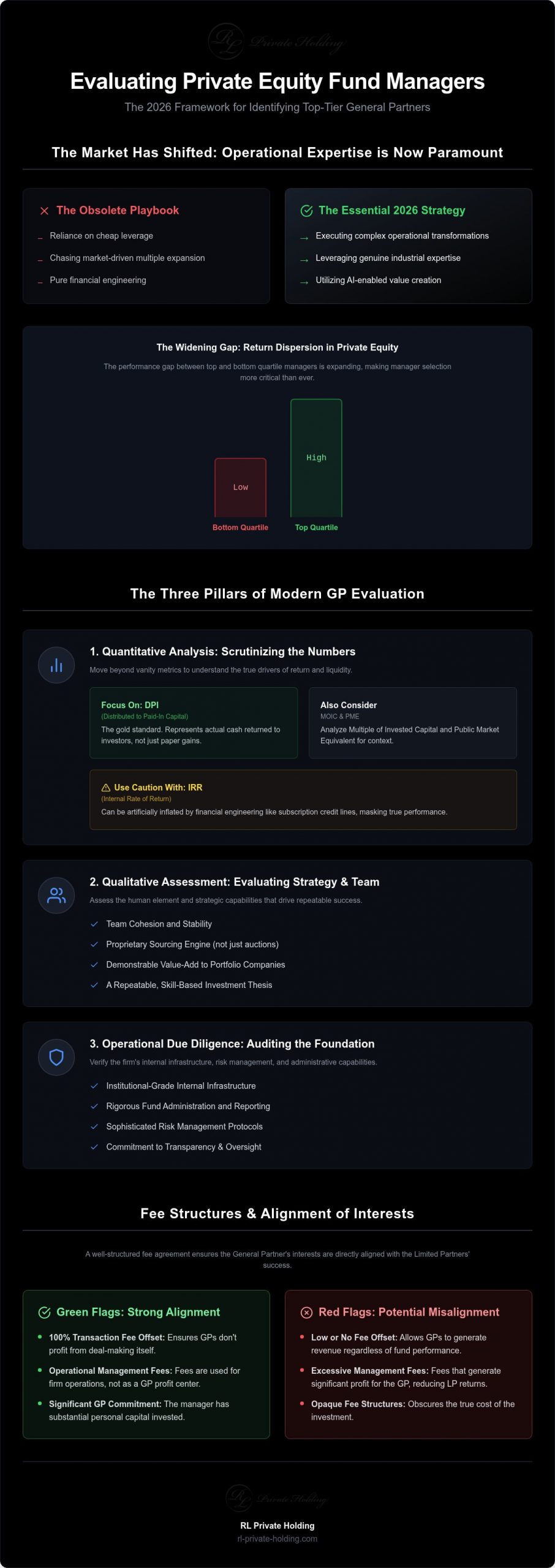
The era of generating outsized returns through cheap leverage and multiple expansion has effectively ended. In 2026, success depends almost exclusively on a General Partner’s ability to execute complex operational transformations within portfolio companies. This fundamental shift has made the process of how to evaluate a private equity fund manager far more rigorous, as investors must now distinguish between genuine industrial expertise and mere market timing. It’s clear that the dispersion of returns between top and bottom quartile managers is widening, a challenge often exacerbated by a lack of transparency in unrealised valuations.
We’ve structured this analysis to help you master the institutional-grade due diligence protocols required to identify top-tier managers and ensure long-term portfolio performance. You’ll gain a repeatable framework for GP selection that prioritizes operational value creation over traditional financial engineering. We’ll also examine the alignment of interests through fee structure analysis, such as the 100% transaction fee offset norm, and provide methods to verify a manager’s capability to utilize AI-enabled value creation to drive consistent alpha.
Key Takeaways
- Understand the widening return dispersion between top and bottom quartile performers and why systematic verification of a General Partner’s thesis is critical in the current market.
- Shift focus from unrealised valuations to Distributed to Paid-In (DPI) capital as the definitive indicator of a manager’s ability to deliver actual liquidity.
- Learn how to evaluate a private equity fund manager by auditing their proprietary sourcing engines and their ability to execute operational transformations rather than relying on financial engineering.
- Identify potential misalignments in fee structures by analyzing transaction fee offsets and ensuring management fees are used for operations rather than generating GP-level profit.
- Leverage the Luxembourg regulatory environment to integrate private equity into a sophisticated global allocation strategy that prioritizes transparency and institutional-grade oversight.
The Strategic Importance of Private Equity Manager Due Diligence
Manager due diligence is the systematic verification of a General Partner’s (GP) investment thesis. This process involves a granular analysis of how a firm intends to deploy capital and generate value within a specific Private Equity Fund Structure. It moves beyond basic compliance to scrutinize the underlying drivers of historical performance. The primary objective is to distinguish between market-driven returns, known as beta, and skill-driven returns, or alpha. Without this distinction, investors risk attributing a rising tide in the broader economy to a manager’s specific investment acumen.
The private equity asset class is characterized by a significant return dispersion phenomenon. While the performance gap between top and bottom quartile managers in public equities is often marginal, the delta in private markets can reach hundreds of basis points. As we move through 2026, the macroeconomic environment has shifted. The era of low interest rates has concluded, meaning managers can no longer rely on inexpensive debt to mask mediocre operational performance. This reality necessitates a more rigorous framework for how to evaluate a private equity fund manager to ensure capital is only committed to those with repeatable, skill-based strategies.
Why Selection Outweighs Strategy Allocation
Empirical data suggests that the “manager effect” often carries more weight than the “sector effect” in private markets. A top-tier manager operating in a mature industrial sector frequently outperforms a median manager in a high-growth technology vertical. This hierarchy of importance makes the selection process paramount. Because private equity is an illiquid asset class, a poor allocation decision remains a significant burden for the duration of a ten-year fund life. There is no simple exit strategy for a suboptimal partnership. Furthermore, securing access to oversubscribed, top-tier funds requires a level of institutional standing and a disciplined approach to how to evaluate a private equity fund manager before the fundraising window closes.
The Three Pillars of Modern Manager Evaluation
A holistic assessment of a GP rests on three distinct pillars: quantitative, qualitative, and operational. The quantitative pillar focuses on historical track records, loss ratios, and cash flow patterns. The qualitative pillar examines the team’s cohesion, their proprietary sourcing methods, and their ability to add value to portfolio companies. Finally, the operational pillar audits the firm’s internal infrastructure, including fund administration and risk management protocols. These three components interact to provide a 360-degree view of the GP’s organizational health. The repeatability of success serves as the ultimate due diligence metric for any sophisticated allocation strategy.
Quantitative Metrics: Analyzing Track Records and Performance Persistence
Quantitative assessment requires moving beyond surface-level figures to understand the structural drivers of return. Most managers highlight Internal Rate of Return (IRR) because it accounts for the time value of money. However, IRR can be artificially enhanced through the strategic use of subscription credit lines, which delay capital calls and compress the investment period. A more robust approach to how to evaluate a private equity fund manager prioritizes Multiple of Invested Capital (MOIC) alongside Distributed to Paid-In (DPI) capital. DPI remains the only definitive measure of success, as it represents actual cash returned to limited partners rather than theoretical gains held on balance sheets.
In the early stages of a fund’s lifecycle, the “J-Curve” effect typically results in negative returns as management fees and setup costs precede meaningful capital deployment. Investors shouldn’t be deterred by these initial figures, but they must apply a Public Market Equivalent (PME) analysis to contextualize later performance. This benchmark allows institutional allocators to determine if the inherent illiquidity of private equity has actually yielded a premium over accessible public indices. Engaging with a partner focused on private equity investment management ensures these quantitative audits are conducted with the necessary institutional gravity.
Evaluating Performance Persistence
Historical data from the early 2020s indicates that performance persistence is no longer a guaranteed trait among established firms. A successful first fund doesn’t automatically ensure the success of subsequent vintages. It’s essential to normalize returns across different economic cycles to account for varying market conditions and “vintage year” bias. A thorough attribution analysis is also required to identify which specific partners were responsible for past successes. If the individuals who drove the alpha in Fund I have departed, the track record of Fund II may be fundamentally decoupled from its predecessor’s results.
The Reality of Unrealised Portfolios
A significant portion of reported returns often resides in unrealised Net Asset Value (NAV). In 2026, it’s vital to audit these valuations to identify “zombie assets,” which are companies that appear valuable on paper but lack a viable path to exit in the current liquidity environment. These assets can inflate paper returns and mislead investors regarding the true health of a portfolio. In a market characterized by ongoing volatility, the adoption of conservative valuation policies in 2026 is an absolute prerequisite for maintaining institutional credibility and preventing the misallocation of future capital. Managers who provide transparent, third-party verified NAV assessments demonstrate the discipline required for long-term partnership.
Qualitative Assessment: Evaluating Strategy, Team, and Sourcing
While quantitative data provides a historical record, qualitative analysis reveals the probability of future success. A critical component of how to evaluate a private equity fund manager involves scrutinizing the investment thesis for its relevance in the 2026 macroeconomic environment. With interest rates stabilized at higher levels than the previous decade, the traditional reliance on cheap leverage has become obsolete. A defensible thesis must now focus on sectors with structural tailwinds and managers who demonstrate a specific, repeatable method for identifying undervalued assets.
The “sourcing engine” of a General Partner (GP) requires careful verification. Many firms claim to have proprietary networks, but true differentiation lies in the ability to secure deals outside of broad, competitive auctions. Investors should ask for specific examples of “off-market” transactions and the origin stories behind them. If a GP primarily wins deals by being the highest bidder in an investment bank led process, their margins for error are significantly reduced. A robust sourcing strategy often involves deep industry relationships or specialized geographic focus that competitors cannot easily replicate.
The Shift to Operational Alpha
In 2026, the focus has shifted entirely from financial engineering to operational alpha. Managers must demonstrate a clear playbook for driving EBITDA growth through internal improvements. This includes evaluating the GP’s in-house operating team and their historical success in executing digital transformations or ESG integration. A firm that relies solely on financial modeling without a dedicated team of industry experts is unlikely to thrive in a market where exit multiples are no longer expanding. For a deeper look at these mechanics, see our framework for private equity value creation.
Team Dynamics and Succession Planning
Team stability is a leading indicator of fund health. High partner turnover or “key-man” risk can jeopardize the execution of a long-term strategy. It’s vital to analyze the distribution of carried interest among the investment team. If the incentives are overly concentrated at the top, junior and mid-level talent may depart, taking their institutional knowledge with them. A disciplined GP will have a clear succession plan that ensures the firm’s longevity beyond its founding partners. This institutional gravity is essential for maintaining investment discipline over multiple fund cycles. When considering how to evaluate a private equity fund manager, the alignment of the team’s internal economics often tells a more honest story than their marketing materials.
Operational Due Diligence and Fee Alignment Frameworks
Operational due diligence (ODD) serves as the final safeguard in the selection process. It ensures that the firm’s internal infrastructure is capable of supporting its investment strategy without introducing systemic risk. A critical part of how to evaluate a private equity fund manager involves auditing the “back office” and the quality of their third-party service providers. Institutional investors should verify that the GP employs reputable fund administrators, legal counsel, and audit firms. High-quality service providers act as a secondary layer of oversight, ensuring that valuations and cash flows are handled with professional rigor.
The alignment of interest is best scrutinized through the management fee and the GP’s operating budget. As of 2026, the institutional norm has shifted toward a 100% transaction fee offset and an 80% monitoring fee offset. Investors must determine if the GP is generating a profit from management fees alone. If the fee income significantly exceeds the firm’s actual operating costs, the manager’s incentive to generate carry through performance may be diminished. A disciplined GP should primarily rely on performance-based carry to drive firm-level wealth, ensuring they remain focused on long-term capital appreciation for their partners.
GP commitment is another definitive indicator of alignment. When a manager invests a significant portion of their own capital into the fund, they share the same downside risk as the limited partners. While the traditional standard was 1% to 2%, many top-tier firms now commit much higher percentages. This “skin in the game” provides a psychological and financial guarantee that the manager’s interests are inextricably linked to the fund’s success. For those seeking institutional-grade oversight, our firm provides specialized private equity investment management to help navigate these complex structural requirements.
European vs. American Waterfalls
The “waterfall” structure determines the order in which capital is distributed between the LP and the GP. The European waterfall, or whole-of-fund model, is generally preferred by limited partners. In this structure, the GP does not receive carried interest until the LPs have received their entire contributed capital plus a preferred return. Conversely, the American waterfall operates on a deal-by-deal basis, allowing the GP to collect carry after each successful exit. While the American model can accelerate GP payments, it necessitates robust clawback provisions. These provisions ensure that if subsequent deals underperform, the GP must return previously distributed carry to maintain the agreed-upon profit split.
Governance and Reporting Standards
Transparency is the cornerstone of a successful partnership. Institutional investors should look for compliance with ILPA (Institutional Limited Partners Association) reporting standards. This ensures that quarterly reports are standardized, providing clear insights into fee allocations and portfolio company health. Active participation in the Limited Partner Advisory Committee (LPAC) further enhances governance by allowing LPs to oversee conflicts of interest and valuation changes. It’s evident that private equity risk management begins with operational transparency and a commitment to rigorous reporting. This level of disclosure allows for a more accurate assessment of how to evaluate a private equity fund manager over the long term.
Developing a Sophisticated Allocation Strategy for 2026
Sophisticated allocation in 2026 requires a departure from opportunistic buying toward structural integration. Private equity serves as a cornerstone of modern wealth management, yet its efficacy depends on a rigorous selection process. Allocators must balance their portfolios across multiple vintages to mitigate the risk of economic cycles and avoid over-concentration in a single market environment. Integrating various sectors, such as venture capital, alongside traditional buyouts provides a broader exposure to innovation and growth. This diversified approach ensures that the portfolio remains resilient even when specific sectors face headwinds. The Grand Duchy has solidified its position as the premier jurisdiction for private equity investment management, offering the infrastructure needed for global scale.
Selecting a partner with institutional discipline and a global footprint is the final step in securing long-term performance. A manager’s ability to operate across different regulatory frameworks and geographic markets provides a significant advantage in identifying undervalued assets. When considering how to evaluate a private equity fund manager, investors should prioritize firms that demonstrate a clear, repeatable process for global deployment. This discipline is what separates top-tier performers from those who rely on localized market anomalies.
The Luxembourg Advantage for Global Allocators
The Luxembourg special limited partnership (SCSp) is the preferred vehicle for global investors due to its contractual flexibility and tax transparency. Regulatory stability, overseen by the Commission de Surveillance du Secteur Financier (CSSF), provides a level of institutional confidence that is difficult to replicate. This oversight ensures that fund managers adhere to strict operational and reporting standards, which is a key component of how to evaluate a private equity fund manager in a transparent manner. By leveraging local expertise, global allocators can ensure their structures meet the highest standards of compliance while maintaining the agility required for rapid capital deployment.
Final Checklist for Manager Selection
Before finalizing any commitment, the investment committee must conduct a thorough review. A 10-point summary for the final presentation should include:
- Verification of DPI over IRR as the primary success metric.
- Audit of the proprietary sourcing engine and deal origin stories.
- Assessment of the in-house operating team’s historical track record.
- Analysis of fee offsets and the GP’s own capital commitment.
- Review of the waterfall structure and the presence of clawback provisions.
- Evaluation of team stability and the distribution of carried interest.
- Confirmation of ILPA reporting compliance and transparency levels.
- Stress-testing the investment thesis against 2026 macroeconomic conditions.
- Review of ODD findings and third-party service provider quality.
- Direct reference calls with former CEOs of portfolio companies.
Reference calls are often the most revealing part of the due diligence process. Speaking with the executives who have worked under the GP provides an unvarnished view of their value-creation capabilities. It’s essential to confirm whether the manager acted as a supportive partner or merely a financial overseer during periods of stress. We invite you to contact RL Private Holding to discuss institutional allocation strategies and our approach to disciplined asset management.
Advancing Institutional Excellence in Private Equity Selection
Success in 2026 demands a definitive shift from passive allocation to rigorous, operational scrutiny. Investors must prioritize Distributed to Paid-In (DPI) capital and verified value-creation playbooks over theoretical paper returns. Mastering how to evaluate a private equity fund manager requires a holistic approach that balances quantitative persistence with qualitative team stability and operational transparency. This disciplined framework ensures that capital is committed to General Partners capable of generating alpha through industrial transformation rather than mere financial leverage.
RL Private Holding provides Luxembourg-based global investment expertise to help institutional partners navigate these structural complexities. Our firm offers institutional-grade portfolio management with a specialized focus on the technology and real estate sectors. We invite you to Explore Strategic Private Equity Management with RL Private Holding to refine your allocation framework for the years ahead. Building a resilient portfolio is a deliberate process, and the right partnership ensures your capital remains positioned for sustained growth in an evolving global landscape.
Frequently Asked Questions
What is the most important metric when evaluating a private equity fund manager?
Distributed to Paid-In (DPI) capital is the most critical metric for institutional investors. While Internal Rate of Return (IRR) accounts for the time value of money, it is susceptible to manipulation through subscription credit lines. DPI provides a definitive measure of success by representing the actual cash returned to limited partners. It is the only metric that confirms a manager’s ability to successfully exit investments and deliver liquidity.
How do I distinguish between a manager’s skill and market timing?
Distinguishing between skill and timing involves a granular attribution analysis. Skill is evidenced by EBITDA growth and operational improvements within portfolio companies. Market timing usually reflects broader sector tailwinds or multiple expansion. A sophisticated framework for how to evaluate a private equity fund manager utilizes Public Market Equivalent (PME) benchmarks to isolate the manager’s specific alpha from general market movements.
What are the red flags to look for during private equity due diligence?
Primary red flags include high partner turnover and management fees that exceed the firm’s actual operating budget. If a General Partner is generating a profit on fees alone, their incentive to drive performance through carried interest is diminished. Other warnings include a lack of transparent valuation policies or a history of “zombie assets” that remain in the portfolio without a viable path to exit.
How does the ‘J-curve’ affect the evaluation of a new private equity fund?
The J-curve represents the initial period of negative returns caused by management fees and investment setup costs. When assessing a new fund, investors should focus on the quality of the initial assets and the pace of capital deployment rather than early-stage IRR. A deep dip in the J-curve is normal, provided the manager demonstrates a clear trajectory toward value creation and eventual liquidity.
What is the difference between a European and an American waterfall structure?
The European waterfall returns all contributed capital and the preferred return to limited partners before the General Partner receives any carried interest. The American waterfall allows the manager to collect carry on a deal-by-deal basis. The European model is generally preferred by institutional allocators because it ensures the GP is only rewarded after the entire fund has reached its performance hurdle.
Why is the GP’s personal commitment to the fund important for LPs?
General Partner commitment ensures a fundamental alignment of interest between the manager and the investors. When a manager invests a significant portion of their own capital, they share the same downside risk as the limited partners. This “skin in the game” acts as a psychological and financial guarantee that the manager will maintain investment discipline throughout the ten-year life of the fund.
How should I evaluate a manager’s exit track record in a high-interest-rate environment?
In 2026, a manager’s exit track record must be scrutinized for its reliance on fundamental growth rather than leverage. High interest rates have made debt-fueled exits less viable. Assessing how to evaluate a private equity fund manager in this context involves verifying that realizations were driven by operational alpha. This ensures the manager can deliver liquidity even when capital markets are constrained and multiples are no longer expanding.
What role does the fund’s operational infrastructure play in long-term returns?
Robust operational infrastructure reduces systemic risk and ensures the accuracy of financial reporting. High-quality fund administration and risk management protocols prevent administrative errors that can erode returns over time. Institutional investors prioritize managers who employ reputable third-party service providers, as this adds a necessary layer of oversight and transparency to the fund’s internal processes.