

Trust is a poor substitute for rigorous data when millions in capital are at stake. As institutional investors face tighter syndication windows, the risk of adverse selection becomes a structural reality rather than a mere possibility. Successfully evaluating co-investment opportunities with a GP requires more than a cursory review of a pre-packaged deal memo. It demands a disciplined, technical approach that separates the asset’s intrinsic value from the General Partner’s marketing narrative to ensure long-term portfolio stability.
You’re likely familiar with the pressure of multi-million euro decisions made under compressed timelines, often without the internal technical resources to conduct a deep-dive audit of the underlying asset. This article provides a strategic 2026 protocol designed to neutralize GP bias and validate the standalone merit of every syndicated deal. We’ll outline a repeatable, defensible framework that ensures regulatory compliance with evolving AIFMD II and SFDR standards while targeting the superior risk-adjusted returns your institution requires in an increasingly complex global market.
Key Takeaways
- Identify structural conflicts of interest in syndication to protect institutional capital from adverse selection and GP risk-shedding.
- Implement a standalone merit test when evaluating co-investment opportunities with a GP to validate the asset’s intrinsic value.
- Navigate the 2026 regulatory landscape by utilizing the Luxembourg SCSp structure and meeting new AIFMD II reporting obligations.
- Adopt a two-phase operational protocol that combines an efficient initial filter with a comprehensive technical deep-dive.
- Strengthen portfolio discipline through a technical governance framework that prioritizes objective data over GP marketing narratives.
The Imperative for Independent Scrutiny in Co-Investment Syndication
The 2026 financial environment reflects a structural shift toward higher capital costs. The era of easy money has concluded, making the precision of asset selection paramount. Within this context, an Equity co-investment represents a critical juncture for institutional portfolios. It’s a multi-layered verification process that must go beyond the General Partner’s (GP) initial underwriting. Relying on a GP’s data room without external validation is a governance failure. It ignores the reality that GPs may syndicate capital to mitigate their own concentration risks rather than simply seeking partnership.
Neutralizing the Adverse Selection Risk
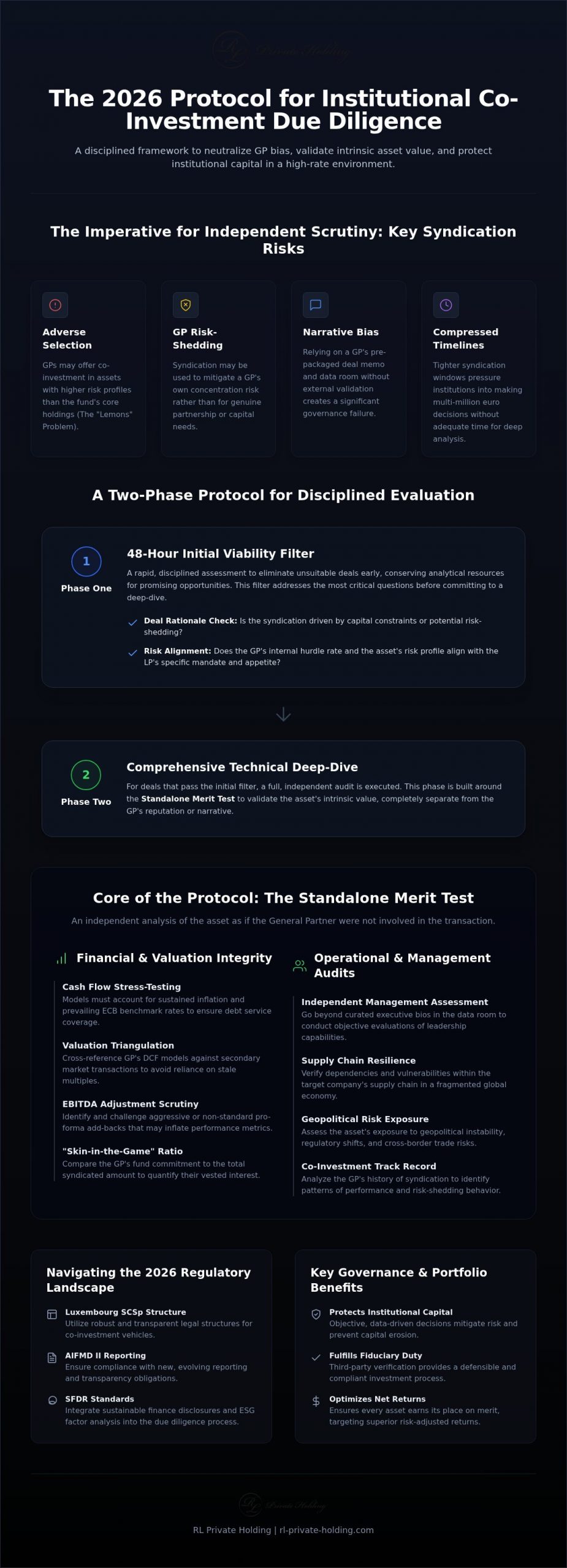
Adverse selection remains a persistent threat in deal syndication. The Lemons problem occurs when a GP offers deal slices that carry higher risk profiles than the fund’s core holdings. When evaluating co-investment opportunities with a GP, it’s vital to assess why the deal is being syndicated. Is it truly a matter of capital constraints, or is it risk shedding? A disciplined 48-hour filter is essential here. It allows the investment team to assess deal viability quickly, ensuring they don’t waste resources on assets that fail the standalone merit test. This initial scrutiny identifies if the GP’s internal hurdle rate aligns with the LP’s specific risk appetite before deeper capital is committed.
Economic and Governance Benefits of Independence
Sophisticated private equity investment management relies on independent scrutiny to optimize net returns. This objective approach protects institutional stakeholders by fulfilling fiduciary obligations through third-party verification. Beyond risk mitigation, independent due diligence assists in J-curve management. By accurately forecasting capital call timing and exit valuations, investors can maintain a more stable cash flow profile. This level of discipline is no longer optional. It’s a requirement for those seeking to outperform in a high-rate environment. Evaluating co-investment opportunities with a GP through an independent lens ensures that every asset in the portfolio earns its place on its own merits, regardless of the GP’s marketing narrative.
Neutralizing Adverse Selection: Advanced Technical Verification Protocols
The core of sophisticated asset selection lies in the Standalone Merit test. This protocol requires an institutional investor to analyze the underlying asset as if the General Partner (GP) were not involved in the transaction. By removing the GP’s historical reputation from the equation, investors can focus on the asset’s intrinsic fundamentals. Effective evaluating co-investment opportunities with a GP also necessitates a thorough diligence on a GP’s co-investment track record. This analysis reveals whether the GP consistently syndicates high-quality deals or primarily uses co-investment to shed risk in over-concentrated positions. A critical metric in this phase is the skin-in-the-game ratio, which compares the GP’s fund commitment to the total syndicated amount.
Financial and Valuation Integrity
Current market conditions in 2026 demand rigorous stress-testing of cash flow projections. Models must account for sustained inflation and the prevailing ECB benchmark rates to ensure debt service coverage remains viable. Valuation Triangulation is the process of cross-referencing GP DCF models with secondary market transactions. This triangulation prevents reliance on stale multiples that don’t reflect the current liquidity environment. Investors should maintain a high degree of skepticism toward pro-forma add-backs. Identifying aggressive EBITDA adjustments is a primary objective of the technical audit. If you require assistance in developing these technical benchmarks, our team at RL Private Holding provides the institutional discipline needed for such deep-dive scrutiny.
Operational and Management Audits
Technical verification extends beyond financial statements into the operational core of the target company. It’s necessary to conduct an independent management assessment that goes beyond the curated executive bios found in the GP’s data room. In the fragmented global economy of 2026, supply chain resilience and geopolitical risk exposure must be verified through primary research. The focus of the audit should be the Value Creation Plan. It’s essential to differentiate between operational alpha, which results from genuine management improvements, and market beta, which is simply the result of broader industry tailwinds. When evaluating co-investment opportunities with a GP, confirming that the projected returns are driven by tangible operational levers is the most effective defense against adverse selection.
Evaluating Structural Integrity: Luxembourg’s Regulatory Framework in 2026
Structural integrity is the foundation of institutional trust. In the 2026 market, the Luxembourg special limited partnership (SCSp) remains the preferred vehicle for sophisticated deal structuring. This vehicle offers the flexibility required for complex syndications while maintaining the rigorous standards expected by global regulators. When evaluating co-investment opportunities with a GP, investors must verify that the chosen structure aligns with AIFMD II. This directive introduces enhanced reporting obligations for co-investment vehicles in 2026, focusing on leverage transparency and liquidity management. Ensuring the structure meets global anti-avoidance standards is equally critical. Tax efficiency cannot come at the expense of substance. The SPV must demonstrate genuine economic activity within Luxembourg to withstand international scrutiny.
Sustainability mandates have also evolved. Under SFDR Article 8 and 9, investors are required to verify that target assets meet specific environmental and social benchmarks. Passive acceptance of a GP’s ESG claims is insufficient. Institutional governance now requires a technical audit of the asset’s sustainability data to ensure it meets the internal mandates of the limited partners. This level of oversight ensures that the investment remains compliant with both local and international expectations.
Structuring for Transparency and Stability
Sophisticated limited partners utilize Luxembourg-based SPVs to manage cross-border complexities. These structures provide a stable legal environment that protects the interests of all participants. A key component of this stability is the role of the Depository. The Depository provides an additional layer of asset oversight, ensuring that capital is deployed according to the agreed terms. Governance risks are further mitigated through the establishment of well-defined LP Advisory Committees (LPAC). These committees provide a formal mechanism for oversight, allowing LPs to monitor the co-investment due diligence process and ensure the GP adheres to the investment thesis throughout the holding period.
Regulatory Safeguards as a Due Diligence Pillar
Assessing a GP’s compliance history is a fundamental step in evaluating co-investment opportunities with a GP. This involves a thorough review of their track record with Luxembourgish regulators and their adherence to AML/KYC protocols. A syndicate is only as secure as its weakest link. Therefore, the verification of all participants within the co-investment vehicle is mandatory to prevent reputational risk. These safeguards are particularly important when aligning deal structures with family office investment strategies Luxembourg. For long-term wealth preservation, the regulatory environment must offer both transparency and institutional-grade protection. By prioritizing these pillars, investors can ensure their capital is protected by a framework designed for the complexities of the 2026 global economy.
The Operational Framework: Executing a Multi-Phased Due Diligence Review
A systematic approach is required to manage the high-velocity nature of deal syndication. Successfully evaluating co-investment opportunities with a GP demands a structured timeline that balances immediate triage with exhaustive verification. This framework ensures that institutional resources are only deployed on assets with the highest probability of delivering risk-adjusted alpha. The process is divided into four distinct phases, moving from a rapid viability assessment to a final risk-adjusted presentation for the Investment Committee.
The Quick-Look Filter: Triage for High-Velocity Deals
The initial 48 to 72 hours are decisive. During this phase, investors apply a Three-Strike rule to reject deals that fail core criteria, such as sector misalignment, excessive leverage, or questionable entry multiples. It’s essential to assess the GP’s specific incentive for syndication. We verify if the GP is seeking capital to fill a genuine funding gap or if they’re attempting to reduce exposure to a volatile asset. This stage includes a preliminary valuation check against internal venture capital Luxembourg benchmarks to ensure the entry price remains competitive in the 2026 environment. If the deal fails any of these initial tests, it’s discarded immediately to preserve bandwidth.
Technical Deep-Dive: Triangulating Data with Specialists
Once a deal passes the initial filter, a deep-dive audit spanning two to four weeks begins. This phase often involves engaging third-party technical auditors to validate operational claims that internal teams might lack the specific expertise to verify. We utilize the Reverse Inquiry method. This involves speaking to competitors and former employees of the target asset to uncover risks not documented in the GP’s data room. This primary research is the only way to build a truly independent investment thesis that isn’t colored by the GP’s marketing narrative.
The final stages of the protocol involve a structural and legal review to optimize the Luxembourg vehicle and a final Investment Committee presentation. Each deal is risk-adjusted based on the findings of the technical audit. This ensures that capital is only committed to opportunities where the standalone merit is undeniable. If your institution requires a disciplined partner to manage these complex workflows, RL Private Holding offers the institutional scale and technical expertise to lead your co-investment program with precision.
RL Private Holding: Advancing Institutional Co-Investment Governance
RL Private Holding operates as a disciplined global partner, prioritizing institutional gravity in every transaction. Our firm specializes in evaluating co-investment opportunities with a GP by applying a practitioner’s lens that consultants often lack. We don’t merely advise; we manage capital with a focus on long term stability and objective technical scrutiny. This approach ensures that every syndicated deal is validated for its standalone merit, protecting the portfolio from the structural biases inherent in modern deal making. By leveraging our headquarters in the Luxembourg financial center, we provide a benchmark for transparency that resonates across global markets.
Our commitment to institutional excellence is reflected in our internal governance protocols. We integrate deep expertise in private equity and venture capital to validate growth stage assets, ensuring that operational alpha is genuine and sustainable. This multi disciplinary perspective allows us to identify risks that traditional analysis might overlook. We maintain a composed, neutral register in our evaluations, focusing on factual data rather than market hyperbole. This steady hand provides our partners with the confidence required to commit capital in a high stakes environment.
Proprietary Analysis and Global Portfolio Discipline
We maintain a proprietary Red Flag database that tracks performance and behavioral patterns across European and global private markets. This tool is essential for identifying subtle inconsistencies in GP underwriting before they manifest as portfolio losses. By utilizing private wealth management firms Luxembourg standards, we protect client capital through a framework of rigorous oversight. The synergy between our asset management and private equity divisions creates a feedback loop of technical intelligence. This internal cooperation allows us to stress test assumptions across different asset classes, ensuring a holistic view of risk that benefits our institutional partners.
Strategic Alignment for Institutional Partners
The Luxembourg financial center serves as our strategic base for shaping transparent investment structures. We assist institutional partners in navigating the complexities of the 2026 regulatory environment, ensuring that every co-investment vehicle is built for permanence. Our operational framework allows partners to manage compressed deal timelines without compromising the rigor of their due diligence. We provide the technical resources needed for deep dive audits, acting as a disciplined extension of our partners’ internal teams. If you are seeking a partner that prioritizes objective data and institutional discipline, Contact RL Private Holding to discuss strategic co-investment alignment. We remain focused on providing the global portfolio discipline required to outperform in an increasingly fragmented economy.
Strengthening Institutional Resilience in Deal Syndication
The transition to a high-rate environment in 2026 necessitates a shift from passive participation to active, technical scrutiny. It’s essential to maintain a repeatable framework for evaluating co-investment opportunities with a GP to ensure that institutional capital is protected from the structural biases of deal syndication. By prioritizing standalone merit and regulatory alignment within the Luxembourg financial center, investors can achieve superior risk-adjusted returns while meeting the rigorous transparency requirements of AIFMD II. A disciplined approach to asset selection remains the most effective defense against market volatility.
RL Private Holding stands as a discreet, authoritative partner for those seeking to institutionalize their co-investment governance. Our global investment holding company leverages multi-sector expertise across private equity, venture capital, and real estate to provide the objective analysis required for sophisticated portfolios. We operate with a steady hand, ensuring that every transaction meets the highest standards of stability and professional distance. We invite you to Contact RL Private Holding to discuss institutional co-investment frameworks and explore how our Luxembourg-based governance can enhance your portfolio discipline. The path to long-term wealth preservation is built on the foundation of technical integrity and worldly expertise.
Frequently Asked Questions
What is the primary difference between GP due diligence and independent LP due diligence?
GP due diligence is fundamentally designed to support a broad fund mandate and facilitate transaction closure. In contrast, independent LP due diligence focuses on the asset’s standalone merit and its specific alignment with the institutional investor’s risk profile. While the GP manages the overall deal process, the LP must verify that the asset’s fundamentals remain robust without relying solely on the GP’s marketing narrative or historical performance.
How long should an independent due diligence process typically take for a co-investment?
A comprehensive process for evaluating co-investment opportunities with a GP generally requires two to four weeks for a technical deep-dive. This timeline follows an initial 48 to 72 hour triage phase used to determine deal viability. These compressed schedules are common in syndicated deals, making it necessary for institutional investors to have pre-established technical resources or specialist partners ready to deploy immediately upon receipt of the deal memorandum.
Why is Luxembourg the preferred jurisdiction for structuring co-investment deals in 2026?
Luxembourg remains the global benchmark for stability and transparency due to its specialized investment structures like the SCSp. In 2026, the jurisdiction provides the necessary legal infrastructure for AIFMD II compliance and sophisticated ESG reporting under SFDR. The presence of institutional depositories and specialized service providers ensures that co-investment vehicles are managed with the high degree of substance required to meet global anti-avoidance standards and protect cross-border capital.
How can LPs mitigate information asymmetry when the GP controls the data room?
Mitigating asymmetry requires LPs to look beyond the curated documents found in a GP’s data room. Investors should utilize the reverse inquiry method by conducting primary research with competitors and former executives of the target asset. Engaging independent technical auditors to perform site visits or supply chain audits provides an objective layer of data that the GP may not have fully disclosed during the initial syndication phase.
What are the specific red flags in a GP valuation model that LPs should look for?
Institutional investors should prioritize identifying aggressive EBITDA adjustments and pro-forma add-backs that artificially inflate valuation. Another critical red flag is the use of exit multiples that don’t reflect the 2026 liquidity environment or the prevailing ECB benchmark rates. When evaluating co-investment opportunities with a GP, a model that lacks sensitivity analysis for sustained inflation or higher capital costs should be viewed with significant professional skepticism.
Does independent due diligence significantly impact the cost-efficiency of co-investments?
While independent scrutiny involves upfront technical costs, it significantly enhances long-term cost-efficiency by preventing capital commitment to underperforming assets. The avoidance of adverse selection and the mitigation of J-curve effects through more accurate capital call forecasting provide a clear economic rationale. For institutional investors, the expense of a technical audit is a necessary governance cost that is typically justified by superior risk-adjusted returns and portfolio stability.
How does AIFMD II affect co-investment reporting and transparency in 2026?
AIFMD II introduces enhanced reporting obligations that increase transparency regarding leverage and liquidity within co-investment vehicles. Starting in 2026, GPs and LPs must provide more granular data to regulators concerning the underlying assets and the structural integrity of the SPV. These requirements ensure that co-investment syndicates operate with a level of oversight that aligns with broader European financial stability goals and investor protection mandates.
What role does the Quick-Look filter play in high-velocity private equity markets?
The Quick-Look filter acts as a critical triage mechanism to preserve institutional bandwidth in high-velocity markets. By applying a Three-Strike rule based on sector alignment, entry multiples, and GP skin-in-the-game, investors can reject unsuitable deals within 72 hours. This ensures that internal technical resources are only committed to assets that pass a preliminary viability test, allowing the firm to maintain deal velocity without sacrificing the rigor of their final audit.