

Strategic capital allocation in 2026 requires a transition from passive participation to the active integration of institutional governance and cross-sector synergy. It’s clear that traditional investment vehicles often obscure their internal mechanisms with opaque fee structures and inconsistent deal flow. Joining a network of sophisticated investors provides a structured pathway to high-quality, pre-vetted opportunities that are typically reserved for institutional entities. This article explores the institutional advantages of co-investment networks and the methods through which disciplined capital allocation drives long-term portfolio resilience. We will examine the strategic framework for accessing a diversified global portfolio, the benefits of aligning with an authoritative investment partner, and the impact of Luxembourg’s modernized regulatory environment, including the 2026 updates to the AIFMD II and the reformed carried interest tax regime. By focusing on these structural components, investors can better position their capital within the global financial landscape. This approach ensures that wealth preservation is grounded in transparency and professional oversight, allowing for a methodical expansion into niche sectors like technology and real estate.
Key Takeaways
- Understand the transition from transactional deal clubs to strategic institutional partnerships as a requirement for portfolio stability in 2026.
- Identify the synergies between real estate asset management and private equity allocations to maximize capital efficiency within a diversified global portfolio.
- Explore the strategic advantages of Luxembourg as a premier jurisdiction, specifically regarding the utility of the Special Limited Partnership (SCSp) structure.
- Discover how joining a network of sophisticated investors provides access to high-quality, pre-vetted deal flow while bypassing traditional, opaque fee structures.
- Establish a rigorous due diligence framework to evaluate management track records and ensure alignment with long-term wealth preservation objectives.
The Paradigm Shift in Sophisticated Investment Networks
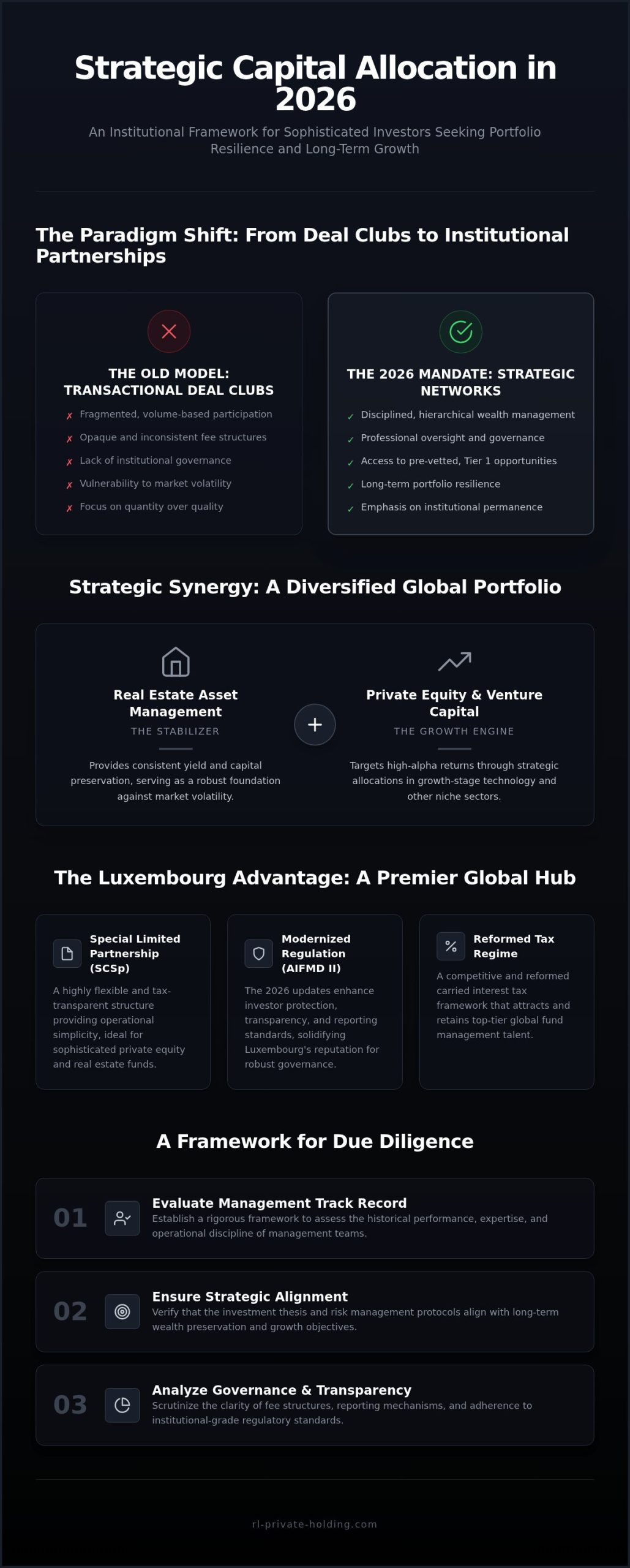
The economic environment of 2026 has redefined the parameters of capital engagement. For many Ultra-High-Net-Worth Individuals (UHNWIs), the traditional model of fragmented, volume-based angel syndicates no longer meets the requirements for portfolio resilience. Instead, joining a network of sophisticated investors has become a strategic necessity for those seeking institutional-grade access and structural stability. This evolution represents a departure from the “deal club” mentality, where the focus was often on the quantity of transactions rather than the strategic alignment of the capital. It’s a shift toward a more disciplined, hierarchical approach to wealth management.
A Accredited or sophisticated investor in 2026 operates within a framework that prioritizes discretion and “quiet authority.” This shift is driven by the recognition that exclusive capital access is best facilitated through global holding companies that provide a steady hand in complex markets. These entities offer a layer of professional oversight and governance that individual participation often lacks. They ensure every allocation is part of a broader, well-ordered strategy that emphasizes institutional permanence over temporary market trends.
From Transactional to Relational Capital
Sophisticated investors are increasingly moving away from one-off, isolated investments. The risks associated with fragmented portfolios become apparent during periods of global market volatility, where a lack of institutional gravity can lead to suboptimal outcomes. By contrast, a relational capital model focuses on long-term partnerships with established firms. This approach secures access to Tier 1 venture capital and private equity exits that are rarely available to the general market. It’s about building a sustainable ecosystem where capital, expertise, and governance intersect to preserve wealth across generations.
The 2026 Landscape for Private Equity and Venture Capital
Current trends in 2026 highlight a significant move toward growth-stage funding in specialized technology sectors. Investors now require cross-sector expertise to manage the complexities of modern asset allocation, particularly as the distinction between real estate and private equity continues to blur. The implementation of AIFMD II has brought a new level of transparency and reporting requirements, making the role of a disciplined holding company even more critical. A sophisticated network serves as a nexus where capital, governance, and expertise converge to drive institutional excellence.
Strategic Synergies in Diversified Asset Management
The management of a Diversified Global Portfolio under a unified holding structure offers distinct advantages in 2026. By centralizing assets, investors reduce the administrative friction often found in fragmented portfolios. This structural efficiency allows for greater agility when reallocating capital between sectors. Joining a network of sophisticated investors facilitates this transition by providing the necessary institutional framework to manage diverse asset classes simultaneously. It’s a method that moves beyond the simplistic definitions of wealth, as seen in critiques like The Sophisticated Investor Farce, which argue that net worth alone doesn’t guarantee strategic success. True sophistication lies in the ability to harmonize disparate assets into a cohesive, resilient strategy.
Integrating Real Estate and Private Equity
Real estate serves as a fundamental stabilizer within a growth-oriented portfolio. While private equity and venture capital target high-alpha returns, real estate provides consistent yield and capital preservation. Utilizing real estate asset management Luxembourg allows investors to leverage the country’s stable regulatory environment. Institutional strategies differ from retail property investments through their focus on scale, long-term lease structures, and professional property management. This creates a synergy where the steady cash flow from real property supports the more volatile cycles of private equity allocations, ensuring the portfolio remains robust during market transitions.
Venture Capital as a Growth Engine
Technology-focused venture capital Luxembourg serves as the primary engine for portfolio growth in the current landscape. In 2026, growth-stage firms require more than just capital; they require a network that offers operational expertise and market access. This is where the “silent giant” approach becomes effective. By providing steady support without disruptive interference, holding companies help scale portfolio companies efficiently. The integration of technology into other sectors, such as prop-tech in real estate, further enhances the overall value of the holding structure. This cross-pollination of innovation ensures that growth in one sector fuels advancements across the entire portfolio.
Alignment between the holding company and its partners is maintained through transparent fee structures. Management fees cover operational costs, while performance-based incentives ensure that the interests of the management team are strictly tied to investor success. This model discourages short-term risk-taking and prioritizes long-term wealth preservation. To explore how these structures are implemented within a global context, investors may consider the framework provided by RL Private Holding.
The Role of Luxembourg in Global Capital Aggregation
Luxembourg’s position as a premier global financial center is solidified in 2026 by its ability to aggregate and protect institutional capital. For those considering joining a network of sophisticated investors, the choice of jurisdiction is as critical as the deal flow itself. Unlike financial hubs that rely on high transaction volumes, Luxembourg prioritizes the structural quality and legal certainty of its investment vehicles. This focus on transparency and regulatory stability builds a level of trust that is essential for long-term wealth preservation. In the current landscape, Luxembourg structures are frequently compared to other global hubs, yet they consistently lead due to their alignment with European Union standards and their sophisticated network of tax treaties.
The Luxembourg special limited partnership (SCSp) is particularly relevant in this context. It allows for a high degree of contractual freedom while maintaining the benefits of a regulated ecosystem. This balance is vital for managing complex, cross-sector portfolios that include private equity and real estate. It provides the flexibility required to adapt to the 2026 tax year reforms while ensuring the capital remains within a secure, recognized framework.
Institutional Governance and SOPARFI Structures
A SOPARFI (Société de Participations Financières) provides a sophisticated framework for cross-border asset management. It’s designed to facilitate the holding and financing of global participations while offering significant wealth preservation benefits. This structure allows investors to operate with institutional gravity, ensuring that their capital is managed with the same level of professional oversight as a major global entity. The jurisdictional integrity of Luxembourg is defined by a dual-layer security model that combines rigorous regulatory oversight with the internal discipline of private holding structures. This ecosystem supports global scale, providing the stability needed for sophisticated capital allocation across multiple jurisdictions.
Wealth Management for Global Investors
The methodologies employed by private wealth management firms Luxembourg have evolved to meet the needs of a more discerning global audience. Family offices now play a central role in this landscape, often acting as the bridge between individual capital and institutional opportunities. By utilizing Luxembourg’s diverse toolkit, these firms help investors maintain a professional distance from day-to-day operations while ensuring they retain strategic control over their capital. This approach is particularly effective for those joining a network of sophisticated investors who value discretion and institutional permanence. It ensures that wealth is not just managed, but strategically positioned for the 2026 regulatory environment, including the updated AIFMD II requirements.
Evaluating Institutional Networks: A Due Diligence Framework
Selection of an investment network in 2026 requires a rigorous methodology that extends beyond basic legal compliance. When joining a network of sophisticated investors, the primary objective is to verify that the entity’s operational framework matches the complexity of the global market. Key criteria include the holding company’s ability to navigate the updated AIFMD II requirements and its specific expertise in high-growth sectors like technology and commercial real estate. Assessing the management team’s track record is essential. One must look for institutional permanence rather than short-term gains. A firm’s history of managing capital through various economic cycles provides the necessary evidence of its strategic discipline and reliability.
The evaluation process should also focus on the technical nuances of the jurisdiction. In Luxembourg, this involves understanding how the holding company utilizes specific structures to optimize capital aggregation. A disciplined network doesn’t just offer access; it provides a structured environment where risk is mitigated through professional oversight and a clear organizational hierarchy. This methodical approach ensures that the interests of all parties are protected under a recognized legal framework.
Alignment of Interest and Incentives
The structure of fees serves as a primary indicator of a firm’s commitment to its partners. Performance-based incentives, such as carried interest, ensure that the holding company’s objectives are perfectly aligned with the investor’s long-term success. It’s a model that prioritizes wealth preservation. By contrast, fee structures that rely heavily on high management fees without performance hurdles often lack institutional discipline. Utilizing established private equity investment management protocols helps protect capital from unnecessary risk. These protocols ensure that every allocation is vetted through a standardized, objective process. Such a framework is necessary to avoid the red flags associated with opaque or poorly structured deal clubs.
Portfolio Transparency and Reporting
Institutional-grade reporting has transitioned toward a more transparent, data-driven model in 2026. Sophisticated investors now expect real-time access to portfolio performance and a clear overview of the underlying assets. This level of transparency is vital when managing a diversified portfolio that spans multiple jurisdictions and sectors. Evaluating the quality of assets requires a factual, sober presentation of data, free from marketing hyperbole. It’s this professional distance and objectivity that build long-term trust between the firm and its partners. High-quality reporting should detail not just the successes, but also the strategic adjustments made in response to market shifts. To learn more about our rigorous due diligence and reporting standards, you may explore the services provided by RL Private Holding.
Institutional Excellence through RL Private Holding
The operational philosophy of RL Private Holding is defined by institutional gravity and a commitment to objective, data-driven decision making. In the 2026 financial environment, the firm acts as an authoritative nexus for capital, providing access to a diversified global portfolio through a single, well-ordered structure. This approach eliminates the complexities associated with managing multiple, disconnected assets. By joining a network of sophisticated investors aligned with this framework, partners benefit from an environment where stability and exclusivity are prioritized. The firm’s scope encompasses private equity, venture capital, and real estate, ensuring that each allocation is part of a broader, cohesive strategy designed for long-term wealth preservation.
RL Private Holding maintains a position of “quiet authority” within the global landscape. It functions as a steady hand in the background of major international investments, avoiding the volatility often found in more disruptive or trend-driven firms. This disciplined focus ensures that the holding company’s interests remain strictly aligned with those of its partners. The organizational hierarchy is designed to provide transparency while maintaining the professional distance necessary for effective asset management. This creates an impression of institutional permanence, appealing to those who value a methodical and secure approach to capital growth.
A Disciplined Global Partner
Leveraging its headquarters in Luxembourg, RL Private Holding utilizes the country’s premier financial ecosystem to facilitate global asset management. The firm’s methodology incorporates family office investment strategies Luxembourg to ensure that capital is managed with a high degree of technical precision. This strategic framework is particularly effective for navigating the 2026 regulatory landscape, including modernized carried interest regimes and updated transparency requirements. As the “silent giant” of Luxembourg private equity, the firm provides the structural integrity required to scale portfolio companies across technology and real estate sectors without the friction of traditional fund structures.
Securing a Position in the Network
The process of joining a network of sophisticated investors through an institutional holding company is inherently selective. RL Private Holding maintains high standards for its partnerships to preserve the exclusivity and stability of the network. This selectivity ensures that all participants are aligned with a long-term, disciplined investment horizon. For institutional and sophisticated private investors, the next steps involve a formal review of the firm’s current portfolio and organizational framework. Engaging with the team results in a sober, factual presentation of opportunities currently available within the holding structure. This professional dialogue is the first stage in establishing a relationship based on mutual trust and strategic focus. To initiate this process, investors can contact the management team directly for a comprehensive overview of the firm’s 2026 strategic objectives.
Advancing Institutional Resilience in 2026
The transition from transactional investing to a relational, institutional framework is a prerequisite for stability in the 2026 economic landscape. Success requires a methodical approach that leverages jurisdictional integrity and cross-sector synergies. By focusing on the structural advantages of the Luxembourg financial ecosystem, investors ensure their capital is managed with a high degree of technical precision and professional oversight. This disciplined strategy effectively addresses the common challenges of opaque fee structures and fragmented deal flow. It’s a framework that prioritizes institutional permanence over temporary market trends.
Joining a network of sophisticated investors through an authoritative nexus like RL Private Holding allows for the seamless integration of private equity, real estate, and venture capital. The firm’s commitment to performance-based alignment and institutional gravity provides a steady hand in the global market. Partners gain access to a diversified global portfolio managed under a single, transparent hierarchy designed for long-term wealth preservation. We invite you to explore the strategic advantages of aligning with RL Private Holding to secure your position within a network built on stability and exclusivity. We look forward to facilitating your strategic capital objectives.
Frequently Asked Questions
What defines a sophisticated investor in the context of private holding networks?
A sophisticated investor is defined by their professional experience and financial capacity to evaluate complex investment structures. In 2026, this classification often aligns with European Regulation 2020/1503, which requires specific income or portfolio thresholds. Beyond regulatory definitions, sophistication in a private holding network implies an understanding of institutional governance and a commitment to long-term wealth preservation through diversified, cross-sector allocations rather than speculative, short-term trades.
How does joining a network of sophisticated investors differ from a traditional venture capital fund?
Joining a network of sophisticated investors offers a broader scope than a specialized venture capital fund. While a traditional fund typically focuses on a single asset class or sector, a network managed by a global holding company integrates venture capital with private equity and real estate. This structure provides enhanced portfolio synergy and institutional gravity. It moves beyond transactional deal-making to a relational model where capital allocation is part of a unified strategic framework.
Why is Luxembourg considered the optimal jurisdiction for joining a global investment network?
Luxembourg is a premier global financial center that provides a stable, transparent regulatory environment for international capital aggregation. The jurisdiction offers sophisticated vehicles such as the SOPARFI and the Special Limited Partnership (SCSp), which are ideal for cross-border asset management. These structures benefit from a robust network of tax treaties and a modernized legal framework that aligns with 2026 EU standards, ensuring a secure environment for institutional-grade private holdings and wealth management.
What are the typical fee structures for institutional-grade private equity management?
Institutional-grade management typically utilizes a dual-component fee structure to ensure alignment between the firm and its partners. This includes a recurring management fee based on a percentage of total assets under management to cover operational costs. Additionally, performance-based incentives, known as carried interest, are collected upon the successful realization of investment gains. This model prioritizes long-term growth and disciplined risk management, as the firm’s revenue is directly tied to the success of the portfolio.
Can a network provide access to both technology venture capital and real estate simultaneously?
Yes, joining a network of sophisticated investors managed by an integrated holding company provides simultaneous access to diverse sectors. This structure allows for the strategic integration of high-growth technology venture capital with the stabilizing yield of real estate asset management. By centralizing these assets under a single authoritative nexus, investors benefit from cross-sector synergies. This approach ensures that growth in technology-driven enterprises is balanced by the capital preservation inherent in institutional real estate holdings.
How does RL Private Holding ensure the security and stability of its global portfolio?
RL Private Holding ensures stability through a disciplined, hierarchical approach to investment management. The firm utilizes Luxembourg’s rigorous regulatory oversight combined with internal governance protocols to protect capital across its global portfolio. By maintaining a diversified allocation in private equity, venture capital, and real estate, the firm mitigates sector-specific risks. This “silent giant” philosophy emphasizes professional distance and objective analysis, ensuring that each investment meets institutional-grade due diligence standards before allocation.
What is the role of performance-based carried interest in an investment network?
Performance-based carried interest serves as the primary mechanism for aligning the interests of the holding company with its investors. It’s an incentive structure where the management team only receives a share of the profits after specific performance hurdles are met. This model discourages short-term risk-taking and encourages a focus on sustainable, long-term value creation. It ensures that the firm remains a disciplined partner, committed to the successful realization of investment exits across the portfolio.
How can institutional investors benefit from a Luxembourg SOPARFI structure?
Institutional investors utilize the Luxembourg SOPARFI (Société de Participations Financières) for its efficiency in holding and financing global participations. This structure provides a sophisticated framework for cross-border wealth preservation and asset management. It’s particularly effective for managing diversified global portfolios, as it benefits from Luxembourg’s extensive tax treaty network and stable legal environment. The SOPARFI allows for institutional gravity and professional oversight, making it a preferred vehicle for those seeking a secure, long-term investment nexus.