

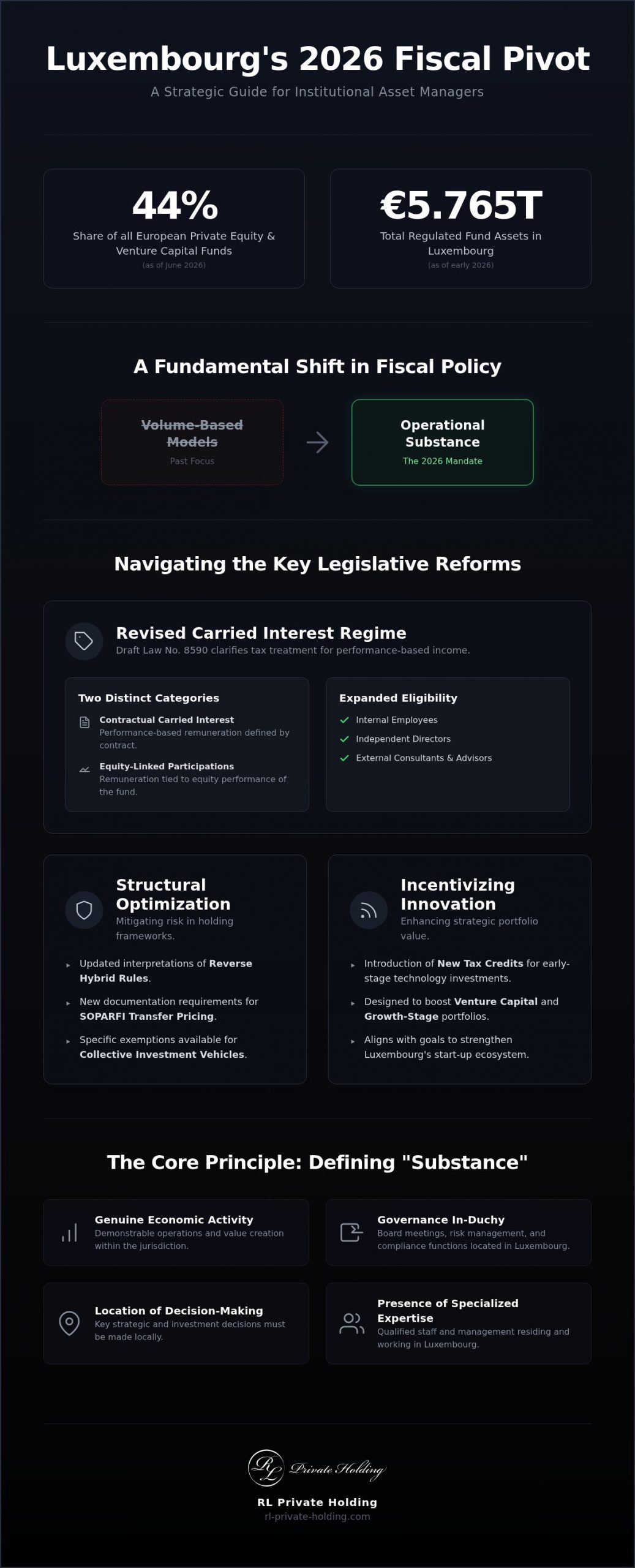
Luxembourg holds a 44% share of all European private equity and venture capital funds as of June 2026, yet the latest fiscal reforms have introduced a new layer of complexity for institutional asset managers. For firms focused on long-term stability, navigating Luxembourg investment tax laws 2026 isn’t merely a compliance exercise but a strategic necessity to protect fund performance. Institutional leaders recognize that maintaining a competitive edge requires absolute clarity on evolving carried interest and reverse hybrid standards.
This article provides a comprehensive analysis of the 2026 fiscal reforms, focusing on the technical distinctions between contractual and equity-linked carried interest. We’ll also examine the updated transfer pricing documentation for SOPARFIs and the specific exemptions available for collective investment vehicles. By understanding these shifts, you’ll be better positioned to mitigate risks and align your private equity and real estate assets with the current regulatory environment.
Key Takeaways
- Gain a comprehensive understanding of the 2026 fiscal pivot to ensure institutional structures remain compliant while navigating Luxembourg investment tax laws 2026.
- Identify the technical distinctions between contractual and equity-linked carried interest under Draft Law No. 8590 to maintain tax efficiency for fund managers.
- Apply the updated interpretations of reverse hybrid rules and transfer pricing requirements for SOPARFIs to mitigate structural risks within complex holding frameworks.
- Evaluate new tax credits for early-stage technology investments to enhance the strategic value of venture capital and growth-stage portfolios.
- Integrate these regulatory updates into a disciplined, multi-sectoral asset management strategy that prioritizes long-term stability and risk-hedged returns.
The 2026 Fiscal Pivot: Understanding the New Luxembourg Tax Framework
Luxembourg’s position as a premier financial center is solidified by the €5.765 trillion in regulated fund assets recorded in early 2026. The fiscal landscape has matured, moving beyond simple domiciliation toward a framework that rewards operational substance. Navigating Luxembourg investment tax laws 2026 requires an understanding of how the government has balanced its traditional attractiveness with modern transparency requirements. The primary objectives of this reform are to enhance European competitiveness while ensuring the jurisdiction remains a leader in global regulatory compliance. This pivot isn’t merely a set of administrative updates; it’s a strategic realignment of the country’s economic value proposition.
The transition from the 2025 legislative sessions to the 2026 implementation phase represents a calculated shift in fiscal policy. While earlier draft laws focused on broad adjustments, the 2026 framework provides specific clarity for institutional asset managers. This period marks a move away from volume-based models, emphasizing the technical depth of Taxation in Luxembourg. Substance is now the primary metric for tax optimization, requiring firms to demonstrate genuine economic activity and governance within the Grand Duchy. For institutional portfolios, this means that the location of decision-making and the presence of specialized expertise are more critical than ever before.
Key Legislative Drivers for Institutional Portfolios
The introduction of a single tax class for individuals, scheduled for full application by 2028 but impacting planning today, changes how management entities structure internal compensation. These reforms align closely with OECD Pillar Two and broader European transparency standards, ensuring that profits are taxed where economic value is created. For institutional investors, these changes directly influence Luxembourg investment structures like the SCSp, which remains a preferred vehicle due to its inherent flexibility and transparency. The 2026 rules provide the necessary legal certainty to maintain these structures over long-term investment horizons.
Macro-Economic Context for Asset Managers
Luxembourg continues to dominate the European landscape, holding a 44% share of all private equity and venture capital funds as of June 2026. This stability is a cornerstone of private equity investment management, providing a predictable environment for long-term capital deployment. Market reactions to the 2026 updates have been largely positive, as the increased legal certainty regarding reverse hybrid rules and carried interest clarifies the path for future exits. Successfully navigating Luxembourg investment tax laws 2026 allows managers to leverage the jurisdiction’s resilience against shifting global economic tides while maintaining institutional gravity in their operations.
The Revised Carried Interest Regime: Strategic Implications for AIFMs
Draft Law No. 8590, effective January 1, 2026, codifies the tax treatment of performance-based income, providing the legal certainty that institutional fund managers require. This legislative update distinguishes between contractual carried interest and equity-linked participations, ensuring that remuneration reflects the actual economic performance of the fund. Navigating Luxembourg investment tax laws 2026 involves a technical assessment of these two categories, as they carry significantly different tax implications for Alternative Investment Fund Managers (AIFMs). By formalizing these definitions, Luxembourg reinforces its position as a transparent and predictable jurisdiction for global capital.
The 2026 regime expands eligibility for preferential tax treatment beyond internal employees to include independent directors and external consultants. This expansion acknowledges the collaborative nature of modern fund management, where specialized expertise is often sourced externally. To qualify, the remuneration must be linked to “outperformance,” typically defined by market-standard hurdle rates. These rates serve as a benchmark, ensuring that carried interest is only triggered once investors have received a specified return on their capital. This alignment of interests is fundamental to the institutional gravity of the Luxembourg financial center.
Taxation of Performance-Based Remuneration
Contractual carried interest is now taxed as extraordinary miscellaneous income at one-quarter of the individual’s overall income tax rate. In contrast, equity-linked carried interest falls under the capital gains regime. This latter category may benefit from a full exemption if the participation is held for more than six months and represents less than 10% of the fund’s share capital. These structures must remain compliant with broader OECD Pillar Two rules, which aim to prevent profit shifting and ensure a global minimum level of taxation. Anti-abuse provisions remain a priority, as authorities will scrutinize fee structures to prevent the recharacterization of ordinary salary as performance-based income.
Strategic Structuring for Fund Managers
Optimizing these arrangements requires meticulous documentation to substantiate the nature of the income. For those involved in venture capital Luxembourg management, the 2026 reforms provide a clear framework for rewarding long-term value creation in technology and growth-stage assets. Managers must ensure that their carried interest models are integrated into the fund’s constitutional documents from the outset. Maintaining a disciplined approach to these technical nuances is essential for preserving the integrity of the investment structure. For institutional partners seeking to refine their holding strategies, the expertise of RL Private Holding offers a steady hand in a changing regulatory landscape.
Structural Optimization: Navigating Reverse Hybrid Rules and SOPARFIs
The circular issued on August 22, 2025, provides the necessary clarity for institutional managers navigating Luxembourg investment tax laws 2026, particularly regarding reverse hybrid rule exemptions. This guidance confirms that Undertakings for Collective Investment (UCIs), Specialised Investment Funds (SIFs), and Reserved Alternative Investment Funds (RAIFs) are classified as Collective Investment Vehicles (CIVs). Such entities are exempt from the reverse hybrid rules, which previously created technical uncertainty for transparent partnerships. For other fund structures, the 2026 framework requires strict adherence to the “widely held” and “diversified portfolio” conditions to maintain their tax-neutral status and ensure investor protection.
The SOPARFI (Société de Participations Financières) remains a cornerstone of the Luxembourg holding landscape. Successfully navigating Luxembourg investment tax laws 2026 involves balancing these corporate vehicles with transparent fund structures. While the aggregate corporate tax rate in Luxembourg City stands at approximately 23.87%, the participation exemption regime continues to offer substantial benefits for institutional portfolios. To qualify, a SOPARFI must hold at least 10% of a subsidiary’s share capital, or a participation with an acquisition cost of at least €1.2 million, for a minimum of 12 months. New transfer pricing documentation requirements implemented in January 2026 demand a higher level of technical rigor, ensuring all intercompany transactions reflect arm’s length principles.
SCSp vs. SOPARFI: Efficiency in 2026
Choosing between the tax-transparent Special Limited Partnership (SCSp) and the corporate SOPARFI depends on the specific needs of the asset class. The SCSp offers significant flexibility for real estate asset management Luxembourg, as it allows for the flow-through of income without an intermediate layer of corporate taxation. However, managers must carefully manage withholding tax considerations for cross-border distributions to ensure the structure doesn’t inadvertently trigger liabilities in the investor’s home jurisdiction. Corporate opacity in a SOPARFI can sometimes be preferable for certain exit strategies where a clean share deal is required.
Compliance Protocols for Holding Companies
Reverse hybrid entities now face enhanced reporting obligations that require a methodical approach to data management. Maintaining a diversified portfolio is no longer just a risk management strategy; it’s a regulatory requirement for certain exemptions. These protocols are especially relevant for family office investment strategies Luxembourg, where the preservation of capital across generations relies on the structural integrity of the holding vehicle. By implementing robust compliance frameworks, institutional partners can mitigate the risks associated with non-optimized structures while maintaining the disciplined focus required for long-term growth.
Incentivizing Innovation: Tax Measures for the Start-up Ecosystem
The 2026 fiscal framework introduces specific incentives designed to channel private capital into the innovation economy. A central feature is the new 20% tax credit for individual investors who subscribe to the share capital of qualifying innovative start-ups. This credit applies to cash subscriptions of at least €10,000, with the annual eligible investment capped at €100,000 per taxpayer. Shares must be held for a minimum of three years to retain the benefit. For institutional partners navigating Luxembourg investment tax laws 2026, these measures provide a structured pathway to support the next generation of technology leaders while optimizing the fiscal profile of their portfolios.
The “Young Innovative Enterprise” (Jeune Entreprise Innovante) status has also been expanded to capture a broader range of high-growth entities. This designation allows companies to benefit from accelerated depreciation rules, particularly for investments in digital transformation and sustainable energy renovations. These provisions are not merely administrative; they’re strategic tools that lower the cost of capital for firms in their most critical growth phases. By reducing the tax burden on essential infrastructure, Luxembourg encourages a more resilient and technologically advanced business environment. This shift aligns the interests of founders with those of institutional backers who prioritize substance and long-term value.
Venture Capital Synergies
Growth-stage technology investments stand to benefit from the interplay between start-up credits and broader employment incentives. The 2026 reform introduces a tax allowance of up to €750 per month for employees eligible for early retirement who choose to continue working. This measure helps maintain specialized expertise within fund management teams, which is a critical factor for venture capital success. Strategic allocation of capital into these innovative sectors allows for a disciplined approach to appreciation, leveraging the jurisdiction’s focus on professional longevity and technical depth.
Sustainable Investment Frameworks
Environmental, Social, and Governance (ESG) considerations are now deeply integrated into the tax code. The 2026 framework provides enhanced deductibility for green investment schemes, with the annual ceiling for pension contributions increasing from €3,200 to €4,500 per taxpayer. These changes align private wealth management firms Luxembourg with global sustainability trends. Additionally, the CO2 tax continues to influence real estate asset valuations, making energy-efficient renovations a fiscal necessity. For those looking to deploy capital in this evolving market, RL Private Holding provides the institutional oversight required to navigate these complex incentives.
Institutional Resilience: The RL Private Holding Approach to 2026
The 2026 fiscal environment demands a disciplined synthesis of tax updates into a global holding strategy. Successfully navigating Luxembourg investment tax laws 2026 isn’t a reactive task; it’s a proactive alignment of capital with the jurisdiction’s new standards of substance. RL Private Holding approaches this transition with institutional gravity, ensuring that every structure within the portfolio reflects the highest level of regulatory excellence. By focusing on the technical nuances of the revised carried interest regime and the clarified reverse hybrid rules, the firm maintains its position as a steady global partner in an increasingly complex market.
Resilience in 2026 is built on a multi-sectoral foundation. The firm manages diversified portfolios across venture capital funding, private equity investment management, and real estate asset management, allowing for risk-hedged returns in a shifting economic landscape. With the total net assets of regulated investment funds in Luxembourg surpassing €5.765 trillion in early 2026, the firm leverages this market depth to secure long-term stability. This disciplined approach to asset management ensures that fiscal changes don’t disrupt the underlying investment thesis. Instead, these updates strengthen the firm’s operational framework and its commitment to transparency.
Value Creation in an Evolving Landscape
RL Private Holding optimizes carried interest structures to ensure long-term alignment between managers and institutional investors. The firm’s focus remains on growth-stage technology and diversified real estate assets, sectors that now benefit from the specific 2026 incentives discussed in previous sections. By establishing a stable foundation, the firm provides a reliable environment for wealth preservation. This methodical approach to value creation is essential for institutional portfolios that prioritize technical depth and structural integrity over short-term gains.
Strategic Partnership and Next Steps
The role of a sophisticated partner is critical when navigating the complexities of the 2026 tax reforms. RL Private Holding offers the specialized expertise required to manage these transitions while maintaining a professional distance that ensures objective oversight. This disciplined focus on governance allows for the seamless integration of new reporting obligations and transfer pricing requirements for SOPARFIs. Institutional partners and asset managers are invited to review the firm’s approach to global portfolio management and its commitment to institutional permanence in the Luxembourg financial center.
Securing Institutional Advantage in a Transformed Fiscal Landscape
The 2026 fiscal reforms represent a decisive shift toward a substance-based economy in Luxembourg. By formalizing the treatment of carried interest and clarifying reverse hybrid exemptions, the Grand Duchy has provided the legal certainty required for long-term capital deployment. Successfully navigating Luxembourg investment tax laws 2026 allows institutional managers to move beyond mere compliance, turning regulatory changes into a framework for structural optimization. This transition rewards firms that prioritize technical rigor and operational depth over volume-based models.
Headquartered in the heart of the Luxembourg financial center, RL Private Holding remains a disciplined partner for those managing complex, multi-sectoral portfolios. The firm’s established expertise in private equity, real estate, and growth-stage venture capital ensures that every asset is positioned for resilience and long-term appreciation. Maintaining structural integrity in this evolving landscape is the only way to secure institutional value for the next decade. A steady hand and a clear plan will ensure your investments thrive under these new protocols.
Explore RL Private Holding’s Institutional Investment Strategies
Frequently Asked Questions
What are the primary changes to the Luxembourg carried interest regime in 2026?
The primary changes to the carried interest regime involve a formal distinction between contractual and equity-linked remuneration models. Contractual carried interest is now taxed as extraordinary miscellaneous income at one-quarter of the individual’s standard income tax rate. Equity-linked participations fall under the capital gains regime, which offers potential exemptions for holdings representing less than 10% of share capital held for more than six months.
How do the 2026 reverse hybrid rules impact Alternative Investment Funds?
Reverse hybrid rules impact Alternative Investment Funds by requiring strict adherence to the “collective investment vehicle” (CIV) exemption criteria. The August 2025 circular confirms that SIFs, RAIFs, and UCIs are considered CIVs and remain exempt from these rules. Other fund structures must demonstrate they are widely held and maintain a diversified portfolio to avoid being recharacterized as transparent entities for tax purposes.
Is the Luxembourg SOPARFI still a viable structure for 2026 investments?
The Luxembourg SOPARFI remains a highly viable structure for 2026 investments due to the stability of the participation exemption regime. While the aggregate corporate tax rate in Luxembourg City is approximately 23.87%, the exemption for dividends and capital gains remains accessible for participations of at least 10% or €1.2 million. Managers must ensure compliance with the new transfer pricing documentation requirements effective as of January 2026.
What new tax incentives are available for venture capital in Luxembourg for 2026?
New tax incentives for venture capital in 2026 include a 20% tax credit for individual investors who subscribe to the share capital of innovative start-ups. This credit applies to cash subscriptions of at least €10,000, capped at an investment of €100,000 per taxpayer annually. Successfully navigating Luxembourg investment tax laws 2026 requires ensuring that these shares are held for at least three years to maintain the credit’s validity.
How does the introduction of a single tax class affect institutional entities?
The introduction of a single tax class primarily affects the individual taxation of partners and employees within institutional entities. While the full transition is scheduled for the 2028 tax year, the 2026 framework establishes the transitional regime for married or partnered taxpayers. This shift necessitates a review of internal compensation models and wealth management strategies to account for the move toward full individual taxation.
What are the reporting requirements for widely held portfolios under the new 2026 circulars?
Reporting requirements for widely held portfolios under the 2026 circulars demand rigorous substantiation of investor numbers and asset diversification. Entities seeking exemption from reverse hybrid rules must provide detailed documentation proving they meet the “widely held” condition as defined by the August 2025 guidance. This technical rigor ensures that only genuine collective investment vehicles benefit from tax neutrality in the post-reform environment.
Can independent directors benefit from the new carried interest tax treatment?
Independent directors can benefit from the new carried interest tax treatment under the provisions of Draft Law No. 8590. The 2026 regime expands eligibility to include both independent directors and external consultants, provided their remuneration is directly linked to fund outperformance. This change acknowledges the specialized roles that external experts play in modern institutional asset management and private equity structures.
How does the 2026 CO2 tax impact real estate asset management strategies?
The 2026 CO2 tax impacts real estate asset management by increasing the operational costs of carbon-intensive properties and influencing overall valuations. Management strategies must now prioritize energy-efficient renovations to mitigate these costs and leverage new green investment tax credits. Navigating Luxembourg investment tax laws 2026 involves integrating these environmental levies into the long-term appreciation model for real estate assets.