

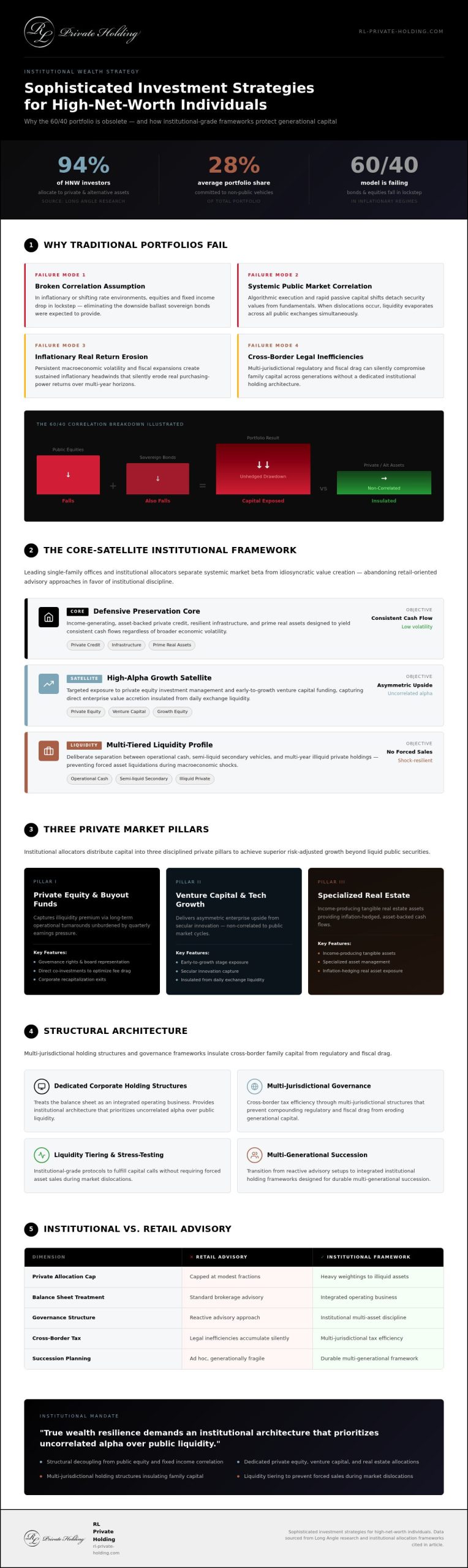
According to research from Long Angle, 94% of high-net-worth investors now allocate capital to private and alternative assets, committing an average of 28% of their overall portfolio to non-public vehicles. This strategic migration reveals a clear reality: conventional 60/40 allocations are no longer sufficient to offset systemic market fluctuations. Deploying sophisticated investment strategies for HNWIs has therefore evolved from an opportunistic search for yield into an absolute necessity for durable balance sheet preservation.
You’ve likely experienced the drag of heightened public volatility and seen how cross-border legal inefficiencies can silently compromise family capital across generations. True wealth resilience demands an institutional architecture that prioritizes uncorrelated alpha over public liquidity. This analysis provides a structured roadmap for alternative asset allocation, cross-border tax efficiency, and long-term risk management. We examine how direct private equity, venture capital allocations, specialized real estate management, and multi-jurisdictional holding structures insulate core capital against macroeconomic disruption.
Key Takeaways
- Examine why the structural decoupling of public equities and fixed income necessitates moving beyond conventional portfolio models in volatile macroeconomic environments.
- Discover how deploying sophisticated investment strategies for HNWIs across private equity, venture capital, and specialized real estate generates resilient, non-correlated returns.
- Learn how dedicated corporate holding structures and multi-jurisdictional governance insulate cross-border family capital from compounding regulatory and fiscal drag.
- Establish institutional-grade liquidity tiering and stress-testing protocols to reliably fulfill capital calls without requiring forced asset sales during market dislocations.
- Evaluate the transition from reactive wealth advisory setups to integrated institutional holding frameworks designed for durable multi-generational succession.
The Paradigm Shift: Why Traditional HNWI Portfolios Fail in 2026
For decades, private wealth management relied on a balanced 60/40 mix of public equities and sovereign fixed income. That formula assumes that sovereign bonds reliably appreciate during market contractions, providing downside ballast. In inflationary or shifting interest rate environments, however, this negative correlation breaks down. Equities and fixed income often drop in lockstep, exposing high-net-worth balance sheets to unhedged drawdowns. To preserve generational capital, investors must deploy sophisticated investment strategies for HNWIs that replace conventional assumptions with institutional multi-asset governance models.
Macroeconomic Volatility and Public Market Correlation
Liquid markets face unprecedented systemic correlation. Quantitative trading strategies, algorithmic execution, and rapid passive capital shifts exacerbate pricing swings, detaching security values from underlying corporate fundamentals. When market dislocations occur, liquidity evaporates across public exchanges simultaneously. Persistent macroeconomic volatility and fiscal expansions also create sustained inflationary headwinds. These forces quietly erode real, purchasing-power returns over multi-year horizons, rendering conventional public portfolios vulnerable to structural capital decay.
The Core-Satellite Institutional Framework
Protecting substantial private wealth requires separating systemic market beta from idiosyncratic value creation. Leading single-family offices and institutional allocators utilize a core-satellite governance framework, abandoning retail-oriented advisory approaches in favor of institutional discipline within modern wealth management structures:
- Defensive Preservation Core: Allocations to income-generating, asset-backed private credit, resilient infrastructure, and prime real assets designed to yield consistent cash flows regardless of broader economic volatility.
- High-Alpha Growth Satellite: Targeted exposure to private equity investment management and early-to-growth venture capital funding, capturing direct enterprise value accretion insulated from daily exchange liquidity.
- Multi-Tiered Liquidity Profile: A deliberate separation between operational cash, semi-liquid secondary vehicles, and multi-year illiquid private holdings, preventing forced asset liquidations during macroeconomic shocks.
Unlike standard brokerage advisory channels, sophisticated investment strategies for HNWIs treat the balance sheet as an integrated operating business. Establishing dedicated allocations to non-correlated private markets creates an enduring structural foundation. It ensures capital preservation across market cycles while actively capturing uncrowded enterprise upside.
Core Pillars of Institutional-Grade Alternative Asset Allocation
Institutional allocators have long recognized that superior risk-adjusted growth requires substantial commitments beyond liquid public securities. While standard retail advisories often cap private allocations at modest fractions, sophisticated family offices allocate heavy weightings to illiquid private assets. Implementing sophisticated investment strategies for HNWIs requires distributing capital into three disciplined private pillars: private equity buyouts, high-conviction venture opportunities, and income-producing tangible real estate assets.
Private Equity: Direct Investments and Buyout Funds
Private equity investments capture an illiquidity premium by executing long-term operational turnarounds unburdened by quarterly public earnings reports. Structuring access through dedicated private equity investment management provides significant governance rights, board representation, and control over capital allocation decisions. Investors can balance primary fund commitments with direct co-investments to optimize management fee drag while maintaining exposure to sponsor-led corporate recapitalizations and clear strategic sale exits.
Venture Capital and Technology Growth Allocations
Growth-oriented portfolios depend on asymmetric enterprise upside derived from secular innovation. Direct venture capital funding delivers this non-correlated growth by backing disruptive private technology companies prior to broader institutional liquidity events. Sophisticated investors balance stage exposure across early-stage seed ventures and late-stage pre-IPO rounds. Those managing multi-jurisdictional private allocations often deploy structures highlighted in venture capital Luxembourg to align early innovation access with robust institutional oversight.
Tangible Real Estate Asset Management
Direct ownership of commercial real estate serves as a durable hedge against persistent inflation, backed by long-term leases and underlying physical land value. Implementing institutional real estate asset management in the Luxembourg market allows private allocators to secure cross-border property exposures, including logistics facilities, prime office assets, and residential developments. These tangible portfolios generate predictable, contractually locked yields while shielding core wealth from currency devaluations.
Executing across these complex private sectors demands institutional cross-asset structuring rather than fragmented individual deals. Balancing cash-flow generation against equity appreciation ensures high-net-worth balance sheets remain resilient. Families seeking integrated access across these private asset pillars can review the cross-asset institutional frameworks developed by RL Private Holding to reinforce their multi-generational holdings.
Structural Architecture: Vehicles, Governance, and Jurisdictional Selection
The ultimate performance of private assets depends fundamentally on the legal structures housing them. Even exceptional investment selection can suffer from compounding cross-border inefficiencies, administrative friction, and regulatory exposure if structural design is overlooked. For this reason, sophisticated investment strategies for HNWIs treat legal engineering and jurisdictional domicile as primary strategic levers rather than secondary operational considerations.
Specialized Holding Companies and Corporate Formations
Holding company architectures consolidate multi-asset global balance sheets under a unified corporate umbrella. By centralizing management, holding entities establish legal firewalls that insulate liquid wealth from operational liabilities in direct commercial real estate or operating businesses. They also streamline intergenerational succession. Family principals can transfer non-voting equity classes to succeeding generations incrementally, ensuring continuity of asset management without disrupting active operational control.
Alternative Fund Vehicles and Limited Partnerships
Managing private market allocations across co-investors or extended family branches requires flexible, tax-transparent fund structures. Allocators frequently implement the Luxembourg special limited partnership to aggregate capital for dedicated private equity and venture allocations. This contractual structure provides immense contractual freedom, allowing general partners to establish bespoke governance terms, tailored distribution waterfalls, and streamlined capital call procedures within an internationally recognized regulatory framework.
Governance Frameworks for Multi-Generational Wealth
Structural longevity requires disciplined internal oversight. Drawing on proven family office investment strategies in Luxembourg, multi-generational families codify their principles into formal investment charters. These institutional governance frameworks achieve several critical objectives:
- Defined Mandates: Documenting explicit risk boundaries, asset class weightings, and maximum illiquidity thresholds across market cycles.
- Conflict Resolution Mechanisms: Establishing independent investment committees to evaluate direct acquisitions and remove subjective family dynamics from asset allocation decisions.
- Succession Alignment: Structuring clear leadership transition protocols to mitigate principal-agent risks before generational leadership handovers occur.
A rigorous corporate architecture ensures investment decisions withstand shifting international regulatory environments. Aligning appropriate legal vehicles with comprehensive governance policies allows sophisticated investment strategies for HNWIs to preserve balance sheet autonomy across successive generations.
Institutional Risk Mitigation, Liquidity Tiering, and Stress-Testing
Liquid assets provide immediate flexibility, but illiquid alternative investments require rigorous forward liability modeling. When allocating meaningful capital to private equity, venture funding, and direct assets, uncalled capital commitments create contractual obligations that cannot rely on reactive funding. Executing sophisticated investment strategies for HNWIs requires proactive liquidity engineering to ensure capital calls are met smoothly without compromising the broader portfolio during market stress.
Dynamic Liquidity Layering Models
Institutional balance sheets prevent liquidity squeezes through a structured three-tier capital framework:
- Operational Liquidity Tier: High-grade short-term reserves dedicated to funding 12 to 24 months of operational expenditures, distributions, and tax obligations.
- Buffer Capital Tier: Income-generating, asset-backed debt and private credit allocations that can be drawn down systematically to satisfy capital calls as private sponsors deploy equity.
- Illiquid Growth Tier: Long-term allocations across direct private equity, venture capital, and commercial property holdings structured to harvest compounding enterprise gains over multi-year cycles.
Modeling cash flows across fund vintages enables allocators to forecast capital calls and distributions predictably. This systematic layering prevents forced secondary sales of illiquid assets at deep discounts during market downturns.
Tail-Risk Hedging and Macro Stress-Testing
Standard deviation metrics and standard Value-at-Risk models often fail to capture tail-risk vulnerabilities during systemic crises. Institutional risk management requires rigorous stress-testing that simulates simultaneous stagflationary shocks, rapid interest rate shifts, and currency dislocations. Allocators integrate non-directional absolute return mandates and disciplined macro hedging overlays to harvest volatility and offset broader equity drawdowns. They also enforce strict counterparty exposure limits across all prime brokers and custodial institutions to insulate private holdings against systemic banking stress.
Disciplined stress-testing ensures that private asset allocations generate steady returns without exposing family balance sheets to catastrophic structural vulnerabilities. Implementing sophisticated investment strategies for HNWIs keeps core capital protected across protracted market contractions. To align your balance sheet with disciplined risk management protocols, explore institutional wealth management services tailored for sophisticated international investors.
Executing a Bespoke Wealth Strategy with RL Private Holding
Substantial generational capital requires moving beyond traditional third-party advisory channels toward an integrated holding model. Standard wealth advisory frameworks often distribute capital across generic fund-of-funds or fragmented public asset portfolios, introducing unnecessary intermediary layers and friction. Establishing sophisticated investment strategies for HNWIs calls for an institutional holding partner capable of providing unified, cross-asset governance across private equity, venture funding, and commercial real estate asset management.
Direct Access to Uncorrelated Private Markets
Working alongside an institutional investment holding company removes the structural barriers typical of retail wealth management. Investors secure direct co-investment access within private transactions rather than settling for retail-packaged feeder funds. This approach provides several direct advantages:
- Fee Optimization: Eliminating redundant administrative and placement layers ensures direct performance alignment between capital and operational assets.
- Sector-Specific Deployment: Allocating capital into high-conviction growth verticals, including enterprise technology solutions and stabilized commercial logistics properties.
- Active Operational Governance: Participating in growth trajectories steered by direct board oversight and hands-on operational turnarounds.
For allocators evaluating cross-border opportunities, aligning with top-tier private wealth management firms in Luxembourg provides the jurisdictional certainty and robust legal structuring required to execute multi-jurisdictional mandates seamlessly.
Institutional Governance and Long-Term Capital Alignment
Capital preservation over multi-generational horizons demands patient, discreet balance sheet alignment. As an investment holding company managing a diversified global portfolio, RL Private Holding approaches balance sheet architecture with a long-term operational mindset. Rather than pursuing short-term trading liquidity, the firm concentrates on building enduring balance sheet equity through disciplined operational management, conservative leverage structures, and comprehensive risk oversight.
Successful execution requires tailored structural frameworks that reflect a family’s unique risk profile, succession objectives, and jurisdictional footprint. Deploying sophisticated investment strategies for HNWIs ensures that wealth compounds securely across generations while remaining insulated from broader macroeconomic dislocations. To evaluate direct co-investment opportunities or align your capital with an institutional investment partner, contact RL Private Holding to initiate a confidential discussion regarding your strategic allocation goals.
Securing Generational Durability Through Institutional Architecture
Navigating persistent macroeconomic fragmentation requires an institutional approach to balance sheet design. Relying solely on conventional liquid portfolios exposes family wealth to systemic correlation breakdowns and real purchasing-power erosion. As private capital structures grow more complex, implementing sophisticated investment strategies for HNWIs establishes the disciplined foundation required to protect capital across multiple generations.
Sustainable capital preservation relies on three interconnected pillars: allocating to non-correlated private markets, establishing resilient corporate holding vehicles, and executing proactive liquidity stress-testing. By operating as a diversified global holding spanning private equity, venture capital, and prime real estate, dedicated institutional management delivers strategic alignment, discretion, and operational discipline. To build an enduring portfolio engineered for long-term stability, discover institutional wealth architecture with RL Private Holding and position your balance sheet for the decades ahead.
Frequently Asked Questions
What distinguishes sophisticated investment strategies for HNWIs from standard wealth management?
Sophisticated investment strategies for HNWIs differ fundamentally from standard retail advisory models by prioritizing structural balance sheet architecture over public market indexing. Rather than relying on liquid mutual funds or standardized balanced models, these institutional strategies incorporate direct private equity investment management, venture capital funding, and bespoke holding vehicles. This framework delivers direct operational control, structural liability protection, and access to non-correlated enterprise value creation.
How much capital should an HNWI allocate to private equity and venture capital?
While traditional advisors often restrict alternative assets to nominal percentages, institutional family offices frequently allocate between 25% and 40% of their total balance sheet to private markets. The precise weighting depends on forward cash flow requirements, multi-generational liquidity horizons, and operational capital needs. Distributing commitments across private equity buyout funds and venture capital funding ensures capital compounds through active operational improvements and asymmetric technological growth.
Why are corporate holding companies preferred over traditional trusts for family wealth?
Corporate holding entities offer superior operational flexibility, centralized governance, and direct management oversight compared to discretionary trusts. A dedicated holding company establishes robust structural firewalls between distinct operating businesses, commercial property, and liquid reserves. It also facilitates frictionless intergenerational equity transfers through multi-tiered share classes. This structure preserves direct family control over capital allocation decisions without triggering administrative gridlock or subjective trustee delays.
How do high-net-worth investors manage liquidity while maintaining large allocations to private markets?
Institutional allocators utilize dynamic liquidity layering to fund private capital commitments without disrupting their broader portfolios. By separating balance sheets into distinct tiers, immediate cash needs remain fully insulated from long-term holdings. Short-term debt and income-generating private credit buffers supply regular cash flows to satisfy contractual capital calls. This systematic forward modeling ensures that deploying sophisticated investment strategies for HNWIs doesn’t force secondary asset sales during market dislocations.
What role does commercial real estate play in an institutional wealth preservation strategy?
Tangible commercial property provides an institutional balance sheet with an intrinsic, inflation-hedged income stream backed by long-term contractual leases. Direct real estate asset management focuses on stabilized logistics, prime industrial assets, and resilient commercial spaces. These real assets generate predictable cash yields that counteract currency debasement while insulating core wealth from public exchange volatility. Over long horizons, direct property ownership anchors the defensive core of a multi-asset portfolio.
How does RL Private Holding approach multi-asset portfolio management for sophisticated investors?
RL Private Holding operates as a discreet investment holding company, managing a diversified global portfolio across private equity investment management, venture capital funding, and real estate asset management. The firm rejects standardized retail products in favor of direct co-investments, operational value creation, and conservative balance sheet governance. This institutional approach prioritizes long-term capital preservation, aligning strategic private allocations directly with the generational objectives of sophisticated private and institutional partners.