

The structural integrity of a private equity fund resides not in its underlying assets, but in the precise calibration of its governing contract. For institutional investors navigating the global landscape in 2026, the challenge lies in deconstructing the legal and economic architecture that dictates long term capital preservation. It’s often difficult to look past the complexity of waterfall calculations or the opacity of fee structures to see if a General Partner’s incentives truly align with your own. Gaining a sophisticated perspective on understanding limited partner agreements is essential for any disciplined partner seeking to mitigate risk and ensure transparency within their portfolio.
We recognize that the dense terminology of fund documents can create significant barriers to effective due diligence. This article provides a comprehensive analysis of the frameworks that govern the relationship between General Partners and Limited Partners in modern investment structures. You’ll gain a clear understanding of standard governance protections and the economic terms that define high level asset management. We’ll examine the mechanics of distribution tiers, the nuances of clawback provisions, and the structural safeguards that protect institutional interests, providing a reliable framework for evaluating future fund commitments with confidence.
Key Takeaways
- Establish a rigorous framework for understanding limited partner agreements to ensure the structural alignment of fiduciary duties between General and Limited Partners.
- Analyze the mechanics of management fees and capital commitment periods to evaluate their direct impact on institutional net returns.
- Identify critical governance protections, including “Key Person” clauses and investment restrictions, to mitigate leadership instability and operational risks.
- Leverage the Limited Partner Advisory Committee (LPAC) and standardized reporting protocols to maintain transparency and fund oversight.
- Examine the strategic benefits of the Luxembourg SCSp as a global standard for flexible and sophisticated private investment structures.
The Foundational Role of the Limited Partner Agreement in Private Fund Structures
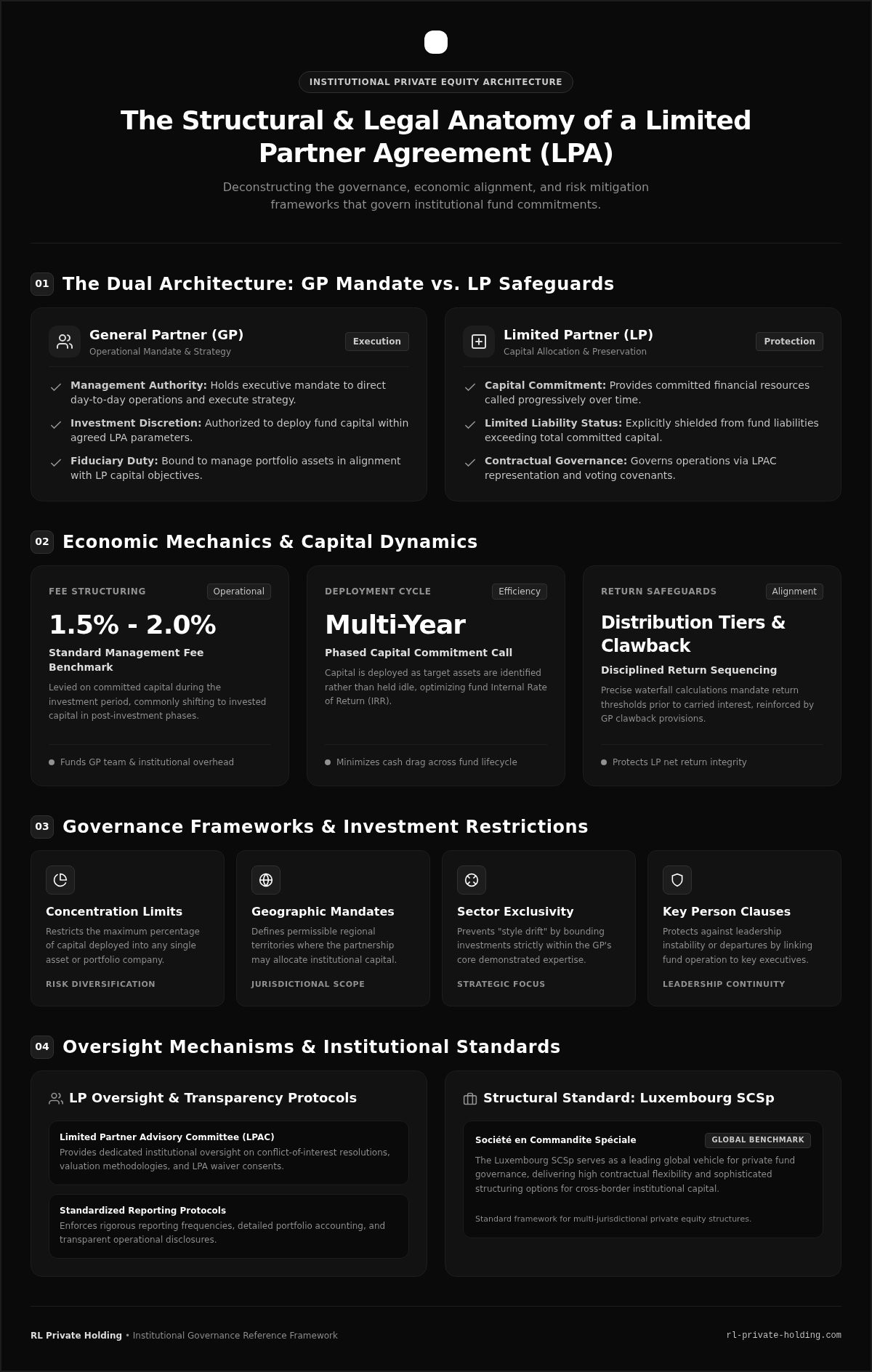
The Limited Partner Agreement (LPA) functions as the definitive blueprint for any private equity or venture capital vehicle. It establishes the contractual parameters that govern the fund’s entire lifecycle; this spans from the initial capital commitment phase to the eventual final liquidation of assets. Understanding limited partner agreements requires a clear view of the fiduciary relationship where the General Partner (GP) holds the mandate to manage the fund’s operations while the Limited Partners (LPs) provide the necessary capital. In 2026, as institutional portfolios face increased scrutiny, the LPA remains the primary mechanism for ensuring that this relationship is both transparent and legally sound. It’s the document that transforms a collection of capital into a disciplined investment vehicle.
The Legal Architecture of Private Equity
A robust private equity fund structure relies on the clear separation of roles and liabilities. The Limited Partner Agreement (LPA) serves as the legal nexus of fund governance, binding all parties to a specific operational framework. This architecture explicitly codifies the limited liability status of investors, ensuring that LPs aren’t personally liable for the fund’s debts beyond their committed capital. Simultaneously, the document defines the GP’s management authority and investment discretion. This gives the GP the necessary latitude to execute complex strategies while remaining bound by the specific terms negotiated at the fund’s inception. Without this structural clarity, the balance between management expertise and capital protection would remain dangerously undefined.
Strategic Objectives for Institutional Investors
For sophisticated investors, the LPA is more than a legal formality; it’s a tool for institutional risk management. It enforces an alignment of interest through structural mandates, ensuring that GP incentives are tied to long term performance rather than just asset volume. By establishing clearly defined investment restrictions, the agreement prevents “style drift” and keeps the fund within its intended risk parameters. These restrictions often include:
- Concentration Limits: Restricting the percentage of capital allocated to a single asset.
- Geographic Mandates: Defining the specific regions where the fund may deploy capital.
- Sector Exclusivity: Ensuring the GP stays within their demonstrated area of expertise.
This level of structural precision is a core component of professional private equity investment management. A deep understanding limited partner agreements allows investors to verify that their capital is protected by governance standards that meet the requirements of a global financial environment. It ensures that the partnership operates with the discipline required for sustained capital appreciation.
Economic Provisions: Aligning GP Incentives with LP Capital Objectives
The economic framework of a private fund dictates how capital flows between the partnership and its investors. While the legal structure defines the rules, the economic provisions define the motivation. A core component of understanding limited partner agreements involves dissecting the mechanics of capital contributions. Investors commit a total sum, but capital is typically “called” over a multi-year commitment period as the General Partner (GP) identifies suitable assets. This phased approach ensures capital isn’t sitting idle, maximizing internal rates of return for the partnership while maintaining a disciplined deployment schedule.
Fee Structures and Operational Expenses
Management fees provide the GP with the necessary liquidity to maintain a professional investment team and institutional infrastructure. In 2026, benchmarking assets under management fees remains a critical exercise for institutional Limited Partners (LPs). Standard fees typically range from 1.5% to 2.0% of committed capital during the investment period, often shifting to a percentage of invested capital as the fund matures. It’s vital to distinguish between fund expenses, such as audit and legal costs, and the GP’s internal management company expenses. Sophisticated agreements often include fee offsets, where transaction or monitoring fees paid by portfolio companies to the GP are credited back to the LPs, effectively reducing the net management cost.
Distribution Waterfalls and Carried Interest
The distribution waterfall is the sequential logic that determines how exit proceeds are shared. There are two primary models: “Whole-of-Fund” and “Deal-by-Deal”. The ILPA Model Limited Partnership Agreement serves as a global benchmark here, often favoring the Whole-of-Fund approach to ensure LPs receive their entire capital contribution plus a preferred return before the GP earns performance incentives. This model prioritizes the return of capital, which is a fundamental requirement for many institutional risk frameworks.
Carried interest represents the GP’s share of the profits, serving as the primary incentive for outperformance. To protect the LP’s base capital, most structures include a “Hurdle Rate”, or preferred return, which is a minimum annual return the LP must receive before the GP can participate in gains. Once this hurdle is cleared, a “catch-up” provision allows the GP to reach their agreed share of total profits. To maintain long-term alignment, clawback mechanisms are essential; they require the GP to return previously distributed carry if the fund’s overall performance falls below the agreed threshold at the end of its life. Those evaluating new allocations may find that structured wealth management services offer the necessary oversight to navigate these complex economic terms. Proper alignment ensures that the GP only thrives when the LP’s capital is successfully preserved and grown.
Governance Frameworks and Risk Mitigation Provisions
Governance in 2026 demands more than financial oversight; it requires structural resilience against operational and leadership risks. While economic terms define the rewards, governance frameworks establish the boundaries of management authority. A sophisticated approach to understanding limited partner agreements involves recognizing how these contracts manage human capital and institutional stability. These provisions ensure that the partnership remains functional even during periods of market volatility or organizational change. They provide the necessary friction to prevent unilateral actions that could jeopardize the fund’s long term objectives.
Key Person and Leadership Continuity
The “Key Person” clause is a vital protection against leadership instability within a fund. If specific individuals named in the agreement cease to devote a substantial portion of their business time to the fund, a “Key Person Event” is triggered. This typically results in an automatic suspension of the investment period, preventing the GP from making new investments until a suitable replacement plan is approved by the investors. This is particularly crucial in specialized sectors like venture capital Luxembourg, where the fund’s success is often inextricably linked to the specific networks and expertise of its managing partners. The LPA also codifies succession planning, ensuring that leadership transitions don’t disrupt the fund’s strategic focus.
Fiduciary Duties and Conflict Resolution
The standard of care expected from a General Partner is a foundational element of risk mitigation. Most agreements distinguish between simple errors in judgment and more severe breaches like gross negligence or willful misconduct. To ensure compliance with legal standards, many funds align their documentation with U.S. Securities and Exchange Commission guidance on private funds. This helps define the limits of indemnification and exculpation, ensuring GPs aren’t held liable for market downturns while remaining accountable for fiduciary failures. The LPA mitigates operational risk by codifying the specific boundaries of management authority and establishing transparent protocols for leadership transition.
Conflict resolution is another pillar of institutional governance. In diversified portfolios, GPs may face overlapping interests between different funds or affiliated entities. The LPA provides a roadmap for resolving these conflicts, often requiring the review and approval of the Limited Partner Advisory Committee. This ensures that any potential self dealing is addressed through a structured, objective process. By establishing these rules at the outset, the agreement protects the integrity of the investment process and maintains the trust of institutional capital providers.
Limited Partner Rights: Transparency, Reporting, and Advisory Committees
The balance of power within a private fund is maintained through a series of negotiated rights that allow investors to monitor their capital without assuming management responsibilities. A deep understanding limited partner agreements requires an appreciation for the mechanisms that facilitate this transparency. These rights are not merely administrative; they are the primary tools for institutional oversight in a landscape where information asymmetry can pose a significant risk. By codifying these rights, the LPA ensures that the GP remains accountable to its capital providers throughout the fund’s term. It creates a framework where transparency is a structural requirement rather than a voluntary disclosure.
The Function of the LPAC
The Limited Partner Advisory Committee (LPAC) serves as the principal forum for investor representation. Composed of a select group of major investors, the LPAC is tasked with reviewing asset valuations and approving transactions that may involve a conflict of interest. This committee provides institutional-grade oversight, acting as a sounding board for the GP on critical governance matters. It’s essential that these advisory functions are clearly defined to ensure that participants don’t inadvertently cross the line into active management, which could jeopardize their limited liability status. The LPAC effectively bridges the gap between passive investment and active governance, providing a necessary layer of protection for the broader partnership.
Reporting and Transparency Standards
Standardization of data is a hallmark of professional fund management in 2026. Investors require quarterly financial statements and detailed capital account reporting to track performance and tax liabilities accurately. Modern agreements have evolved to include comprehensive integration of ESG and impact reporting, reflecting the growing institutional demand for non-financial performance metrics. Many sophisticated investors leverage family office investment strategies Luxembourg to refine their reporting requirements and ensure they receive the granularity needed for complex portfolio management.
Customization often occurs through side letters, which allow specific institutional needs to be addressed without renegotiating the base LPA for all partners. These documents may cover specific tax requirements, regulatory constraints, or enhanced reporting frequencies. While private equity remains an inherently illiquid asset class, the LPA defines the specific transfer rights and liquidity provisions that allow for secondary market transactions under strict conditions. For those seeking to optimize their institutional framework, the wealth management services offered by RL Private Holding provide the expertise required to negotiate and monitor these critical rights.
Strategic Considerations for LPAs in the Luxembourg Financial Landscape
While many global frameworks historically relied on traditional Delaware law, the Luxembourg financial center has emerged as the premier jurisdiction for sophisticated institutional funds. The rise of the SCSp reflects a broader shift toward structures that offer both legal certainty and extreme operational flexibility. Understanding limited partner agreements within this specific context requires a focus on how local regulations integrate with international tax standards. These structures facilitate global capital flows by providing a stable, recognized environment for cross border investment, allowing for the seamless movement of capital between diverse jurisdictions. At RL Private Holding, we prioritize this structural integrity to ensure that every portfolio asset is governed by a framework that supports long term stability.
The Luxembourg SCSp and RAIF Frameworks
The Luxembourg special limited partnership (SCSp) provides an unparalleled level of contractual freedom. Unlike more rigid fund vehicles, the SCSp allows the General Partner and Limited Partners to define their relationship almost entirely through the specific terms of the LPA. This flexibility is often paired with the Reserved Alternative Investment Fund (RAIF) regime, which offers an efficient, fast to market solution without the need for direct product-level supervision by the regulator. It’s a structure that prioritizes tax transparency and regulatory compliance, ensuring that institutional investors can meet their internal mandates while pursuing global returns. By allowing the partnership to be governed by specific negotiated terms rather than prescriptive statutes, Luxembourg provides a environment conducive to high stakes asset management.
Conclusion: Selecting the Right Partnership Framework
Selecting a partnership framework is a strategic decision that extends far beyond the legal text. Rigorous due diligence on the General Partner’s track record and operational history is a necessary prerequisite to any LPA negotiation. As we navigate the investment landscape of 2026, the complexity of these documents continues to increase as new reporting standards and economic models emerge. Professional wealth management Luxembourg services play a critical role in evaluating these structures to ensure they meet the capital preservation goals of the most disciplined investors. Achieving a deep understanding limited partner agreements is the final step in securing a position within a fund that is built for durability.
Before finalizing any commitment, investors should utilize a comprehensive evaluation framework. This final checklist ensures that the fundamental components of the agreement are aligned with institutional standards:
- Economic Alignment: Verify that the hurdle rates, catch-up provisions, and clawback mechanisms protect the LP’s base capital.
- Governance Protections: Confirm that “Key Person” clauses and removal provisions provide adequate safeguards against leadership instability.
- Transparency Protocols: Ensure that reporting frequencies and audit rights meet the requirements for institutional oversight.
- Structural Integrity: Validate that the chosen jurisdiction and vehicle offer the necessary tax transparency and regulatory compliance.
Securing Long-Term Capital Alignment through Structural Integrity
The evolution of private fund structures in 2026 requires a disciplined approach to contract negotiation. A comprehensive understanding limited partner agreements allows institutional investors to move beyond administrative compliance toward true strategic oversight. By prioritizing economic alignment through rigorous hurdle rates and ensuring leadership continuity via Key Person clauses, partners can effectively protect their capital from operational instability. These structural safeguards are essential for maintaining the transparency required in high-stakes asset management across global jurisdictions.
RL Private Holding maintains a reputation for professional institutional gravity in global investment portfolio management, specifically through our expertise in Luxembourg structural frameworks. We focus on the precision of fund governance to ensure that every allocation is supported by a robust legal architecture. It’s this commitment to structural integrity that allows our partners to invest with confidence. Explore our strategic approach to private equity and asset management to see how we implement these frameworks for long-term success. Establishing a disciplined partnership model is the most effective way to secure sustainable capital appreciation.
Frequently Asked Questions
What is the primary difference between a General Partner and a Limited Partner?
The primary distinction lies in the allocation of management authority and liability. The General Partner (GP) holds the mandate to manage the fund’s operations and investments while assuming unlimited liability for the partnership’s obligations. Conversely, Limited Partners (LPs) act as passive capital providers whose liability is strictly limited to their total capital commitment. This structure ensures that those providing the capital aren’t exposed to operational risks beyond their initial investment.
How does a “Key Person” clause protect institutional investors?
A “Key Person” clause protects investors from leadership instability by requiring specific fund managers to devote a substantial portion of their business time to the fund’s activities. If these individuals depart or become inactive, a “Key Person Event” is triggered, which typically suspends the fund’s ability to make new investments. This mechanism prevents style drift and ensures that the expertise promised during the capital raising phase remains available throughout the investment period.
What is a “clawback” provision in a private equity LPA?
A clawback provision is a structural safeguard that ensures the General Partner doesn’t receive more than their agreed share of total fund profits. If a GP receives performance incentives (carried interest) on early exits but the fund’s overall performance later declines, they must return the excess distributions. This requirement is fundamental to understanding limited partner agreements, as it maintains a strict alignment of interest between the GP and the institutional capital providers.
Can a Limited Partner be held liable for fund debts beyond their commitment?
Under standard legal frameworks, a Limited Partner’s liability is capped at their committed capital. However, this protection is contingent upon the LP maintaining a passive role; if an investor participates in the day to day management of the fund, they risk being reclassified as a General Partner with unlimited liability. Most jurisdictions provide “safe harbor” provisions that allow LPs to participate in advisory committees without jeopardizing their limited liability status.
What are the most common management fee benchmarks in 2026?
In 2026, institutional management fees typically range between 1.5% and 2.0% of committed capital during the initial investment period. Once the fund enters its harvest phase, the fee base often shifts to a percentage of the remaining invested capital at cost. It’s common for these fees to be reduced by offsets from transaction or monitoring fees collected by the GP, ensuring that the net cost to the partnership remains within institutional benchmarks.
How do side letters modify the standard terms of an LPA?
Side letters are supplemental agreements that provide specific investors with customized terms that aren’t available to the broader partnership. These documents address unique requirements such as specialized tax reporting, regulatory constraints for sovereign wealth funds, or enhanced information rights. While they offer flexibility, GPs must ensure that side letter provisions don’t disadvantage other investors or create operational conflicts that undermine the foundational Limited Partner Agreement.
What is the role of an LPAC in resolving conflicts of interest?
The Limited Partner Advisory Committee (LPAC) acts as an objective body that reviews and approves transactions where the General Partner may have a conflict of interest. This includes self dealing between affiliated funds or assets where the GP has a personal financial stake. By requiring LPAC approval for these events, the fund ensures that all management decisions are made at arm’s length and in the best interests of the entire partnership.
Why is Luxembourg a preferred jurisdiction for Limited Partnership Agreements?
Luxembourg is a leading jurisdiction due to its sophisticated Special Limited Partnership (SCSp) framework, which offers high levels of contractual freedom and tax transparency. The jurisdiction provides a stable regulatory environment that is recognized by global institutional investors, facilitating the seamless flow of capital across borders. Gaining a thorough perspective on understanding limited partner agreements in Luxembourg allows investors to leverage structures that provide significant operational efficiency and flexibility.